
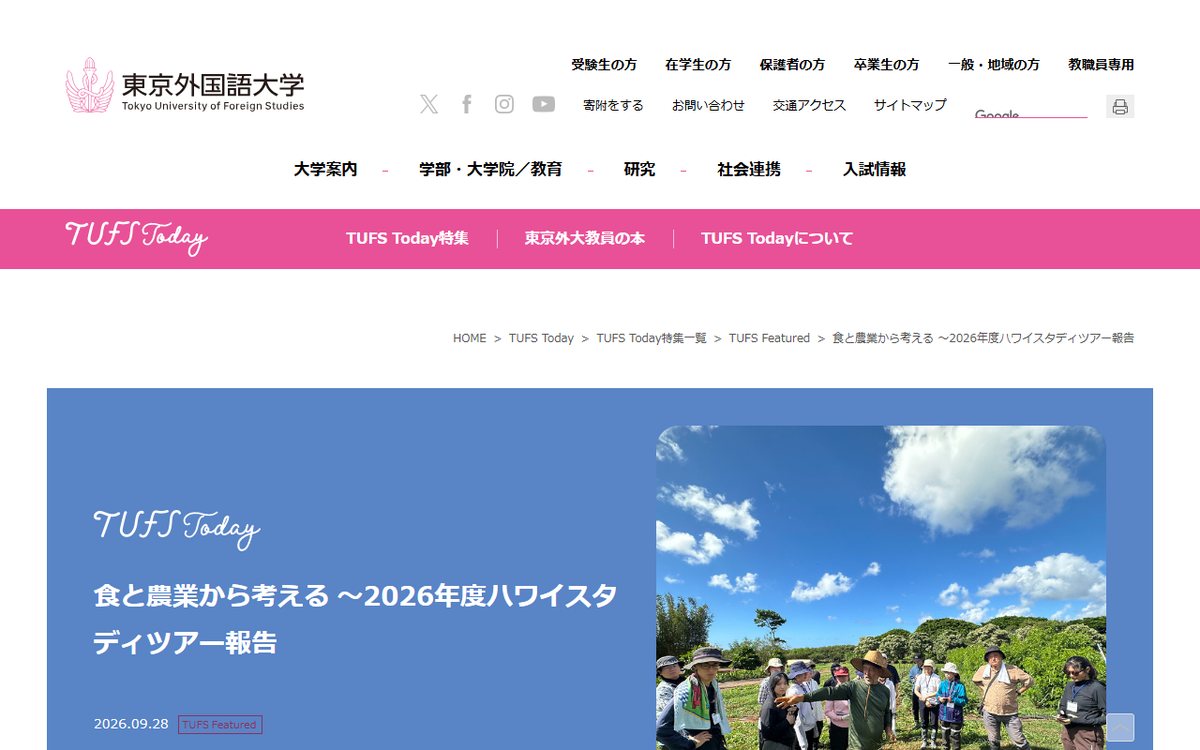
Tokyo University of Foreign Studies held a study tour on Oahu, Hawaii, from September 2 to 8, 2026. It was planned mainly by faculty members taking part in a humanities-and-sciences collaborative research project (J-PEAKS) being carried out with Tokyo University of Agriculture and Technology, and 14 students and 4 faculty and staff members took part. The theme was "ahupuaʻa," the traditional Hawaiian system that views land, water and ecosystems as a single whole, from the mountains to the sea.
Before departure, the group held three sessions of preparatory study, and each student formed a question to examine on site. In Hawaii, they visited taro fields and a stream at the University of Hawaiʻi at Mānoa, and attended lectures on water pollution and social movements, and on food sustainability and inequality. They also took part in a processing plant for the traditional food "poi," weeding at an organic farm that has spent many years restoring soil from a former plantation, and farm work with local people in the university's taro paddies.
In the latter half, they visited a traditional fishpond and learned about changes in how water is used, sea level rise and the history of fishing. In the final reflection session, each student put into words what they had learned, whether their earlier questions had deepened or new questions had emerged. The report says the tour was an opportunity to see Hawaii not only as a "tourist destination" but also as a place where colonialism, multicultural society, Indigenous rights, food and agriculture, and environmental justice overlap.
Key points
- Structured around the traditional land and water system "ahupuaʻa," connecting what is learned from the mountains to the sea
- Rich hands-on experiences beyond lectures, such as farm work in taro paddies and weeding at an organic farm
- A learning flow of forming your own question beforehand, testing it on site and putting it into words at the end
Why this news deserves attention
When we think of study tours, we tend to picture visits to developing countries, but this report shows that even a familiar tourist destination has issues of land, water and food, and an Indigenous history. A perspective that does not try to solve environmental problems by technology alone, but considers history and social structures, is also important for learning about international cooperation.
The flow of forming questions beforehand, working alongside local people, and reflecting at the end is a useful reference for organizations planning study tours and for people thinking of joining one. It is also striking how carefully the report puts into words its respect for the land and people it visited.
Editor's comment
When we hear Hawaii, we picture blue seas and resorts, so the approach of tracing the history of land and water through taro fields and fishponds took me by surprise. Learning while covered in mud from farm work must have been an unforgettable experience for the students.
It is a fine example of a study tour that values not only "where to go" but also "what question to take there." Many photos are included, so please read the original report.