
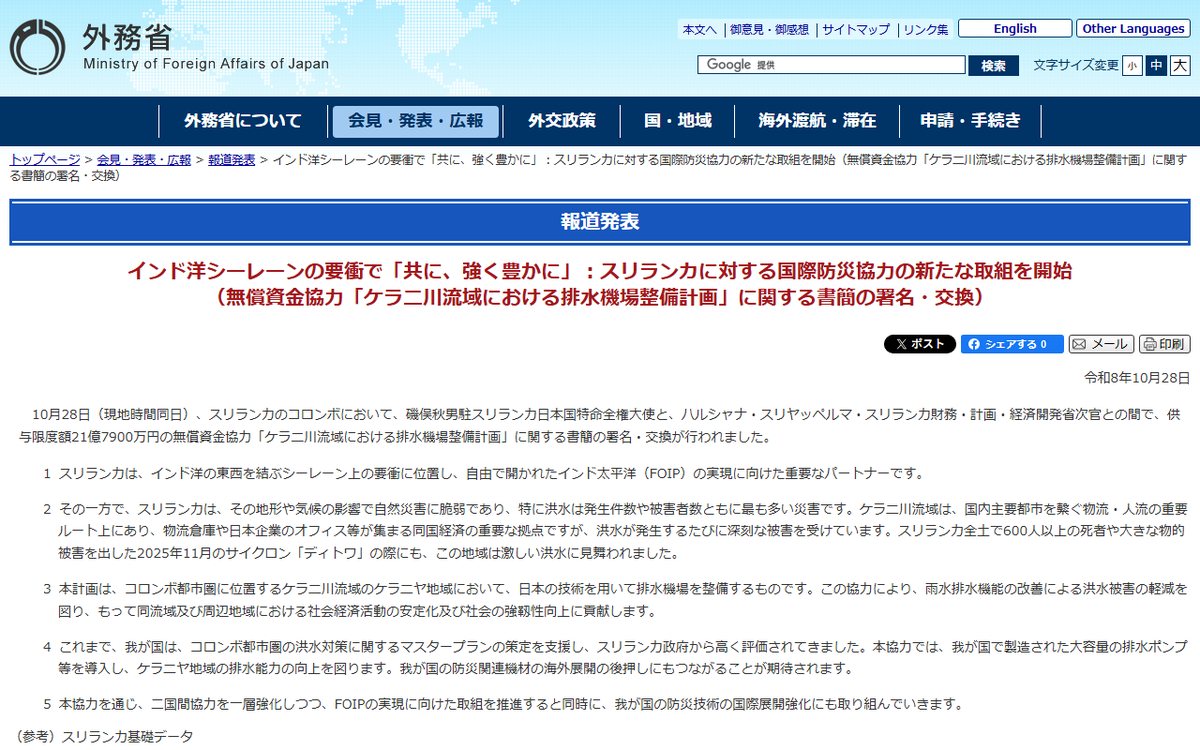
According to the Ministry of Foreign Affairs, on October 28 in Colombo, Sri Lanka, the Ambassador of Japan to Sri Lanka and the Secretary of Sri Lanka's Ministry of Finance, Planning and Economic Development signed and exchanged notes concerning the grant aid project "Construction of Drainage Pumping Stations in the Kelani River Basin." The grant amount is up to 2.179 billion yen.
Because of its terrain and climate, Sri Lanka is vulnerable to natural disasters, and floods are the most common disaster in terms of both the number of occurrences and the number of people affected. The Kelani River basin in the Colombo Metropolitan Region lies on an important route for the movement of goods and people between major cities, but it has suffered serious damage every time a flood occurs. During Cyclone Ditwah in November 2025, which killed more than 600 people across Sri Lanka, this area was also hit by severe flooding.
Under this project, drainage pumping stations will be built in the Kelaniya area of the basin, introducing large-capacity drainage pumps and other equipment manufactured in Japan. By improving the capacity to drain rainwater, the project aims to reduce flood damage, stabilize daily life and economic activity in the basin and surrounding areas, and help build a society that is more resilient to disasters. Japan has previously supported the formulation of a master plan for flood control in the Colombo Metropolitan Region.
Key points
- Drainage pumping stations to improve rainwater drainage in a river basin hit by repeated floods
- The target area was also severely flooded during Cyclone Ditwah in November 2025
- Cooperation drawing on Japanese disaster-prevention technology, following support for a flood-control master plan
Why This News Deserves Attention
Cooperation on disaster prevention, preparing before disasters strike, is an important way to protect people's lives and livelihoods. It is worth noting that concrete flood-reduction measures are now moving forward in an area that experienced major cyclone damage in November 2025.
The step-by-step progress from supporting a master plan to building actual facilities is also a good example of long-term international cooperation.
Staff comments

Minato AobaResearch
“I was surprised to learn that floods are Sri Lanka's most frequent disaster, with the most people affected. It's reassuring that an area hit hard by the 2025 cyclone will get concrete protection like drainage pumping stations.”

Sophie HiroseWriting and translation
“The scale of flooding that surprised Aoba stayed with me too. I like that the cooperation has moved from a master plan to actual facilities. It shows a commitment to making plans real rather than leaving them on paper.”

Mako JozenjiProofreading and verification
“Putting your views together, I see the value of steady, step-by-step work. Drainage stations don't usually stand out, but on rainy days they will protect people's lives. I want to cheer on this kind of behind-the-scenes cooperation.”
Editor-in-Chief’s comment
Ren DateEditor-in-Chief
“It must be very hard for residents when daily life comes to a halt with every flood. Drainage pumping stations may not stand out, but they look set to support the everyday lives of many people.
Let's follow the progress of this project together, looking ahead to the day when people in the Kelani River basin can live with peace of mind.”