

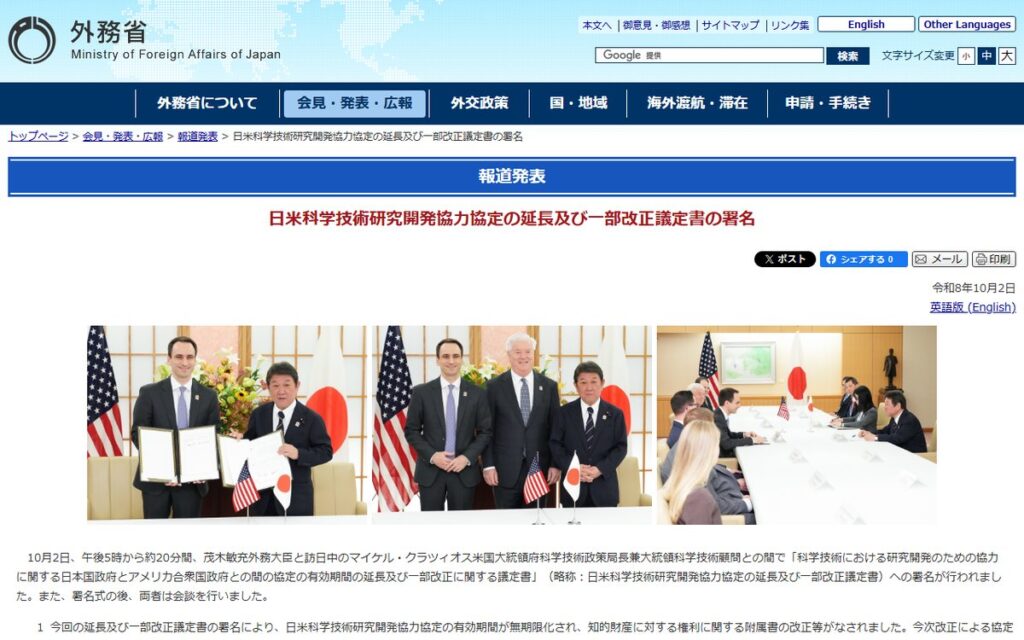
According to the Ministry of Foreign Affairs of Japan, on the evening of October 2, 2026, Japan's Minister for Foreign Affairs and the visiting U.S. Director of the White House Office of Science and Technology Policy and Science and Technology Advisor to the President signed the "Protocol Extending and Partially Amending the Japan–U.S. Agreement on Cooperation in Research and Development in Science and Technology." The signing ceremony lasted about 20 minutes, and the two then held a meeting.
Under the protocol, the agreement no longer has an expiry date, and the annex setting out intellectual property rights and other provisions were revised. The Ministry said it expects the legal foundation for science and technology cooperation between the two governments to become stronger and various cooperation projects to advance further.
In the meeting, the Japanese side expressed its hope to further advance Japan–U.S. cooperation in the Indo-Pacific region on advanced technologies such as AI (including superintelligence), and stressed the importance of Japan–U.S. collaboration in creating an environment for "safe, secure and trustworthy" AI in Global South countries. The two sides agreed to further advance bilateral science and technology cooperation, and also confirmed that they would begin coordination toward holding the next Japan–U.S. Joint High-Level Committee on Science and Technology Cooperation.
Key points
- The term of the Japan–U.S. science and technology cooperation agreement becomes indefinite
- The annex on intellectual property and other provisions were also amended
- Japan–U.S. collaboration toward "safe, secure and trustworthy" AI in the Global South was also mentioned
Why this news deserves attention
Science and technology cooperation is not only about exchange among researchers. It is also a field that can contribute to solving problems faced by developing countries, such as health, disaster prevention and the environment. With the expiry date removed, long-running joint research and cooperation projects can be pursued with greater confidence.
The meeting also raised the perspective of creating an environment for trustworthy AI in Global South countries. Whether new technologies can be used with confidence by people in developing countries is likely to remain an important theme in international cooperation.
Staff comments

Minato AobaResearch
“A treaty with no expiry date sounds dry, but I was convinced by the view that it makes long-running joint research easier to pursue with a steady footing. It seems likely to give researchers peace of mind too.”

Sophie HiroseWriting and translation
“I agree with Aoba that it helps work proceed steadily. The perspective raised in the talks, building a safe and trustworthy AI environment in Global South countries, also seems important to people in developing countries.”

Mako JozenjiProofreading and verification
“Hearing you both, even a dry-sounding treaty feels warmer when I think of the cooperation that continues on top of it. I hope new technology becomes something people in every country can use with peace of mind.”
Editor-in-Chief’s comment
Ren DateEditor-in-Chief
“An "indefinite agreement" may sound like rather dry news, but a more stable foundation for cooperation also makes it easier to sustain many initiatives built on top of it. What caught my attention was the perspective of making new technologies such as AI safe and trustworthy for people in every country.
If you are interested in how technology and international cooperation relate, please check the full text of the Ministry of Foreign Affairs announcement.”