
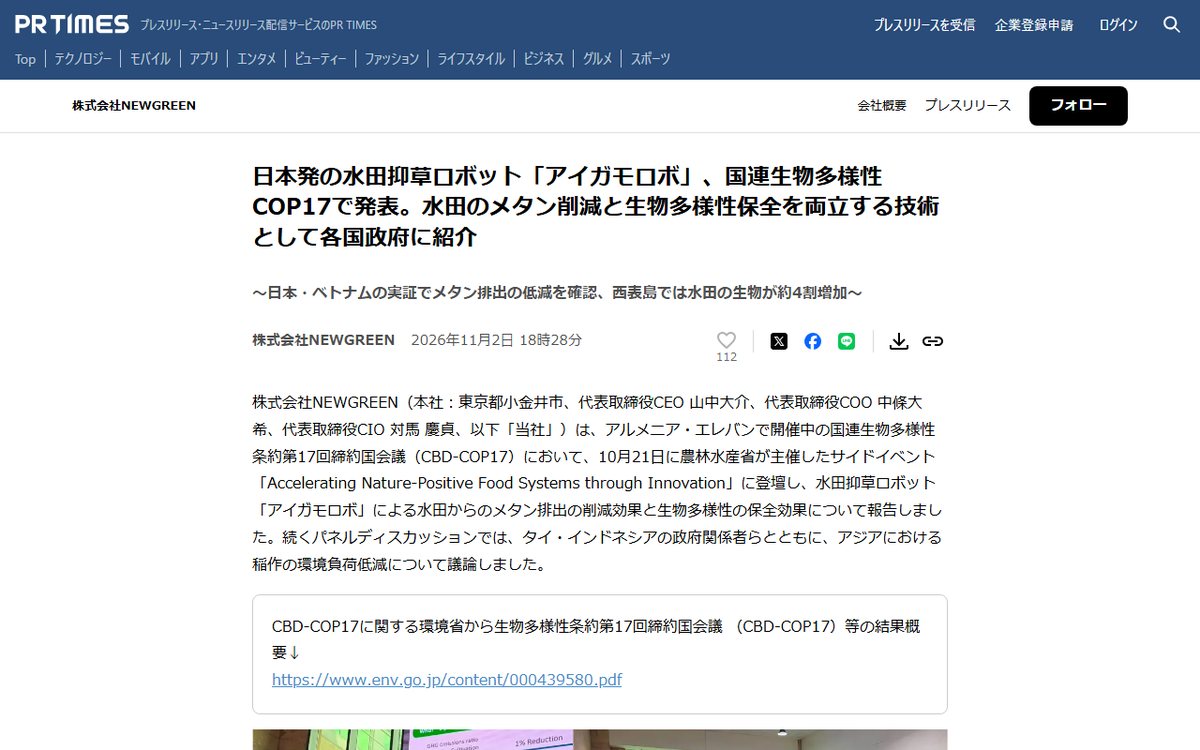
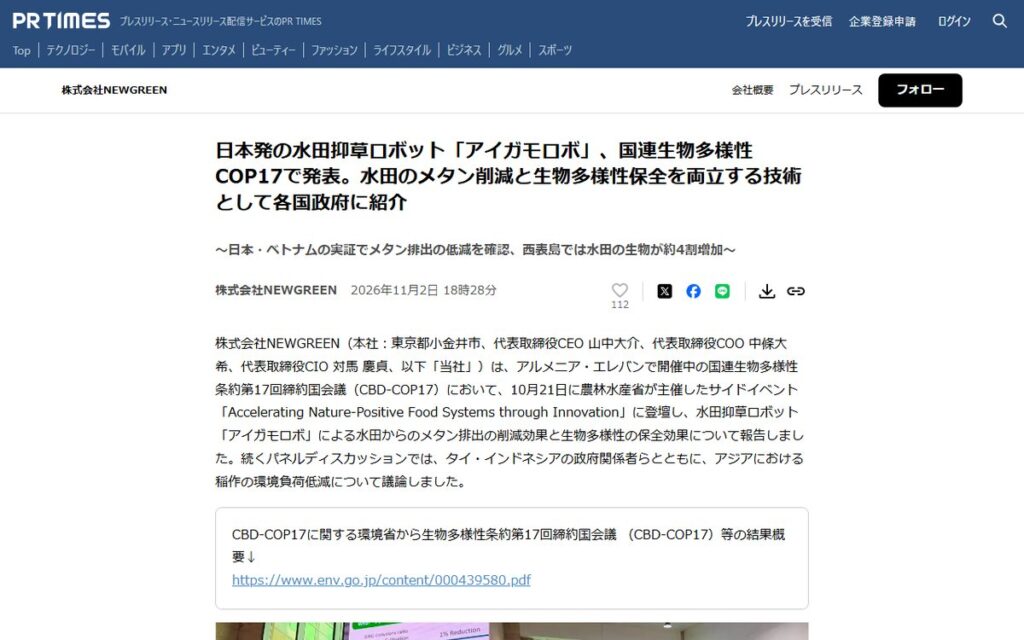
NEWGREEN Inc. spoke at a side event of the 17th Conference of the Parties to the UN Convention on Biological Diversity (COP17) in Yerevan, Armenia, reporting on the environmental effects of its paddy-weeding robot, the "Aigamo Robot." The event was organized by Japan's Ministry of Agriculture, Forestry and Fisheries, and a panel with government officials from Thailand and Indonesia discussed how to reduce the environmental burden of rice farming in Asia.
According to the announcement, rice cultivation accounts for about 42% of Japan's methane emissions, more than livestock belching (about 30%). In flooded paddies, microbes produce methane in low-oxygen soil. Measurements at 53 fields in Japan showed a tendency toward lower methane emissions where the robot was used, and in Vietnam's Mekong Delta, combining it with water-saving irrigation reduced emissions further.
On biodiversity, in paddies on the World Natural Heritage island of Iriomote, the number of species and individuals rose by about 40%, and damage from an invasive snail that eats rice seedlings fell by about 40%. The company says it will continue field trials in Indonesia and Malaysia and aims for commercialization in the Mekong Delta in Vietnam by 2028.
Key points
- Rice farming accounts for about 42% of Japan's methane emissions, a challenge shared across rice-growing Asia
- Methane reductions were confirmed in trials in Japan and Vietnam
- Species and individuals in robot-equipped paddies on Iriomote rose by about 40%
Why this news deserves attention
COP17 is the first meeting where countries review progress toward the 2030 international biodiversity targets. With the world recognized as off track, practical measures that can be used in the field are in demand.
How rice, our staple food, relates to climate change and wildlife is a question that reaches our dining tables. We feature this as a chance to learn how a Japanese technology may spread to rice farming in Asia. The figures are reported by the company; measurement details are in the official release.
Staff comments

Minato AobaResearch
“I was first struck by the figure showing rice farming as a major source of methane. Seeing a paddy-field idea shared at a UN conference also shows how wide international cooperation reaches.”

Sophie HiroseWriting and translation
“The link between rice and methane that surprised Aoba-san was new to me too. And the roughly 40% rise in wildlife on Iriomote gives me hope for balancing the environment and daily life.”

Mako JozenjiProofreading and verification
“As you both say, it is fascinating that a story about our rice connects to a global challenge. Picturing wisdom traveling between paddy fields across Asia warms my heart a little.”
Editor-in-Chief’s comment
Ren DateEditor-in-Chief
“I was surprised to learn that the rice we eat every day is so closely tied to methane, a greenhouse gas. It is encouraging that ideas for protecting the environment are coming from something as familiar as a paddy field.
That a technology from Japanese fields was shared with Asian countries at a UN conference may be a new form of international cooperation. Please take a look at the full announcement.”