
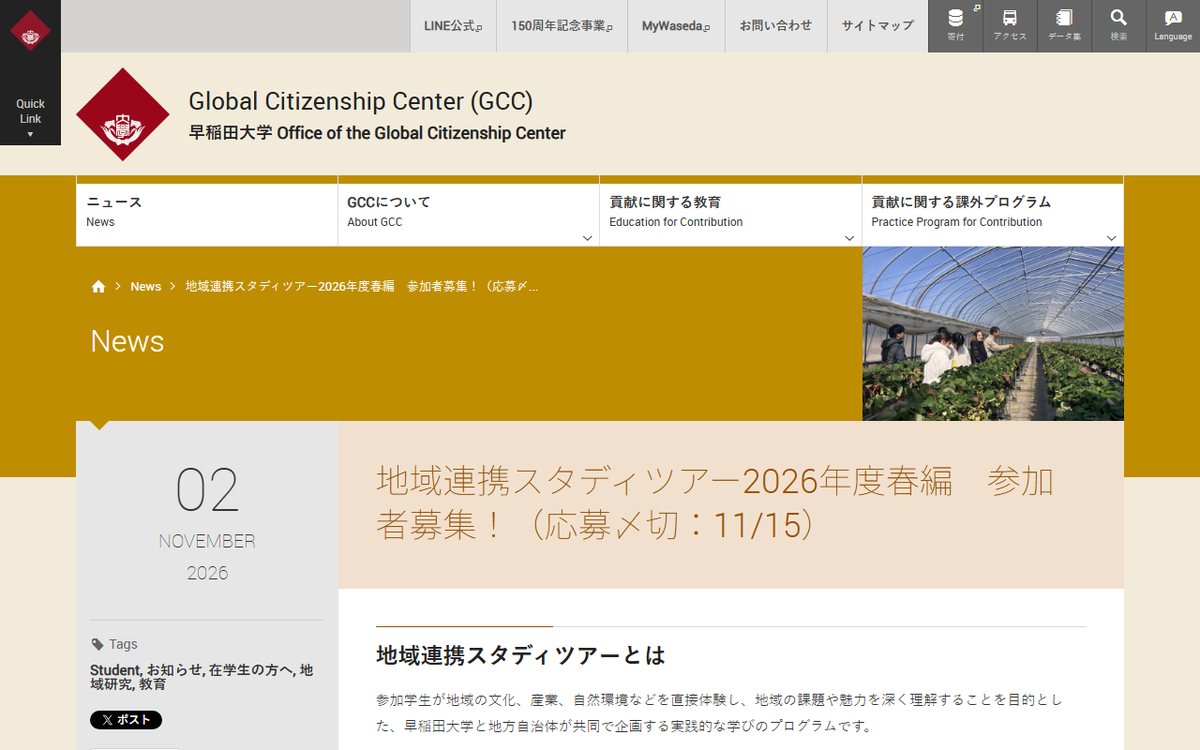
Waseda University's Global Citizenship Center (GCC) is recruiting participants for its "Regional Collaboration Study Tours, Spring 2026." These tours are a hands-on learning program planned jointly by the university and local governments. Students experience the culture, industries and natural environment of each area firsthand, with the aim of gaining a deeper understanding of local challenges and attractions.
This time, there are five destinations, each with its own theme. In Tanohata Village, Iwate, students will propose a winter stay plan. In Kesennuma City, Miyagi, they will consider ways to attract winter visitors, centering on Kameyama Terrace 360° on Oshima Island. In Okuma Town, Fukushima, the theme is the community of a town being rebuilt by diverse people and the future of the area. In Itoigawa City, Niigata, students will promote the city's appeal through social media and video, drawing on Gyofu Soma, known as the father of school songs, and local film locations. In Yachiyo Town, Ibaraki, they will think about the town's future through food and farming.
During the tours, students explore their themes through exchanges with local governments, residents and businesses. By facing real local issues and searching for solutions, participants are said to "learn how to learn." The tours also count toward the practical component of the university-wide minor "Regional Collaboration and Regional Contribution" (equivalent to 1 credit). To apply, students should read the guidelines for each area and use the application form on the official page.
Key points
- Choose a theme from five municipalities in Iwate, Miyagi, Fukushima, Niigata and Ibaraki
- Each area poses a different challenge, from tourism and post-disaster community building to promotion and food and farming
- Counts toward the practical component of the minor "Regional Collaboration and Regional Contribution" (equivalent to 1 credit)
Why We Recommend These Study Tours
Study tours often bring overseas trips to mind, but communities within Japan also face challenges that can only be understood on the ground, such as population, tourism and recovery from disaster. Because the themes are set jointly by local governments and the university, students can think about issues close to real needs while listening to local voices.
Many of the assignments, such as drafting proposals and promotion strategies, make use of students' own perspectives and creativity. The experience of thinking through issues on site can also be a valuable way for anyone interested in community development or international cooperation, in Japan or abroad, to learn how to find and approach challenges.
Staff comments

Minato AobaResearch
“I was surprised by how varied the themes are across the five municipalities, from a winter stay plan to post-disaster community building and food and farming. Since local governments and the university set the issues together, students can get close to what each area really needs right now.”

Sophie HiroseWriting and translation
“Like Aoba says, getting close to real local needs is a big draw. The Itoigawa assignment on promoting the city through social media and video seems like a perfect fit for the fresh eyes of students from outside, and I'm curious what they will create.”

Mako JozenjiProofreading and verification
“Listening to you both, I felt how valuable it is for students to think alongside local people at eye level. Thinking together about the future of daily life in a town still rebuilding, like Okuma, is an experience that will surely stay with them for a long time.”
Editor-in-Chief’s comment
Ren DateEditor-in-Chief
“From a winter stay plan for Tanohata to post-disaster community building in Okuma and food and farming in Yachiyo, each of the five areas has a distinctive theme. It might be hard to choose just one!
Thinking through local issues while talking with the people who live there is an experience that will surely pay off in the future. Waseda students, why not check the guidelines before the November 15 deadline?”