
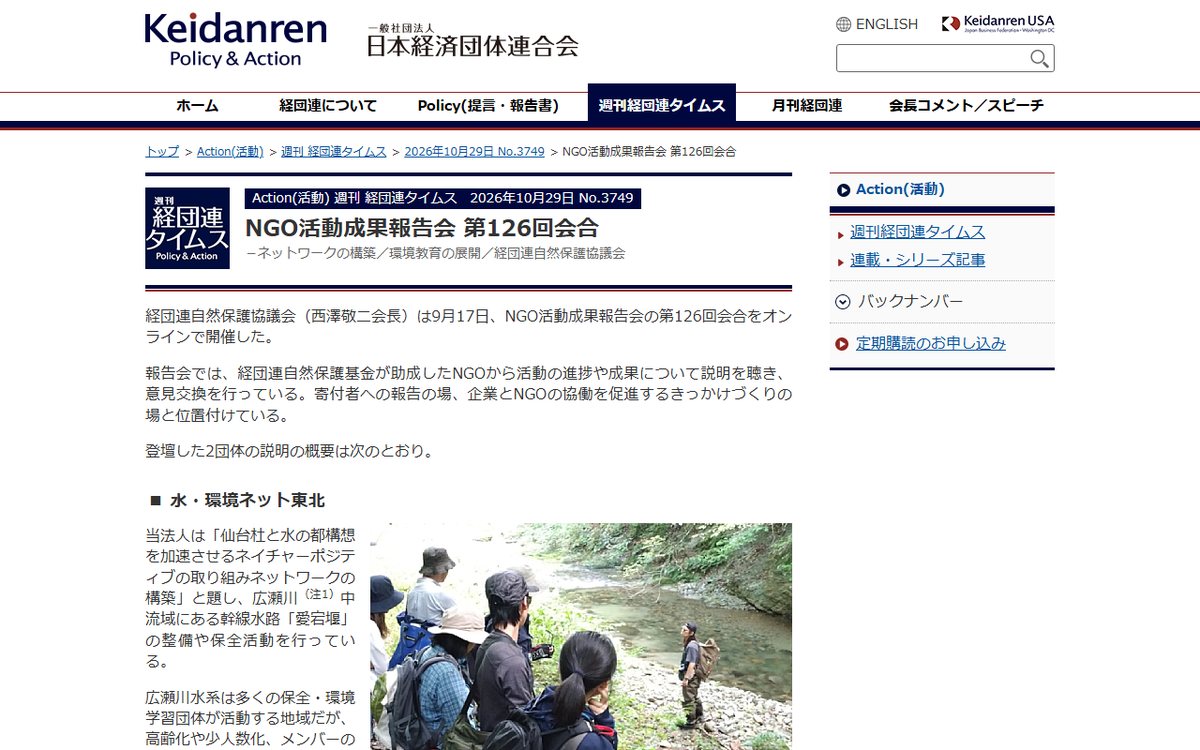
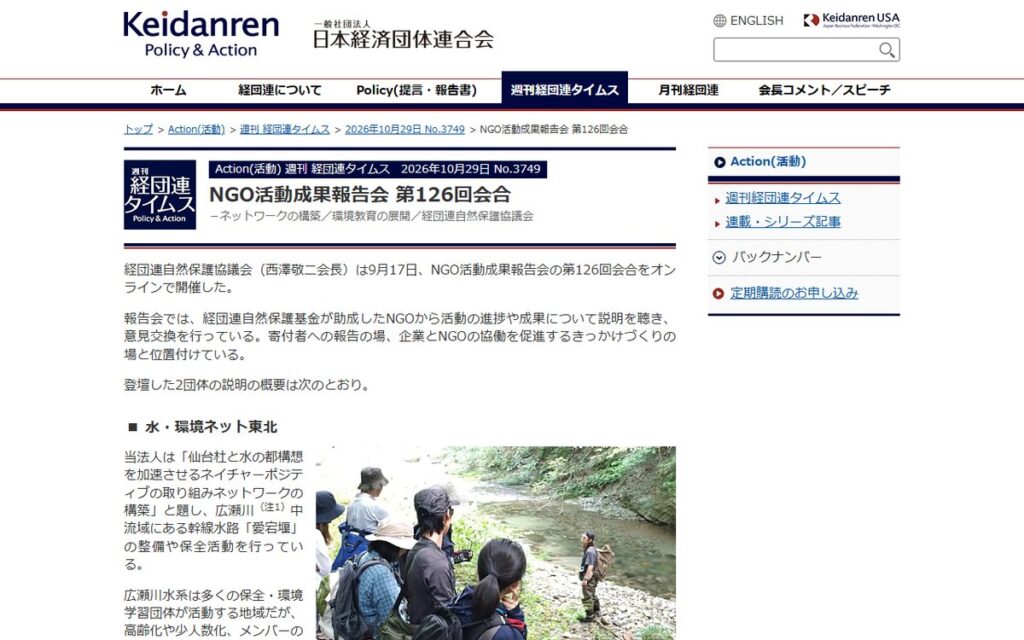
On September 17, 2026, the Keidanren Committee on Nature Conservation held the 126th NGO Activity Report Meeting online. At these meetings, NGOs that have received grants from the Keidanren Nature Conservation Fund report on their progress and results and exchange views with participants. The meetings serve both as a way to report back to donors and as an opportunity to encourage collaboration between companies and NGOs. Two groups presented this time, and their reports were featured in the Weekly Keidanren Times on October 29.
Mizu Kankyo Net Tohoku works on the maintenance and conservation of the Atago Weir, a main waterway in the middle reaches of Sendai's Hirose River. Many groups are active along the Hirose River, but aging members, shrinking numbers and a fixed membership had become challenges. In response, the group built a river-basin platform that brings together multiple organizations and university laboratories, and, working with companies with branches in Sendai, held events that added hands-on experiences such as fly fishing and grilling salted fish to nature observation. In its first year, two sites were registered as Nationally Certified Sustainably Managed Natural Sites, and the group aims to register one more in fiscal 2026. It also plans to install a simple fish ladder at the Atago Weir, which blocks sweetfish (ayu) and cherry salmon from swimming upstream.
The Japanese Society for Preservation of Birds works with a group protecting the grey-faced buzzard, a bird of prey, in the Philippines, supporting anti-poaching measures, awareness-raising among children and tree planting to restore forests. Nueva Vizcaya, one of the project areas, is a stopover and wintering site for migratory birds such as grey-faced buzzards that fly to Japan, but poaching has been a problem there. The society has carried out surveys jointly with the provincial state university and promoted conservation awareness across the community. The surveys revealed the migration routes and numbers of migratory raptors, and the aim is to use this information in considering sites for wind power plants and other purposes.
Key points
- A network involving universities and companies connects river conservation groups struggling with aging and shrinking membership
- Grey-faced buzzards that fly to Japan are protected by whole communities at their stopover and wintering sites in the Philippines
- A donation-based fund supports NGOs' nature conservation work in Japan and abroad and creates a place to share the results
Why This News Matters
Because migratory birds cross national borders, protecting the grey-faced buzzards seen in Japan also requires conservation in the distant Philippines. Working with a local university and communities on surveys and awareness-raising is a useful concrete example of international cooperation in nature conservation.
Even in conserving familiar local rivers, an aging base of volunteers is a challenge shared by many areas. Connecting groups with one another and attracting new participants through hands-on events offers ideas for citizen activities in many places.
Staff comments

Minato AobaResearch
“I was struck that grey-faced buzzards flying to Japan are being protected in the Philippines, at their stopover and wintering sites. It reminded me that protecting migratory birds requires looking beyond Japan alone.”

Sophie HiroseWriting and translation
“Looking beyond Japan, as Aoba says, is so important. I was also drawn to the work on the river in Sendai. It is lovely that enjoyable experiences like fly fishing and grilled salted fish are helping to raise a new generation of caretakers.”

Mako JozenjiProofreading and verification
“From your conversation, I felt that a distant forest and a familiar river are tied together by a single thread: the connections among living things. Steady work, surveying and sharing alongside local people and a university, becomes the strength that protects nature.”
Editor-in-Chief’s comment
Ren DateEditor-in-Chief
“A river in Sendai and forests in the Philippines: two activities that seem far apart, yet both aim to protect the connections among living things. It's heartwarming to think that birds flying to Japan are being protected by people across the sea. Please take a look at the Keidanren Times article too.”