
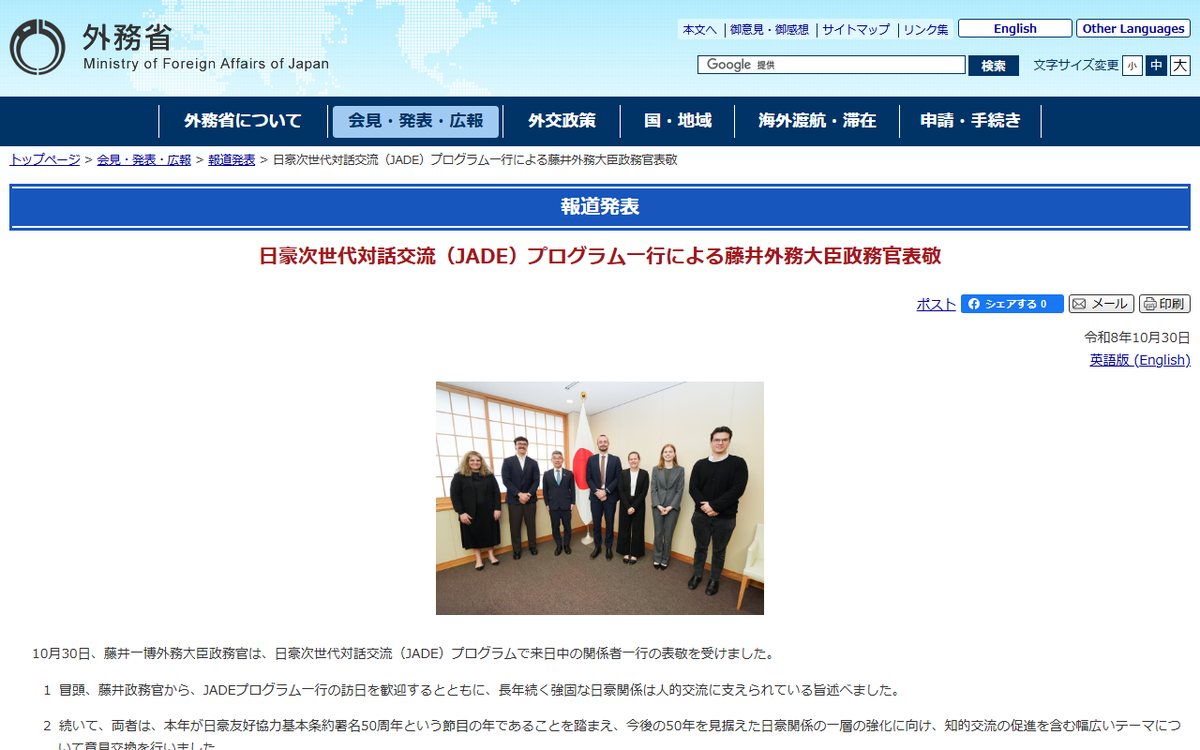
On October 30, 2026, Parliamentary Vice-Minister for Foreign Affairs Fujii received a courtesy call from a delegation visiting Japan under the JADE Program, a Japan–Australia next-generation dialogue and exchange program. The Parliamentary Vice-Minister welcomed the delegation and noted that the long-standing, strong relationship between Japan and Australia is underpinned by people-to-people exchange.
This year marks the 50th anniversary of the signing of the Basic Treaty of Friendship and Cooperation between Japan and Australia. In light of this milestone, the two sides exchanged views on a wide range of topics, including the promotion of intellectual exchange, toward further strengthening Japan–Australia relations over the next 50 years. In closing, the Parliamentary Vice-Minister expressed the hope that participants would draw on their experience in the program to contribute to the further development of intellectual exchange between the two countries.
The JADE Program is co-organized by the Ministry of Foreign Affairs of Japan, the Japan Foundation and the United States Studies Centre at the University of Sydney. Aimed at nurturing the next generation of policy experts who will support future Japan–Australia relations, it is being carried out over three years starting in fiscal 2024. Early- to mid-career researchers and government officials from both countries are selected through open recruitment; fellows visit the other country to exchange views with people in diplomacy, politics and business, write papers and speak at public events, building people-to-people ties and developing researchers.
Key points
- In the 50th anniversary year of the Japan–Australia Basic Treaty, a dialogue with next-generation experts looking ahead to the next 50 years
- Early- to mid-career researchers and government officials, chosen through open recruitment, visit the partner country for dialogue and research writing
- Co-organized by MOFA, the Japan Foundation and the United States Studies Centre at the University of Sydney, running for three years from fiscal 2024
Why This News Matters
Relations between countries are sustained not only by talks between governments but also by ties between people who know each other's country well. A program in which researchers and practitioners actually visit the other country and build their discussions face to face can be seen as a foundation for long-term trust.
It is also striking that, at the 50-year milestone of the treaty, attention is turning to the generation that will carry the next 50 years. Sharing what is learned widely through papers and public events offers a useful model for combining talent development with outreach to the public.
Staff comments

Minato AobaResearch
“What caught my eye was how researchers and government officials actually visit the other country, write papers and speak at public events. Fifty years after the treaty, working now to nurture those who will carry the next fifty shows a long time horizon.”

Sophie HiroseWriting and translation
“I was drawn to the same long time horizon Aoba mentioned. Meeting face to face and building discussions with people of a different language and culture creates an understanding that translation alone cannot reach. People-to-people exchange really does hold relationships together.”

Mako JozenjiProofreading and verification
“Hearing you both, I felt that relations between countries are, in the end, built from encounters between individuals. As young people chosen through open recruitment come to know each other's country, the relationship fifty years from now is being shaped little by little.”
Editor-in-Chief’s comment
Ren DateEditor-in-Chief
“When we hear "international cooperation" or "international exchange," we tend to picture aid on the ground, but this kind of "exchange of knowledge" is also an important way of connecting countries. It reminds us that people-to-people ties lie behind 50 years of relations with Australia. If you're interested, please take a look at the Ministry's announcement.”