
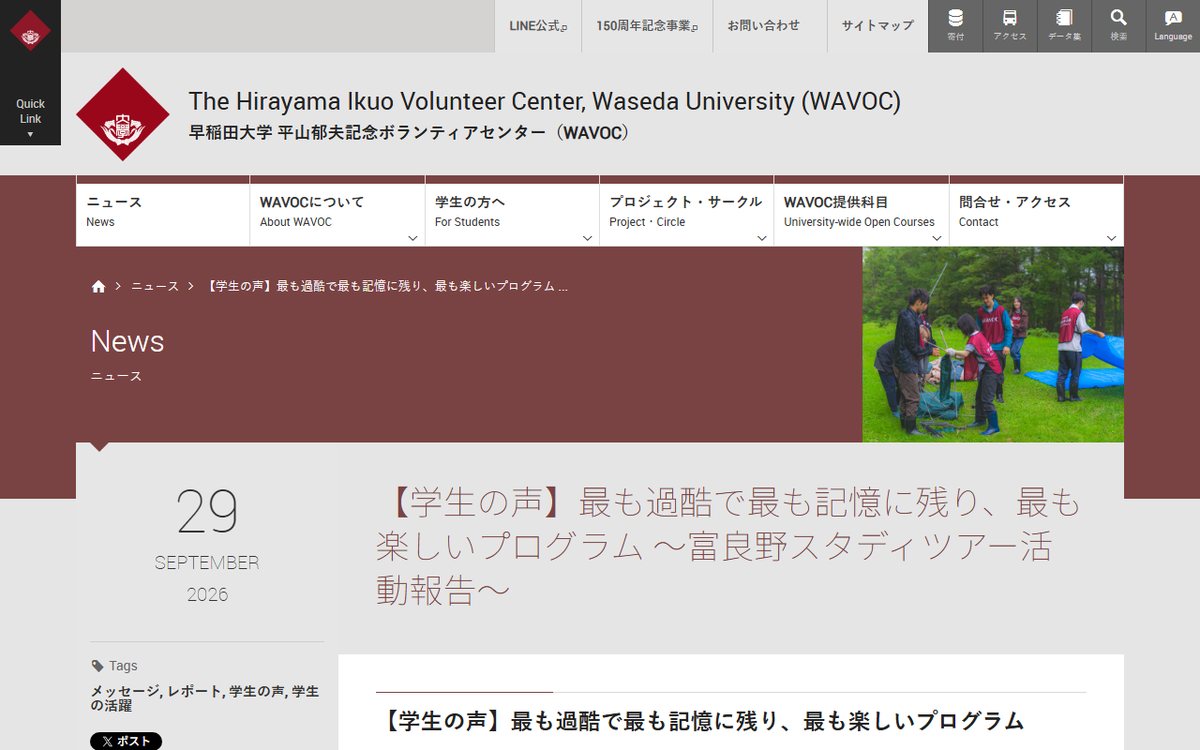
The Waseda University Hirayama Ikuo Volunteer Center (WAVOC) has published a report by a student who took part in a study tour in Furano, Hokkaido. The author is an international student in the fourth year of the School of Creative Science and Engineering.
The tour began with a minimal life without electricity, gas or running water and gradually returned to modern living. On the first night, rain leaked into the tent and soaked everyone. On the second day, they failed again and again to light a fire in the cold rain, and in the storm they all kept holding the tent poles to stop the tent from collapsing.
Even so, getting up early let them see a deer crossing the forest, and the report describes how failure deepened their cooperation with one another, and how an activity at a tomato farm, drawing a world map from memory alone, made them realize that people see the world in completely different ways. The author looks back on the experience as "the toughest, most memorable and most enjoyable program."
Key points
- A deliberately designed study tour that starts with life without electricity, gas or water and gradually returns to modern life
- Failures in the rain and storm built teamwork among companions from different backgrounds
- Through the activity of drawing a world map from memory, the students noticed how differently each person sees the world
Why we recommend this report
When we hear "study tour," we tend to imagine visits to sites overseas, but this report conveys that even within Japan there is deep learning in reexamining "everyday life."
In particular, the world map episode is a good example of learning through experience the starting point of international cooperation, imagining the world as the other person sees it. The experience of students from different countries supporting one another in a storm also makes the meaning of cooperating in a multicultural setting tangible.
Editor's comment
From a first day full of failures to the next morning when they lit a fire together, it was a lively report that made me feel the atmosphere of the place as I read. Noticing how grateful we should be for what we take for granted is also a first step toward thinking about life in faraway countries.
If you are a student considering joining a study tour, I hope you will read the full report. An experience you can call "fun" even with all its hardship is surely waiting for you.