
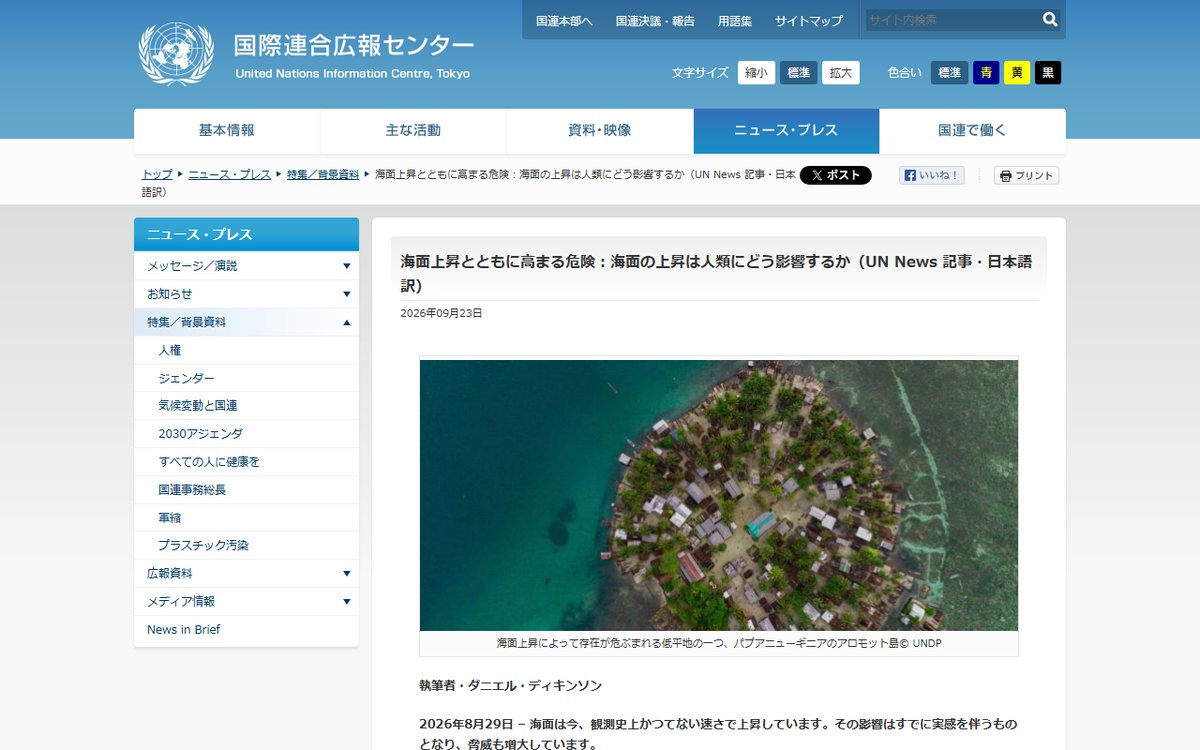
On September 23, 2026, the United Nations Information Centre published a Japanese translation of the UN News article "Rising Risks as Seas Rise: How Does Sea Level Rise Affect Humanity?" The article reports that sea levels are rising faster than at any time since records began, and that the effects are already real.
According to the article, global mean sea level rose by 4.7 mm per year between 2014 and 2023, and reached a record 5.9 mm in 2024. Even under the most optimistic scenario, a rise of 0.55 meters is projected by 2100, and in the worst case, more than one meter. The main causes are the melting of glaciers and ice sheets, and the expansion of seawater as it warms.
About 770 million people, one in 10 people in the world, live in places less than 5 meters above the high-tide line. Salinization of wells and farmland, flooding of hospitals and schools, and damage to fishing and tourism are already occurring, and the article also cites projections that up to 1.2 billion people could be forced to move by 2050. Damage to coastal infrastructure has already exceeded 8 trillion dollars, and the article also points to the psychological toll of losing cultural heritage, ancestral lands and traditional ways of life.
Key points
- The pace of sea level rise reached a record 5.9 mm per year in 2024
- About 770 million people (one in 10 worldwide) live less than 5 m above the high-tide line
- Salinization, flooding, infectious diseases and loss of livelihoods – the effects reach beyond the environment to human rights, economies and culture
Why this article deserves attention
Many of the countries hit hardest by sea level rise are small island nations and developing countries in the Pacific and the Caribbean that bear almost no responsibility for greenhouse gas emissions. In international cooperation, support for "adaptation," such as seawalls, mangrove planting, and measures against salinization of water and farmland, has already become indispensable.
The article points out that today's measures and capacity to adapt will determine whether sea level rise remains a challenge that can be managed or becomes a crisis spanning generations. It sums up the current situation clearly with figures and photographs, and offers a chance to think about climate change as something that concerns us personally.
Editor's comment
The figure that one in 10 people in the world lives just above sea level was startling all over again. Wells turning salty, schools flooding – sea level rise is not a story about the distant future, but a problem that is changing people's daily lives right now.
The Japanese translations from the United Nations Information Centre are a valuable source for reading information from the UN's field work in Japanese. The article includes many photographs from affected places, so please read the full text, perhaps as material for classes or study groups.