
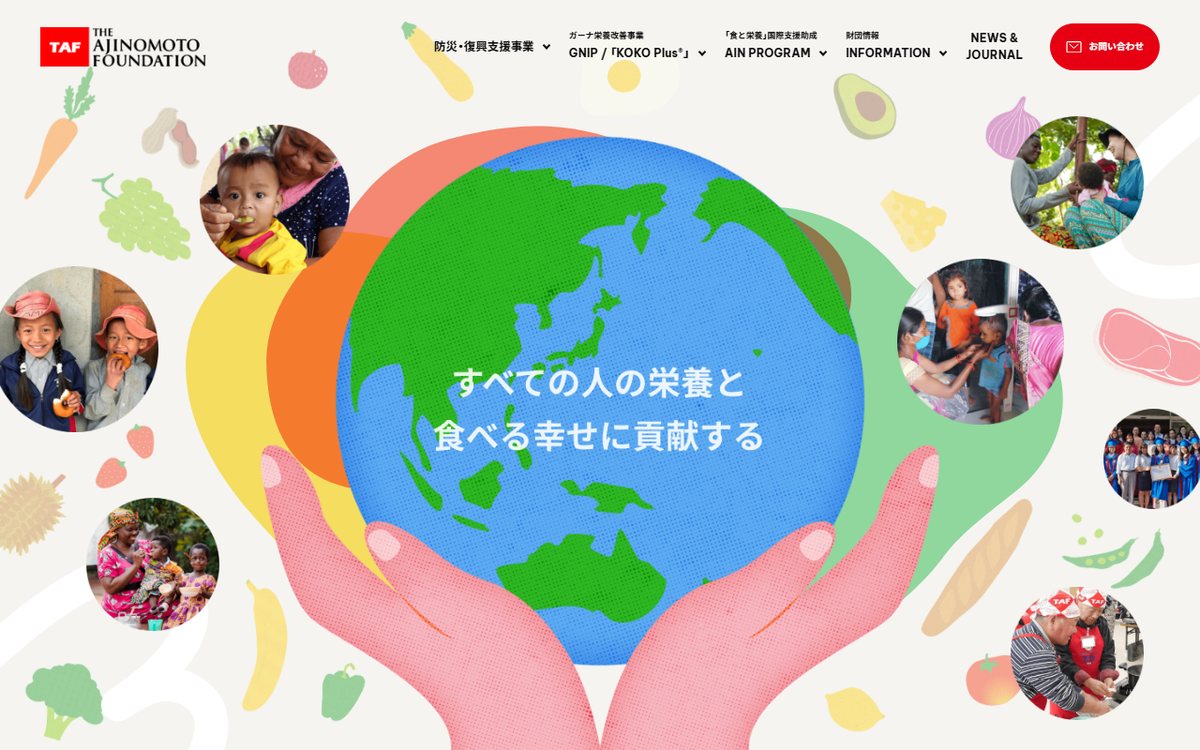
The Ajinomoto Foundation is a public interest foundation whose mission is to contribute to the development of countries and regions around the world, and to a bright future for the people living there, through food and nutrition activities. It was established as a general incorporated foundation in August 2016 and, after being certified by the supervising authority, began operating as a public interest foundation in April 2017.
It currently carries out three activities. The first is the "Red Apron of Friendship Project," which uses the power of food to support recovery in disaster-affected areas, together with the "Food Support Project" (Tabepuro), a platform for everyone to solve food and nutrition problems during disasters. The second is GNIP, which uses the nutritional food KOKO Plus to improve the nutrition of mothers and children in Ghana. The third is the AIN Program, an open-call grant program that supports local activities.
The AIN Program began in 1999, and its grants so far total 113 projects in 29 countries and regions, about 586 million yen in all (as of 2026). Besides funding, it is also characterized by a system for sharing "Lessons Learned" from past successes and failures. Recently, it held cooking classes in Wajima as recovery support after the Noto Peninsula earthquake and delivered food relief supplies to areas affected by the Kumamoto earthquake.
Key points
- Three activities specializing in "food and nutrition": disaster-area support, Ghana, and grants
- The AIN Program has funded 113 projects in 29 countries and regions (as of 2026)
- Support based on "cooking together and eating together," such as cooking classes in Wajima
Why this organization deserves attention
Its distinguishing feature is that it narrows its focus to the single axis of "food and nutrition" while covering a wide range, from disaster preparedness and recovery in Japan to nutrition improvement overseas and grants. It also shows an approach of tackling issues that the foundation cannot solve alone through collaboration among government, business and academia.
Because its grants come with a system for sharing experience and lessons, it seems a reassuring partner for organizations working on the ground. It also publishes recipes and disaster-preparedness content on food, which are easy to use in daily life.
Editor's comment
Eating is at the center of our daily lives. The foundation's work shows that food and nutrition can be a support both in times of disaster and for growing children.
The official website carries recipes useful for disaster preparedness and the latest news on its activities. Why not start by thinking about "just in case" preparations at your own dinner table?