

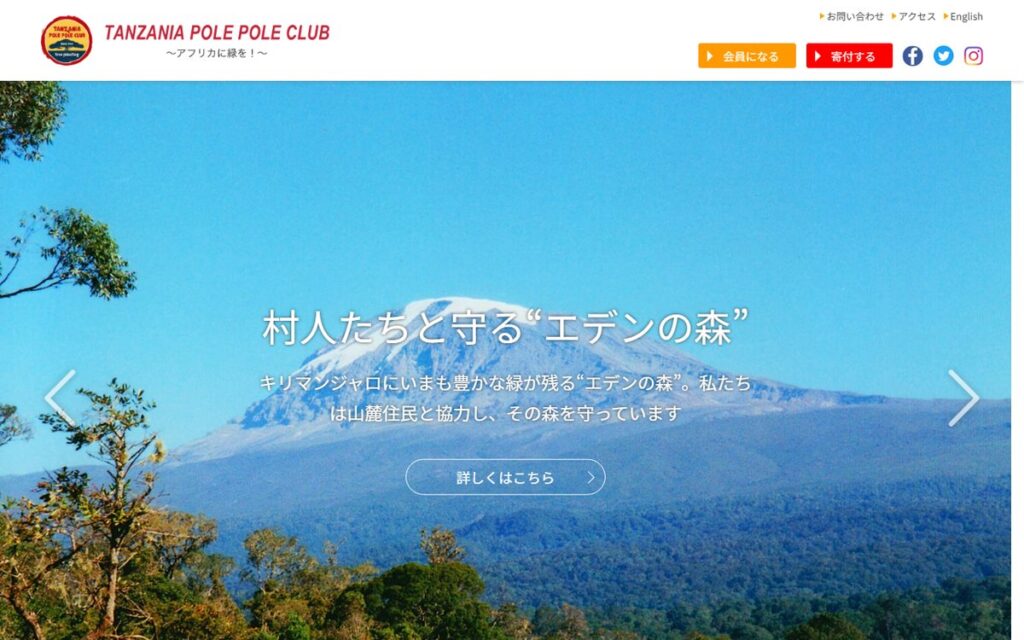
Tanzania Pole Pole Club is a citizens' group founded in 1997. Working with people in Tanzania, it aims for a society where people can live in peace without causing environmental degradation, and for voluntary, sustainable conservation led by local residents. Its website says it has worked with villagers for about 25 years on tree planting to restore the forest at the World Heritage site of Kilimanjaro.
Behind this is the fact that Tanzania lost about 20% of its forests in roughly 25 years from 1990. Forest loss shows up as changes in the climate and environment around people, such as reduced rainfall and depleted water sources. The club considers "protecting nature" and "protecting people's lives" to be two inseparable wheels of a car, and works in three fields: environmental conservation, self-reliance support and improving livelihoods.
Overseas, it works on tree planting and building a local-resident-led forest conservation framework, beekeeping, poultry, improved stoves and sewing classes, as well as building clinics, restoring a traditional water furrow, educational support and a village stay program. In Japan, it runs handicraft activities in cooperation with a Kilimanjaro women's group, lectures, an international cooperation event called Pole Pole Cafe, and information activities such as a newsletter.
Key points
- Has worked for about 25 years with Kilimanjaro villagers on forest restoration through tree planting
- Combines tree planting with activities that support livelihoods, such as beekeeping, improved stoves and sewing classes
- Many ways to take part, including donations, membership, collection drives, volunteering and village stays or homestays
Why this organization deserves attention
A distinctive feature is that it thinks about protecting nature and protecting people's lives together. Aiming for conservation that residents can sustain themselves, it combines tree planting with income generation and better living conditions.
Besides collection drives you can join from Japan, it also introduces village stays, homestays and field visits, giving it a wide range of ways to get involved.
Editor's comment
When forests shrink, water, crops and daily life are affected. The work of protecting Kilimanjaro's forest teaches us that it is also work to protect the daily lives of the people who live there.
The official website shares the latest news and ways to help starting from 100 yen. Why not start by looking at the "Eden Forest"?