
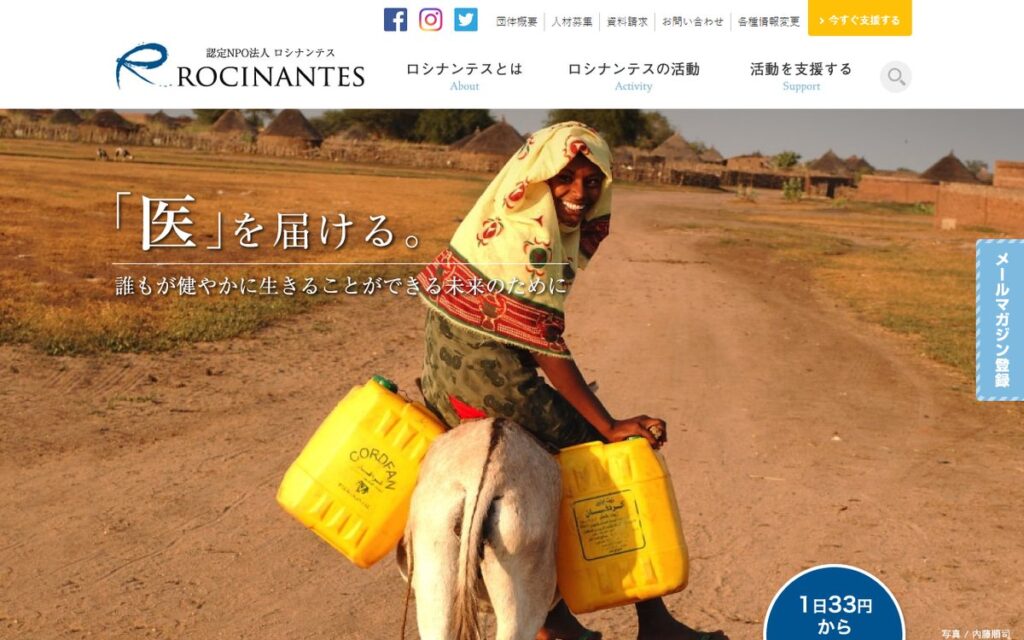
Rocinantes is an international NGO that delivers "i" (the Japanese word for medicine and care) to areas where people cannot get the health care they need because, for example, there are no hospitals. Here "i" is used in a broad sense that includes not only treatment but also digging wells to secure water and building schools to train doctors and nurses.
It began medical activities in Sudan in 2005 and was established as an NPO corporation in Kitakyushu in May 2006. Its name comes from Rocinante, the lean horse in the novel Don Quixote, and carries the wish that individuals, though each small, can bring smiles to the world when they come together.
Its main activities include mobile clinics that visit villages by car (creating a system that brings medical care to 20,000 people), building clinics in three villages, and building and repairing wells. It now works mainly in Sudan and Zambia, also on maternal and child health, tuberculosis control and nutrition improvement. 2026 marks its 20th anniversary, with commemorative talks and a charity walk.
Key points
- Created a system for mobile clinics to bring medical care to 20,000 people
- Built clinics in three villages to deliver stable medical care
- Comprehensive health programs that include wells, school construction and nutrition improvement
Why this organization deserves attention
A distinguishing feature is that it does not stop at treatment but aims to build, together with water, education and nutrition, a system in which local people themselves can sustain health care. The idea of "making medical care their own" is at the heart of its work.
In Japan, too, there are many ways to learn about and join its activities, including talks, free DVD loans, events and intern recruitment. With its 20th anniversary, programs looking back on its history are also being held.
Staff comments
Minato AobaResearch
“My view shifted when I learned that medicine here goes beyond treatment to include digging wells and building schools. Looking into it, I strongly felt it is an idea of supporting people from the foundation of daily life.”
Sophie HiroseWriting and translation
“I share Aoba's feeling about this broad idea of medicine. Making healthcare their own seems like it could help local people carry it on themselves. I think it is support that takes root locally.”
Mako JozenjiProofreading and verification
“Listening to you both, I felt how much it matters for anyone to have a place to be seen quickly when ill. I am cheering for this work to continue steadily after its 20th anniversary. The length of that journey commands respect.”
Editor-in-Chief’s comment
Ren DateEditor-in-Chief
“Having a place where you can be seen right away when you fall ill is a great reassurance. Learning about Rocinantes' work, we sense how important it is to keep working over the long term so that this everyday matter can reach everyone.
The official website is updated regularly with blogs from the field and event information. If a talk or photo exhibition is held near you, why not drop by?”