
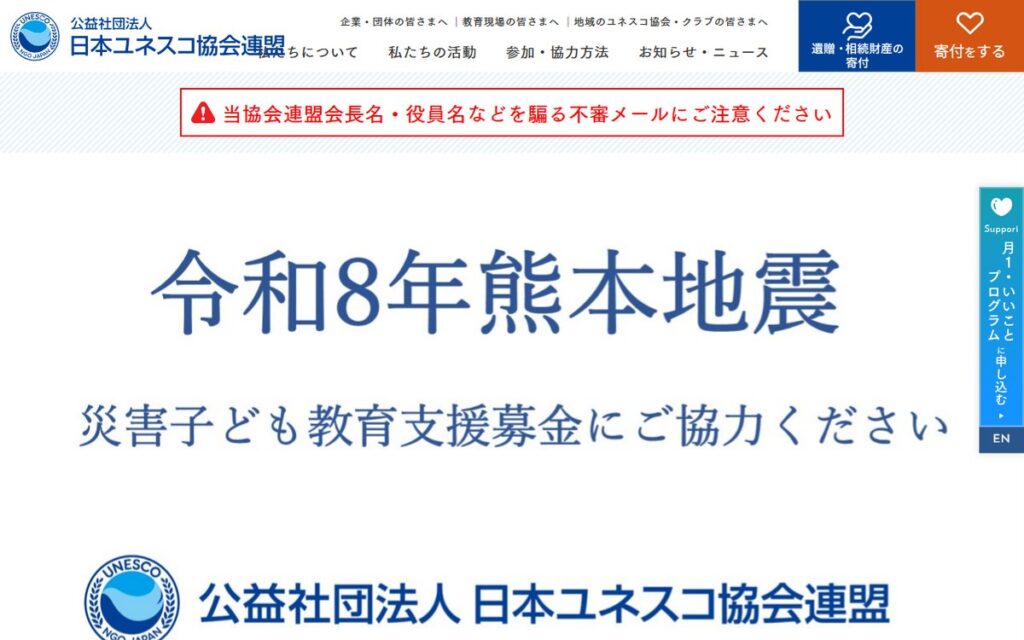
The National Federation of UNESCO Associations in Japan began its work in 1948, in sympathy with the ideals of the UNESCO Constitution, which pledges that humanity must never repeat war. The world's first private UNESCO association was born in Sendai on July 19, 1947, and today the Federation operates as a union of UNESCO associations and clubs across Japan.
While cooperating with UNESCO and the Japanese National Commission for UNESCO, it is not a subordinate body but an independent private NGO, including in its finances. Its activities are wide-ranging: U-Smile, which supports children in difficult circumstances in Japan; support for children's education after disasters; the World Terakoya Movement, which provides places to learn for people who cannot receive an education because of poverty, conflict, gender or other reasons; World Heritage and Heritage for the Future activities; support for children after the Great East Japan Earthquake; and nurturing the next generation.
As ways to take part, it introduces supporting its work through donations, joining events and campaigns, and joining the activities of local UNESCO associations and clubs. It was certified as a public interest incorporated association in March 2011.
Key points
- With the vision "Peace for Tomorrow," it aims at peace and a sustainable society through education
- Efforts such as the World Terakoya Movement widen learning opportunities for children and people in Japan and abroad
- Connected with UNESCO associations and clubs across Japan, so you can take part locally too
Why this organization deserves attention
It works from a broad perspective: education that nurtures respect for history, culture and nature. From creating places to learn overseas to supporting children in Japan and conserving World Heritage and Heritage for the Future sites, everything is linked by a single philosophy.
With associations and clubs nationwide, there are many ways to get involved beyond donating, such as joining events and local activities. It is an entry point for thinking about international cooperation and peace from close to home.
Staff comments
Minato AobaResearch
“I admired how the ideal of building the defenses of peace through education links everything, from the Terakoya movement to support for children in Japan. The consistency of the ideal felt very persuasive as I looked into it.”
Sophie HiroseWriting and translation
“I agree with Aoba about the breadth tied together by one ideal. The handicrafts made by women who learned through the Terakoya movement also struck me, as if their learning has taken shape. The feelings put into the handiwork come through as well.”

Mako JozenjiProofreading and verification
“As you both said, education may not show results right away, but it grows peace in people's hearts. I am also hopeful that the associations and clubs across the country serve as familiar ways to take part.”
Editor-in-Chief’s comment
Ren DateEditor-in-Chief
“The organization's words remind us that education, even when its effects are not immediately visible, builds "defenses of peace" in people's hearts. I was also struck by the handmade goods made by women who studied at the Terakoya schools being introduced.
There may be a UNESCO association or club near where you live. Why not look at the list of activities on the official website?”