
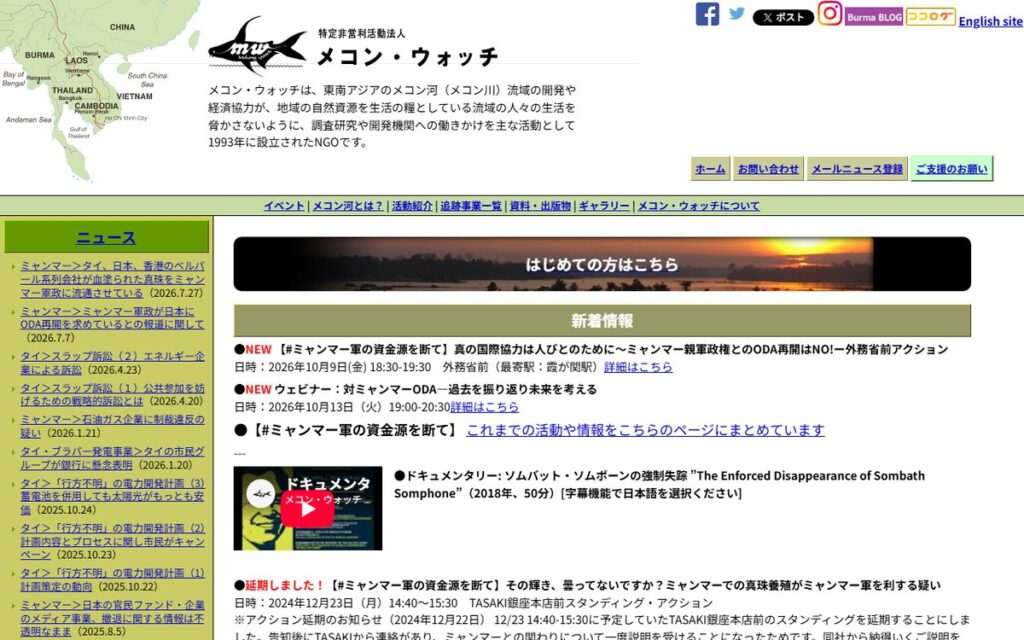
Mekong Watch is an NGO that carries out research and engages with development agencies so that development and economic cooperation in the Mekong River region of Southeast Asia do not threaten the lives of people who depend on local natural resources. It was founded in 1993 as a network of eight NGOs and became an NPO corporation in 2003.
Its aim is for people in the Mekong region to continue lives rooted in rich natural resources such as rivers and forests without being harmed by development. Its main activities are four: research on the links between people and natural resources, monitoring of economic cooperation and investment, information provision for citizens in Japan, and policy proposals to government agencies, financial institutions and companies.
Its website publishes a list of tracked projects covering development projects in Thailand, Laos, Cambodia, Vietnam, Myanmar and Yunnan Province in China, along with research reports, its newsletter Forum Mekong and an email newsletter issued about twice a month. It also offers the Mekong Library, a service for viewing and borrowing materials, making it a useful source of information for students and researchers.
Key points
- Looking at the impact of development projects in the Mekong region through research and dialogue
- Working through four pillars: research, monitoring, information provision and policy proposals
- Publishing materials citizens can learn from, such as research reports, a newsletter and lendable materials
Why this organization deserves attention
It is distinctive for talking with people affected by development and linking their voices to policy proposals that can be reflected in policies and plans. It regards investigating and watching the impacts of development as an important role in supporting people's lives.
Japanese aid and companies are also involved in development along the Mekong. Mekong Watch conveys events in distant regions as themes close to those of us living in Japan. With a small team of three staff, it carries on carefully from research to outreach.
Staff comments

Minato AobaResearch
“Because the Mekong is the source of life supporting fish, water and fields, the meaning of watching the impact of development came across concretely. I was also surprised that they carry on with a small team of three staff.”
Sophie HiroseWriting and translation
“I agree about the small team, Aoba. They carefully continue from research to policy proposals and bring faraway events closer to us in Japan, which I think is truly valuable.”

Mako JozenjiProofreading and verification
“Hearing you both, I felt anew, and want to keep in mind, how important it is to imagine the lives beyond the map. I would like to quietly support work that protects the lives of people who live with the river.”
Editor-in-Chief’s comment
Ren DateEditor-in-Chief
“The Mekong is a source of life for people in the region, supporting fish, water and fields. Reading Mekong Watch's materials makes the link between the river and people concrete, and invites us to imagine lives beyond the map.
The "What is the Mekong?" page on the official website is an easy entry point for first-time readers. Information on events and webinars is also posted, so why not take a look?”