
Médecins du Monde (MdM) Japan was founded after an emergency medical team was sent from France when the Great Hanshin-Awaji Earthquake struck in 1995. Its work is based on supporting people excluded from medical care, beyond barriers of nationality, race, ethnicity, thought and religion.
It is part of a network with offices in 17 countries and, as the base in Asia, works mainly in Bangladesh (support for Rohingya refugees), Laos and Japan (Tokyo). In Japan it has supported disaster-affected areas such as those hit by the Great East Japan Earthquake and the Kumamoto earthquakes, and has provided medical support for people without housing. Overseas it has carried out maternal and child health work in Laos and emergency medical aid in Gaza and Ukraine.
The website introduces many ways to get involved in Japan, including monthly or one-time donations, donation boxes, volunteering, lecturer dispatch and office visits, and support through shopping or points. The organization has also obtained the Accountability Self-Check 2021 mark (ASC2021) and works to ensure accountability.
Key points
- Has delivered medical care to people in need in Japan and abroad since its founding in 1995
- Maternal and child health in Laos, support for Rohingya refugees, and medical support in disaster areas and for people without housing in Japan
- Many ways to get involved, including donations, volunteering and lecturer dispatch
Why this organization deserves attention
There are many reasons people cannot receive medical care, including conflict, disaster, poverty and discrimination. Médecins du Monde Japan faces such barriers in Japan and abroad, and its vision is a world where access to health care is established as every person's right.
It values both emergency aid and long-term support such as strengthening health systems and maternal and child health. Activity reports and events are also shared, so you can learn about conditions on the ground.
Editor's comment
Health care is the foundation of a secure life. We are reminded that care can be hard to reach even close to home, whether for mothers in the mountains of Laos or for people living in Japanese cities.
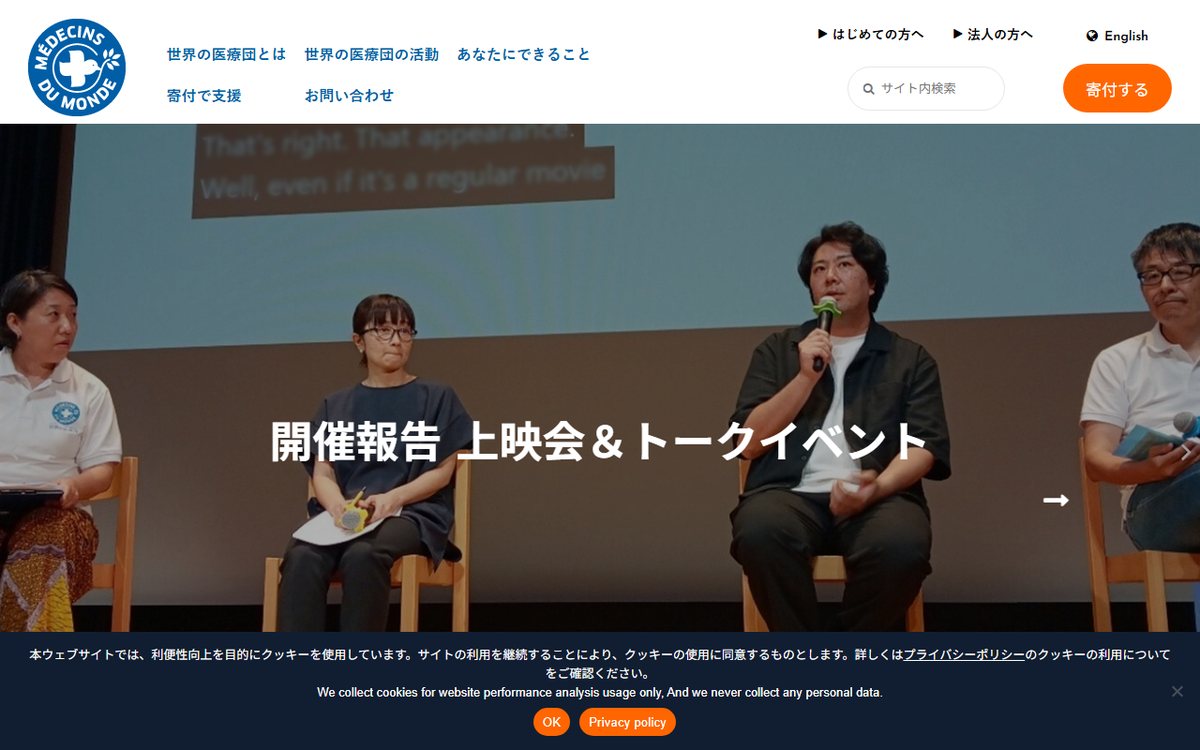
Activity reports and reports of screenings and talk events are collected on the official website. Why not start by reading some of them?