
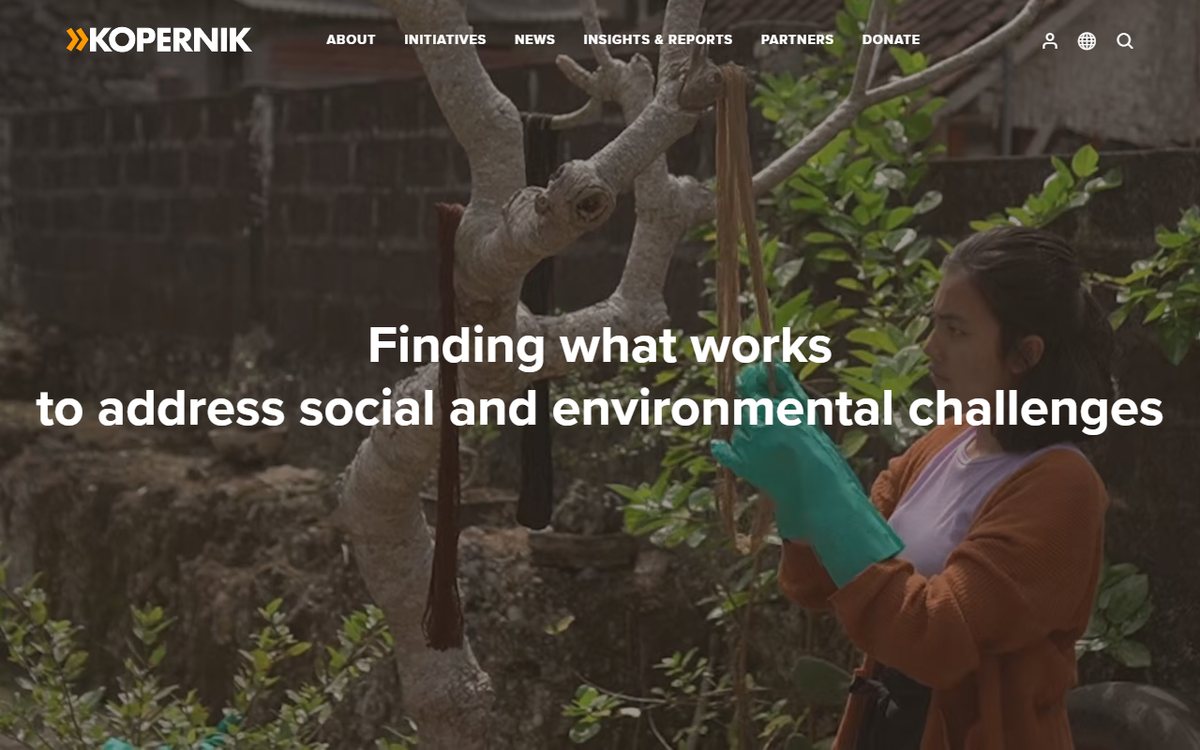
Kopernik is a research and development (R&D) lab for social and environmental challenges based in Indonesia. Its name comes from Mikolaj Kopernik (Nicolaus Copernicus), who changed the way people view the world. Its mission is "Finding what works."
Behind its founding in 2010 was the awareness that affordable, life-changing technologies existed but were not reaching the most remote and hard-to-reach communities. To bridge this "last mile" gap, it values an approach of testing small first and expanding only after confirming the effect. It uses the "innovation funnel" way of thinking: identify challenges, generate potential solutions, experiment, pilot those that show promise, and amplify their impact.
Working with people who often lack regular access to basic services such as electricity, running water, education and health care, it aims to achieve the Sustainable Development Goals, and it currently focuses on five fields: agriculture and fisheries; climate, environment and renewable energy; water, health and sanitation; micro-entrepreneurship; and education. It also provides advisory services to private and public sector clients.
Key points
- A "lean experimentation" approach of testing small and confirming the effect
- Five fields: agriculture and fisheries, environment and energy, water, health and sanitation, micro-entrepreneurship, and education
- Partnerships with a variety of organizations, including foundations, government bodies, universities and companies
Why this organization deserves attention
Confirming "what works" through experiments and data before scaling up is the axis of its work. It shares the idea that not only successes but also what did not work are valuable lessons that can raise knowledge across the whole development sector.
Its flow, from understanding the needs of people on the ground, to experiments, to scaling up results, is clear, and it expands its work through collaboration with partners. It also publishes reports, case studies and guides that can be a useful reference for other efforts.
Editor's comment
Even a good idea means little if people do not actually use it. Kopernik's attitude of "try it first, then confirm" feels like a hint that applies not only to international cooperation but also to everyday efforts close to home.
The official website publishes results, case studies and research reports. Why not start with the field that interests you most?