
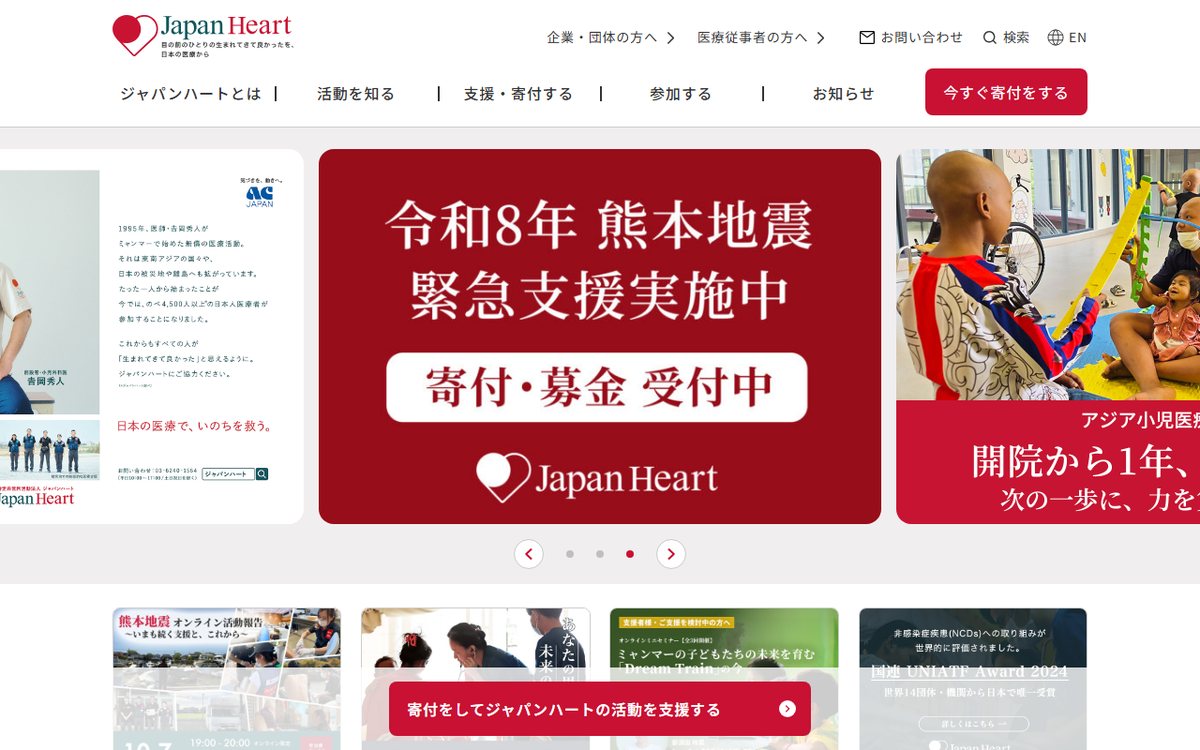
Japan Heart is an international medical NGO born in Japan that works at home and abroad under the principle of "delivering healthcare to medically isolated areas." Its vision is "to build a world where everyone can be grateful for the gift of life," and it believes in medicine that saves not only lives but also people's life stories and hearts.
It sees four places in the world and Japan that healthcare struggles to reach: countries suffering from poverty and a shortage of doctors, remote islands and rural areas of Japan, the hearts of children fighting illness and their families, and areas hit by major disasters. It provides about 40,000 treatments a year, including advanced care such as childhood cancer surgery, and reports more than 400,000 treatments in developing countries since its founding in 2004.
Overseas it carries out medical support, training of local medical personnel, and education and self-reliance support in Cambodia, Myanmar and Laos. In Japan it works on community medical support for remote islands and rural areas, support in disaster-affected areas, and activities in which medical staff help children with cancer and their families go on outings. It also reports having received a UN agency award (the UNIATF Award) in 2020 and 2024.
Key points
- Delivers healthcare to four kinds of hard-to-reach places, both overseas and in Japan
- About 40,000 treatments a year, and more than 400,000 in developing countries since its founding in 2004
- Offers many ways to take part, including donations, volunteering and support through shopping
Why this organization deserves attention
It treats not only the medical treatment itself but also the situation of patients' families and emotional care as part of "medicine." By training medical personnel abroad and supporting remote islands, rural areas and disaster zones, it widens the system that gets care to people who need it.
It welcomes the wish to "do something" in many forms, such as monthly donations, one-time gifts, donating used books or points, and volunteering. Readers can find an entry point to supporting international medical care in a way that suits them.
Editor's comment
Having medical care nearby seems natural, yet it is supported by the hands of many people. Japan Heart's work shows an attitude of facing each person in front of them and bringing care to places where that "natural" is hard to reach.
The official website has activity reports from each country and ways to help. Why not start by reading an activity report?