
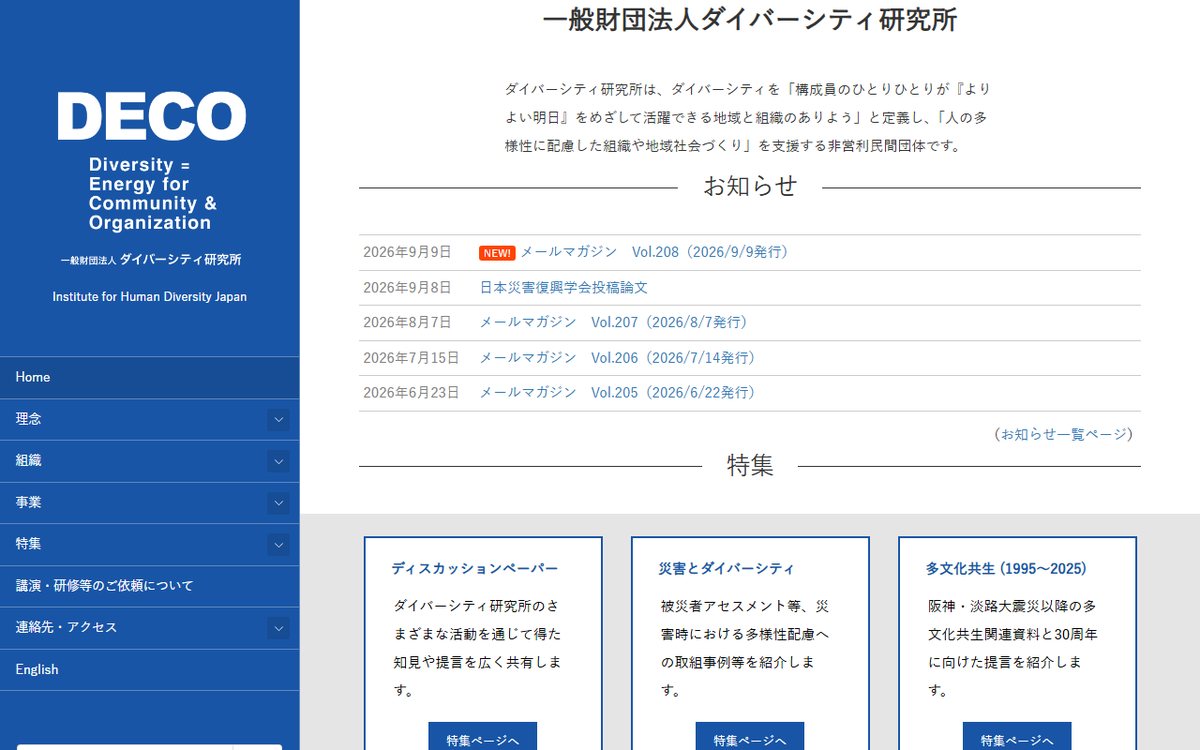
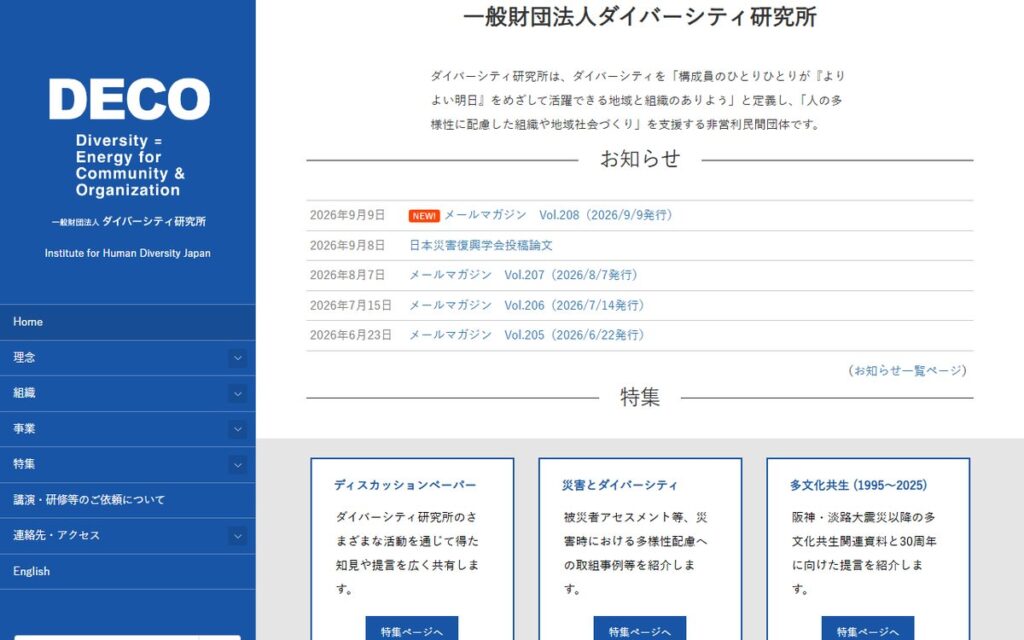
The Institute for Human Diversity Japan defines diversity as "a way of being for communities and organizations in which each member can thrive toward a better tomorrow," and is a private nonprofit that supports building organizations and communities that respect human diversity. It was founded in January 2007 and has offices in Tokyo and Osaka. Its abbreviation "DECO" comes from its basic philosophy, "Diversity = Energy for Community and Organization."
Its work centers on research and consulting on diversity, training sessions, lectures and seminars, and support for promoting diversity. It also offers online training courses, "Introduction to Diversity" and "Training for Facility Managers in Disasters."
Its activity reports list items such as support for running a program to look in on disaster victims in Wajima, Ishikawa, support for running livelihood recovery support organizations based on disaster case management, taking part in drafting and revising municipal multicultural coexistence plans, and support for creating an accessibility guide for a cultural facility. Its feature pages publish "Discussion Papers," "Disasters and Diversity" and "Multicultural Coexistence (1995-2025)," and it also issues an email newsletter.
Key points
- Supports community, organization and society building through consideration for diversity
- Has long worked on disaster-related efforts such as support for disaster victims and rebuilding livelihoods
- Plenty of learning opportunities, including online training courses, feature pages and an email newsletter
Why this organization deserves attention
A distinctive feature is that it turns diversity from an ideal into concrete forms such as research, training and support for running programs on site. It works with a variety of partners, including local governments and cultural facilities.
Materials on diversity in disasters and on multicultural coexistence are published on its feature pages, making them easy to use for anyone who wants to learn.
Editor's comment
The word diversity is now heard widely, but how to give it form in daily life differs from one community or organization to another. The Institute's work looks like a source of concrete hints.
The official website offers a free email newsletter and feature pages. Why not start by reading materials on a topic that interests you?