
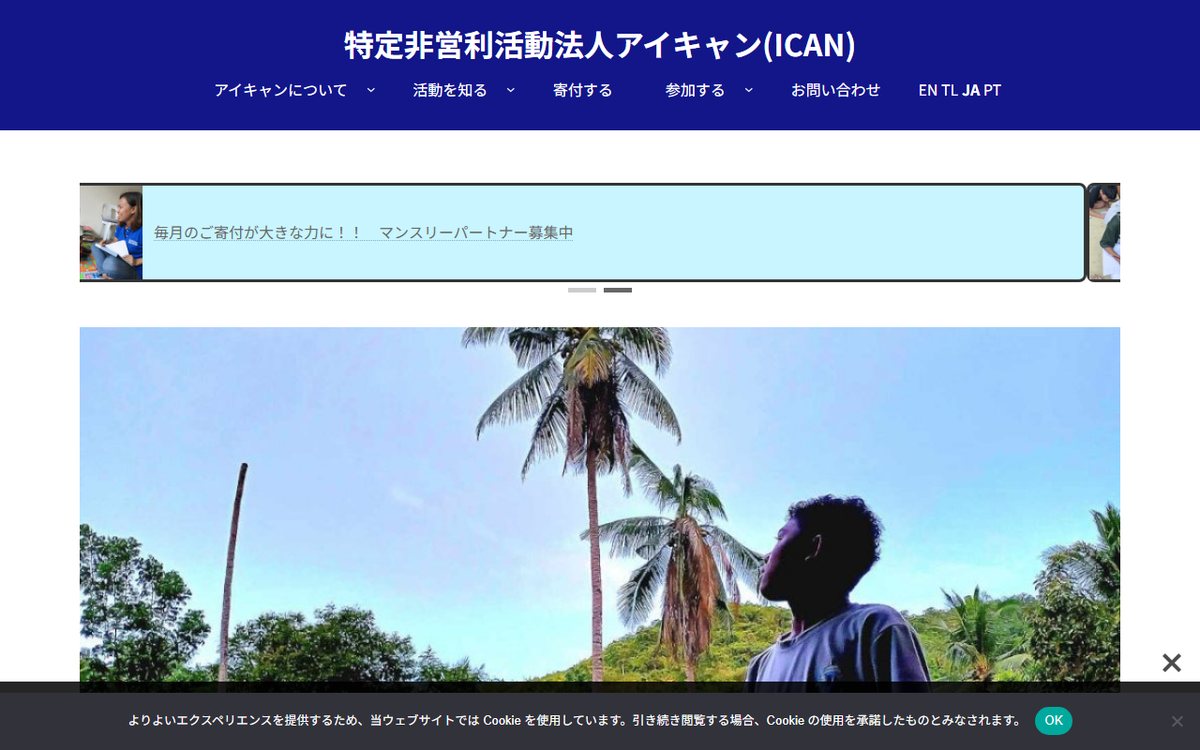
ICAN (アイキャン) is an international cooperation NGO that began in 1994, when a company employee who visited the Philippines, confronted by the situation of the children there, felt there must be something he could do and started with 50,000 yen collected with friends. The name comes from “I can” (there is something I can do too), and for more than 30 years it has kept going by bringing together what each person can do.
In the Philippines, it runs “street education” for children living on the streets of Metro Manila, teaching reading, writing, arithmetic, hygiene, children's rights and more. In 2015 it built the children's home “Kodomo no Ie” (Children's Home), supporting the daily lives, learning and preparation for independence of children aged 5 to 18. KALYE, a youth organization founded by young people from the streets, earns income by making and selling bread and sweets, and puts part of its sales toward street education.
In Japan, based in Minokamo and Kani in Gifu Prefecture, it offers consultations on daily life and creates places for exchange for people of foreign heritage, builds systems that let young people take part in their communities, and also works on creating safe places for children and global citizenship education.
Key points
- Supports Manila's street children step by step, from street education to a children's home
- A cycle in which young people who received support now deliver learning to the next generation as supporters
- Draws on its experience in the Philippines to also work on coexistence with people of foreign heritage in Japanese communities
Why this organization's work stands out
According to its official website, about 370,000 children are said to live on the streets in the Philippines, and many cannot receive education or medical care because they have no birth registration. ICAN does not simply hand out goods. It values experiences that let children themselves feel “I can change too,” and its activities are built around “empowerment” that draws out each person's strength, such as peer education by former street children.
It is also distinctive in connecting the perspective gained from overseas support to the challenges of multicultural coexistence within Japan. Its approach of seeing people of foreign heritage not as “people to be helped” but as members who build the community together offers insights for the future of community-building in Japan.
Editor's comment
An organization that began with 50,000 yen has, over 30 years, grown to run a children's home and see the birth of a youth organization. That journey itself seems to embody the “I can” in its name.
We are also glad that there are so many ways to get involved: monthly supporters, donations of unused postcards, volunteering, study tours, and openings for staff and interns. As a certified NPO, donations are also eligible for tax benefits. If you want to get involved in international cooperation in the Tokai region, please take a look at its official website.