
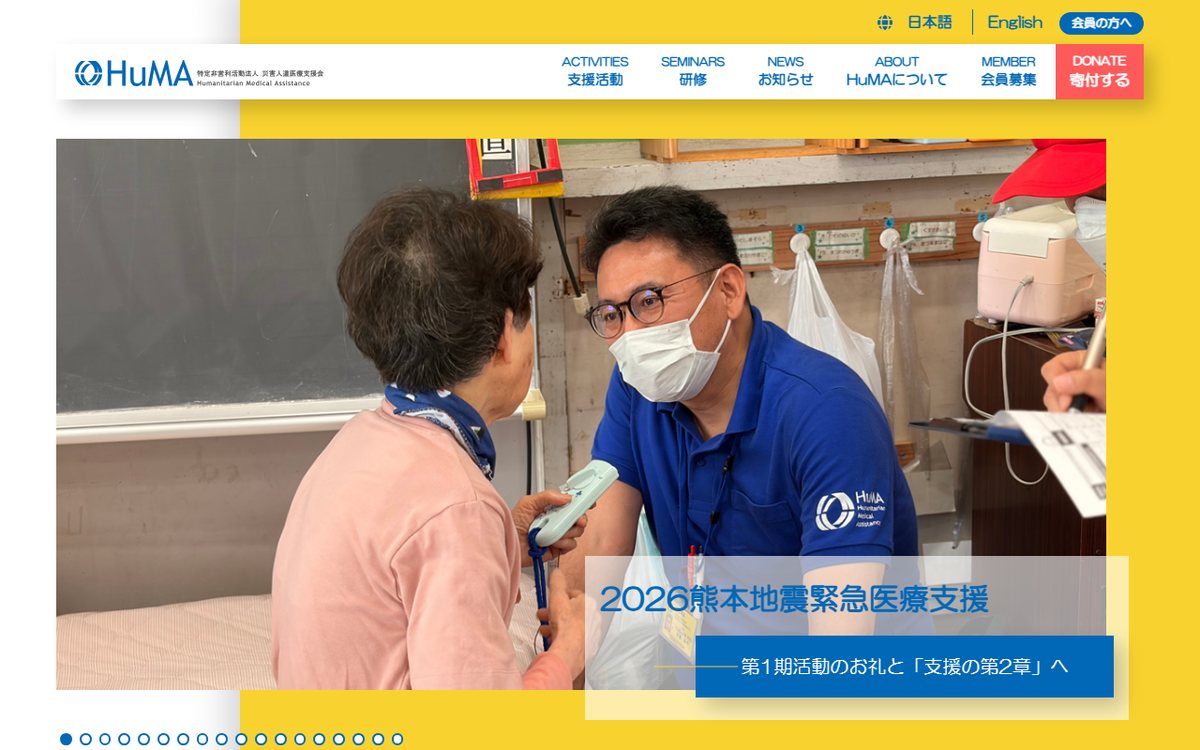
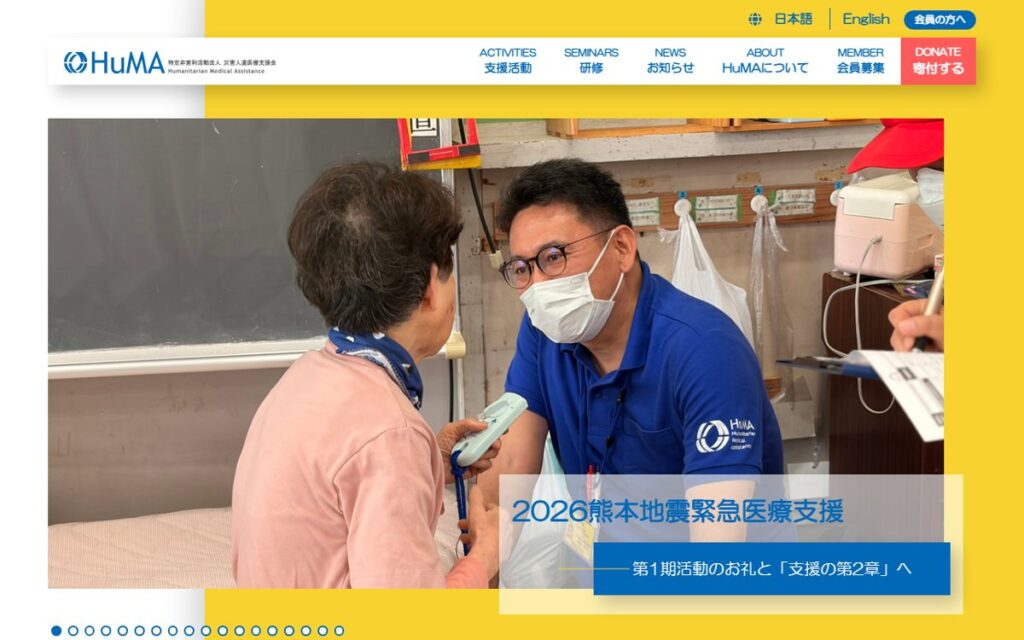
HuMA is a specified nonprofit corporation whose name is short for Humanitarian Medical Assistance (Saigai Jindo Iryo Shienkai in Japanese). When major disasters occur in Japan and abroad, it sends medical teams, and it also provides education and training for people involved in disaster medicine. Professionals such as doctors, nurses, clinical laboratory technicians, pharmacists and radiological technologists take part.
Its guiding principles include responding to all kinds of disasters, natural or human-made; looking from emergency medical aid through to recovery support and community development; not discriminating against people on grounds of race, sex, nationality, religion or politics; and cooperating with international organizations, governments and other NGOs.
Its past relief activities cover many disasters in Japan and abroad, including the Great East Japan Earthquake, the 2016 Kumamoto earthquake, the 2024 Noto Peninsula earthquake, the 2023 Turkey-Syria earthquake, typhoons in the Philippines, the Central Nepal earthquake and the cyclone in Vanuatu. During the COVID-19 pandemic it dispatched health workers to Osaka's hospital-waiting stations and elsewhere. Recent activities introduced on its site include emergency medical support for the 2026 Kumamoto earthquake and 2025 support for business continuity planning (BCP) in Noto.
Key points
- Emergency medical aid by sending medical teams to disasters in Japan and abroad
- An approach that goes beyond emergency relief to recovery support, community development and BCP support
- Education and training for people involved in disaster medicine, and participation in multi-agency drills
Why this organization deserves attention
Its distinguishing approach is to assess local needs, regardless of the type of disaster or whether it is in Japan or abroad, and then deliver the medical and health support that is required. It has supported not only the immediate aftermath but also the subacute phase weeks later, as well as the running of evacuation shelters.
In addition to sending medical teams, it puts effort into training to develop people, drills in ordinary times, and cooperation in Japan and overseas. There are ways to get involved from Japan, such as joining as a member or donating.
Editor's comment
When a disaster strikes, it is very reassuring to know there are people who can put their medical and health skills to work close at hand. HuMA's activities convey a perspective of supporting daily life that continues after the disaster.
The official website also introduces its latest relief activities, activity reports and membership information. Why not start by taking a look at what its work is like?