
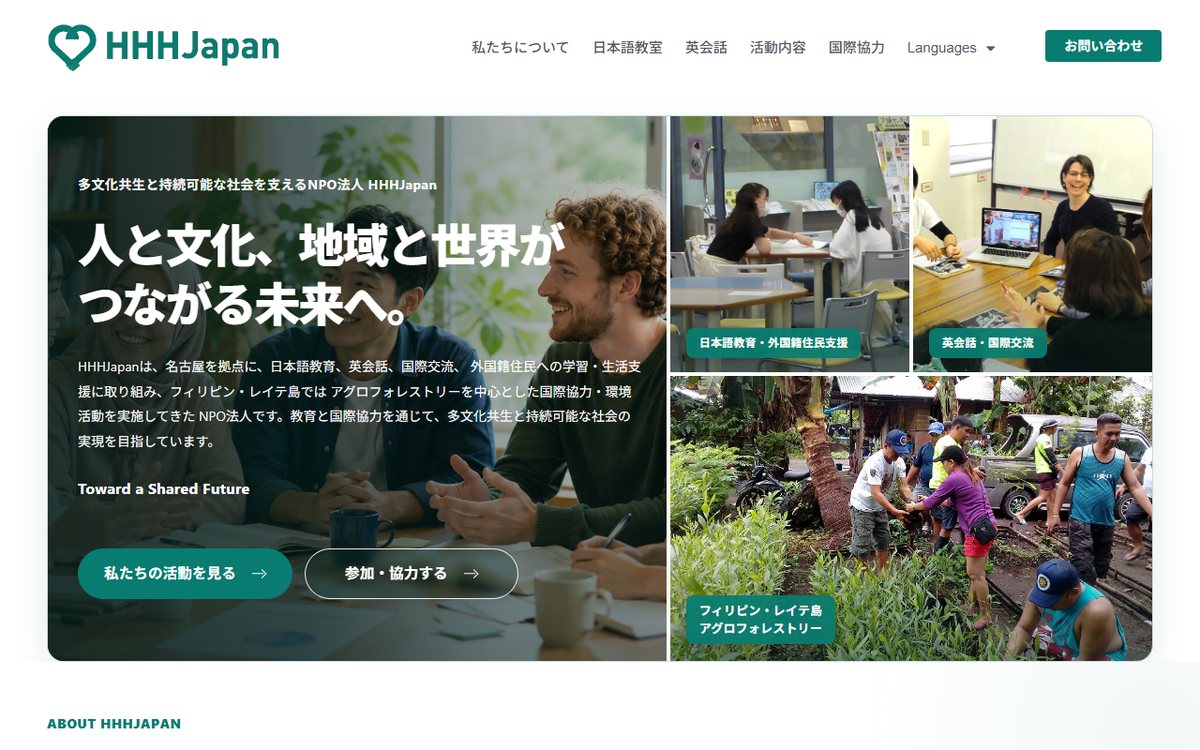
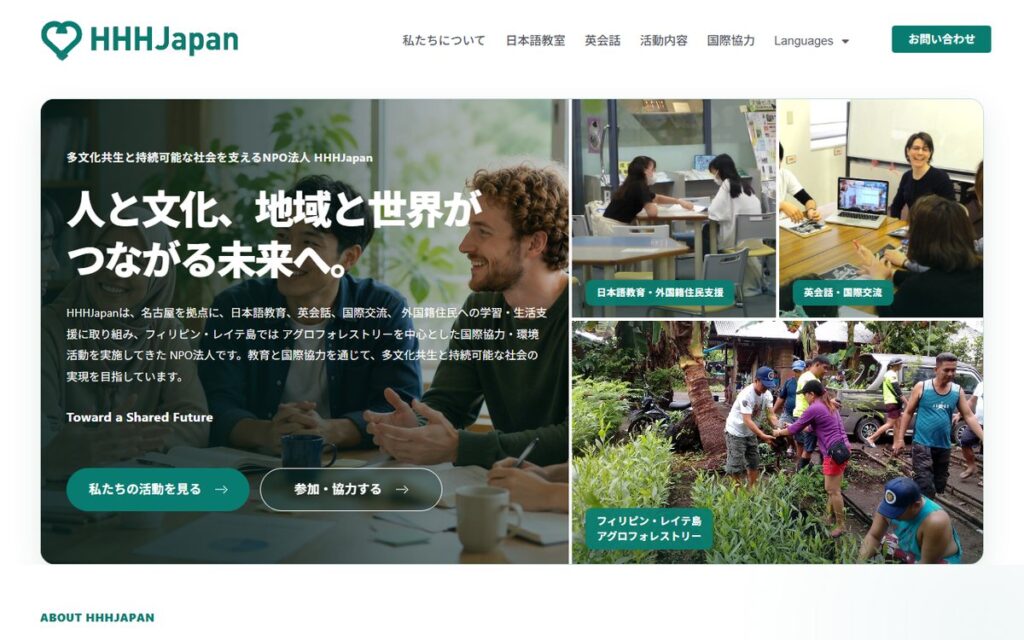
Helping Hands and Hearts Japan (HHHJapan) began its activities in Nagoya in 2008 and was established as an NPO in July 2010. Starting from collaboration with a local corporation in Manila on education and health and sanitation support, it now carries out activities on two pillars: community-rooted multicultural coexistence and sustainable international cooperation.
In Japan, it supports Japanese-language learning, both face-to-face and online, matched to each learner's goals and background. Using its network of volunteer and professional teachers, it also works to connect people who want to learn Japanese with those who want to help. It also offers English conversation with foreign instructors, international exchange and environmental-culture courses.
Overseas, it carried out an agroforestry project in Leyte, the Philippines, for coconut farmers in areas hit by Typhoon Haiyan, combining tree planting with farming. Across three environmental grant projects, from the Japan Fund for Global Environment, the Toyota Environmental Activities Grant Program and the Mitsui & Co. Environment Fund, it reports planting and distributing 112,800 seedlings, vegetables, root crops and other plants, of which more than 46,800 were tree, fruit and bamboo seedlings.
Key points
- Multicultural coexistence from Nagoya through Japanese-language learning support and international exchange
- Restoring rural environments and supporting farmers' livelihoods through agroforestry on Leyte Island
- 112,800 seedlings, vegetables, root crops and more planted and distributed through three environmental grant projects
Why this organization deserves attention
It sees multicultural coexistence at home and international cooperation abroad not as separate activities but as one flow of learning, connecting, supporting each other and building the future. It also presents the idea of "regionally rooted international cooperation," in which experience overseas is put to use in community activities in Japan.
Its emphasis on working with local organizations and farmers to build systems that local people can continue themselves is also instructive. Ways to take part, such as volunteering for Japanese-language teaching and internships, are available.
Editor's comment
A place to learn a language can also be a place that connects people, and communities with the world. Learning about HHHJapan, we realize that Japanese classes and English conversation are linked to international cooperation too.
There may be a similar place of encounter near where you live. Why not look at the official website to see what the activities are like?