
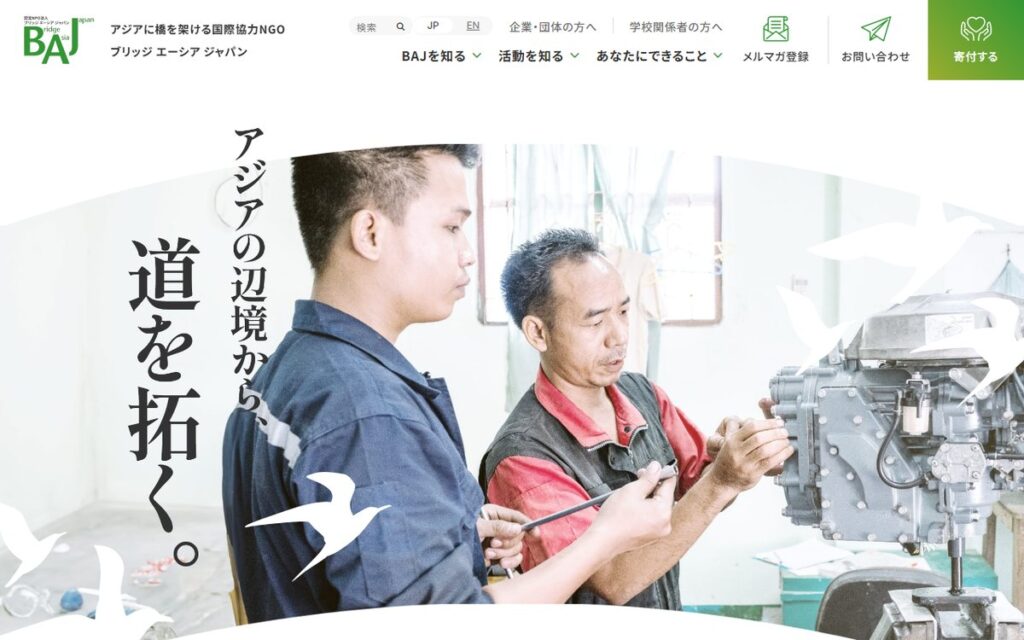
Bridge Asia Japan (BAJ) is an international cooperation NGO from Japan that supports communities in Myanmar and Vietnam. Its vision is to think and act together with local residents, supporting their self-reliance, so as to build an Asia where people can help one another.
It began in 1993 with post-war reconstruction support in Vietnam. In 1994, at the request of the UN High Commissioner for Refugees (UNHCR), it started projects to help returning refugees settle, based in Maungdaw in Rakhine State, Myanmar. From 2000 it supplied water for daily use in Myanmar's central dry zone, and in 2002 it opened a liaison office in Ho Chi Minh City to improve living conditions in poor areas.
Its work follows four missions: people building (skills and capacity), foundation building (environmental infrastructure), job building (income improvement) and society building (awareness). In Vietnam it runs environmental education for junior and senior high school students and circular farming projects, and in Japan it carries out activities such as the "Furukuru" used-clothing collection and event exhibits.
Key points
- Diverse projects in Myanmar and Vietnam, including water supply, sewing training and environmental education
- Activities built around four missions: people, foundations, jobs and society
- Ways to take part from Japan, such as "Furukuru," which turns used clothing into support
Why this organization deserves attention
A consistent strength is its approach of working together with local people toward their self-reliance. Its projects cover the foundations of daily life, such as water supply, school rebuilding and environmental education.
There are also many ways to take part from Japan. Besides donations and volunteering, it collects clothes you no longer wear, and its activity reports let you keep up with what is happening on site.
Staff comments
Minato AobaResearch
“The journey of over thirty years stayed with me: starting with postwar reconstruction in Vietnam, then working with residents in Myanmar to think together and aim for self-reliance. I felt the weight of such lasting relationships, and researching it made me bow my head.”
Sophie HiroseWriting and translation
“I agree with Aoba about thinking together with residents. In Japan, FURUKURU, the used-clothing collection, is a nice way to join in with something familiar. That it is easy to get involved is also part of the appeal.”
Mako JozenjiProofreading and verification
“In what you both said, I sensed a warmth that does not separate those who give from those who receive. I would like to keep cheering on the path toward a society where people help each other. I find the attitude of walking together as equals lovely.”
Editor-in-Chief’s comment
Ren DateEditor-in-Chief
“The phrase "we help each other when in need" conveys a warmth that does not divide those who give from those who receive. BAJ's work seems to begin with thinking together.
Its latest activity reports and event information are on the official website. Why not take a look at an activity that catches your interest?”