
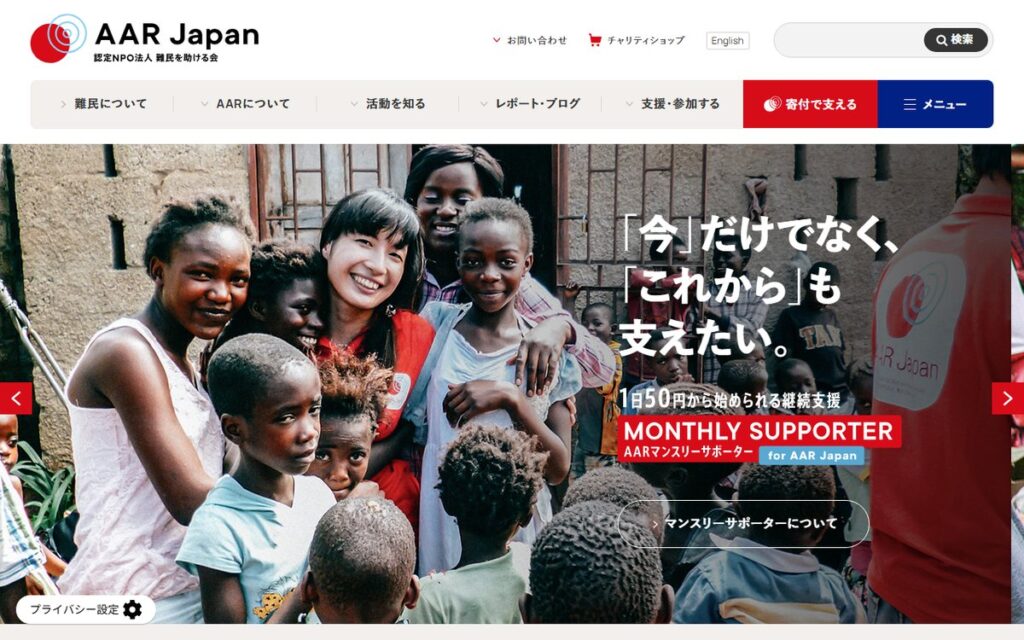
AAR Japan (Association for Aid and Relief, Japan) is a "Japan-born international NGO" recognized and registered by the United Nations, launched in Japan in 1979 to support Indochinese refugees. It began under the name "Association to Help Indochinese Refugees" and has since widened its areas and fields of work, supporting people in more than 65 countries and regions. Its basic principle is to work without bias toward any politics, ideology or religion.
Today it works mainly in six fields: refugee assistance, landmine and unexploded ordnance action, support for people with disabilities, disaster relief, infectious disease control and water and sanitation, and advocacy and international understanding education. In countries including Cambodia, Laos, Myanmar, Bangladesh, Ukraine, Turkey, Syria and Japan, it provides long-term support to people in especially vulnerable situations.
In 1997, the International Campaign to Ban Landmines (ICBL), of which AAR is a member, won the Nobel Peace Prize. In 1998 AAR obtained special consultative status with the UN Economic and Social Council (ECOSOC). Ways to get involved include becoming a monthly supporter, making a one-time donation, membership, joining events and volunteering, buying charity goods, and international understanding education programs for teachers and students.
Key points
- Launched in 1979 to support Indochinese refugees; a Japan-born international NGO that has supported people in more than 65 countries and regions
- Works in six fields, including refugee assistance and landmine and unexploded ordnance action and support for people with disabilities
- Works without bias toward politics, ideology or religion, with a focus on long-term support for especially vulnerable people
Why this organization deserves attention
A distinctive feature is that it connects the Japanese tradition of goodwill, "helping each other in hard times," to support around the world. It has widened its fields while facing people in conflict, disaster and poverty.
Besides donations, it offers chances to take part in daily life, such as volunteering, events, a charity shop and international understanding education for schools.
Staff comments

Minato AobaResearch
“I was impressed by how it began with support for Indochinese refugees and has expanded to more than 65 countries and regions. Its principle of not leaning toward any politics, ideology or religion also stayed with me. The attitude of helping each other across borders feels consistent.”
Sophie HiroseWriting and translation
“I fully agree with Aoba about that greatly expanding journey. I like that there are many easy ways to take part in daily life, such as volunteering, charity shops and school programs.”

Mako JozenjiProofreading and verification
“Hearing you both, I felt that the phrase we help each other when in trouble is a gentle doorway to treating faraway events as our own. I hope this goodwill keeps reaching people.”
Editor-in-Chief’s comment
Ren DateEditor-in-Chief
“"Helping each other in hard times" seems like a gentle way in to thinking about events in distant countries as our own concern. Its journey of more than 45 years shows how the goodwill of many people has reached the world.
The official website has activity reports and a section explaining refugees. Why not start by reading some of them?”