
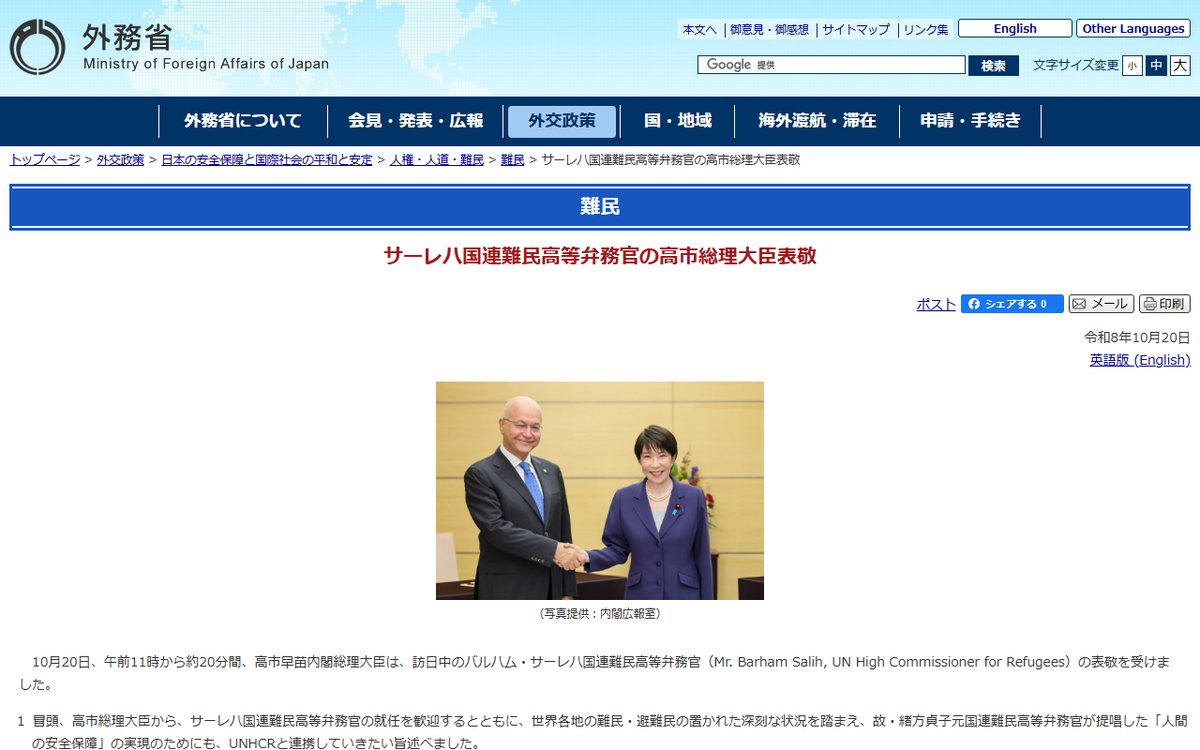
Japan's Ministry of Foreign Affairs announced that UN High Commissioner for Refugees Barham Salih, who is visiting Japan, paid a courtesy call on Prime Minister Takaichi Sanae on the morning of October 20. The meeting lasted about 20 minutes.
The Prime Minister opened by welcoming the High Commissioner's appointment. Given the serious situation of refugees and displaced people around the world, she said Japan wishes to work with UNHCR, including toward realizing "human security," a concept advocated by the late Ogata Sadako, former UN High Commissioner for Refugees.
High Commissioner Salih expressed gratitude for Japan's past support to UNHCR and explained the global situation of refugees and displaced people and UNHCR's activities. Both sides confirmed that support for refugees and displaced people contributes to peace and stability not only in one country but across regions, and that strategic partnership with international organizations leads to better global crisis management. They agreed to keep working closely together.
Key points
- The new head of UNHCR visited Japan and confirmed cooperation
- "Human security," advocated by Ogata Sadako, was cited as a foundation for partnership
- Both sides shared the view that refugee support also serves regional peace and stability
Why this news deserves attention
Many people around the world are forced to leave their homes because of conflict and disasters. That the head of the UN refugee agency and the Japanese government reaffirmed their direction of cooperation is a meaningful development for NGOs and citizens engaged in international cooperation.
On the ground, activities are supported by international organizations, governments, NGOs, and the donations and goodwill of citizens working together. High-level dialogue like this offers a chance to check that foundation.
Staff comments

Minato AobaResearch
“The UN High Commissioner for Refugees, Mr. Saleh, visited Japan and confirmed cooperation in a courtesy call of about 20 minutes. I was struck that Sadako Ogata's idea of human security was named as the foundation.”

Sophie HiroseWriting and translation
“I share Aoba's interest in human security. The shared view that refugee support helps regional peace and stability, not just one country, seems a valuable perspective for all of us thinking about aid.”

Mako JozenjiProofreading and verification
“Your words reminded me that behind high-level talks are the lives of individuals. I hope Sadako Ogata's wish will continue to be carried on, from now on too, together with the support of NGOs and citizens.”
Editor-in-Chief’s comment
Ren DateEditor-in-Chief
“Refugee issues may feel distant, but Japanese NGOs are also continuing their support in many places. Why not use this announcement as a chance to look at the work of UNHCR and of organizations close to home?
NGO Network Japan will keep bringing you news like this. Let's follow it together.”