
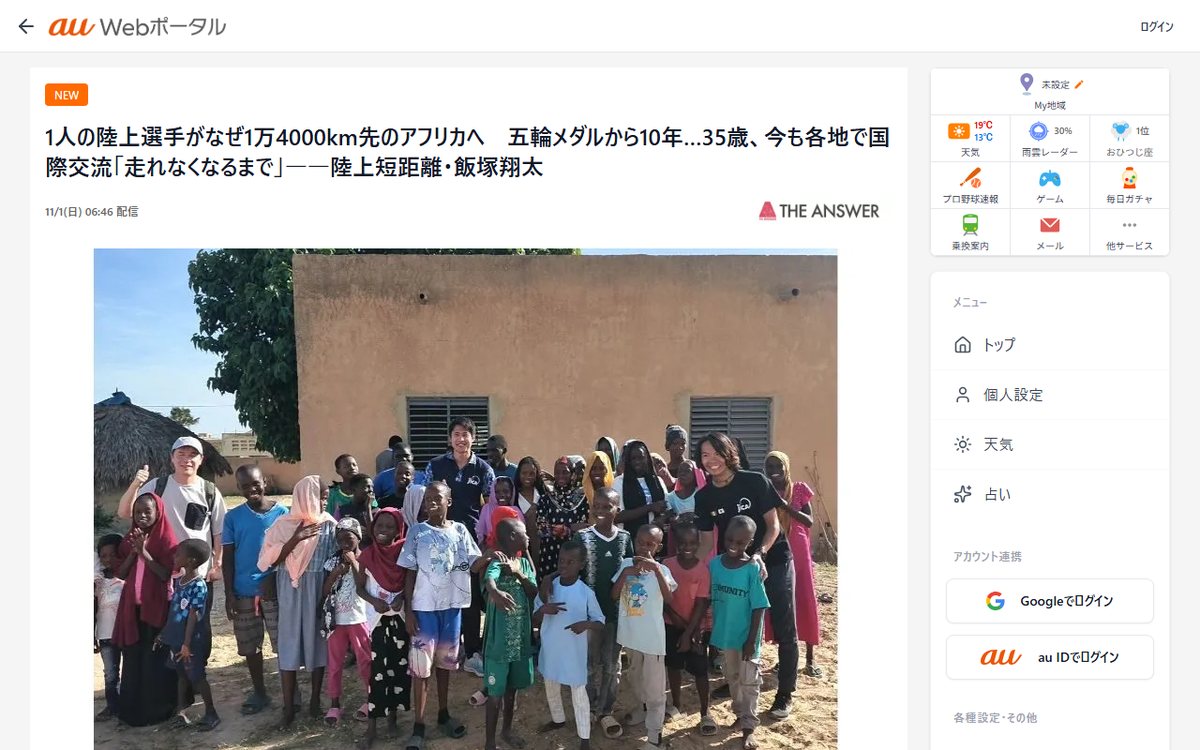
Sprinter Shota Iizuka (Mizuno) visited Senegal in West Africa as part of a program in partnership with the Japan International Cooperation Agency (JICA), spending three days with local children. On October 30, he held an online press conference from Senegal to report on his activities.
Senegal is about 14,000 kilometers from Japan, more than a full day's journey via Paris. The official language is French, and there were times when words did not fully get through, but running together and sharing laughs became a form of communication in itself. He held athletics clinics, visited schools, and gave the children spikes and shoes he had brought from Japan. At the press conference, Iizuka reflected that sport has the power to connect people, and that moving together creates bonds, whether in Japan or abroad.
Starting with athletics clinics and other activities in Eswatini in 2018, Iizuka has continued visiting developing countries during the off-season to spend time with children. For the past five years, he has worked with JICA, visiting Bangladesh, Rwanda, Timor-Leste, and Laos. Still competing at the top level at 35, he said he wants to continue these activities until he can no longer run, and that the exchanges also motivated him in his own sport.
Key points
- An Olympic medalist spent three days with children in Senegal in partnership with JICA
- He held athletics clinics, visited schools, and gave spikes and shoes to the children
- For the past five years, he has teamed up with JICA to visit countries in Asia and Africa every year
Why This News Deserves Attention
Even when language and backgrounds differ, running and laughing together can open hearts. Iizuka's report clearly shows how sport can be a gateway to international exchange. The fact that a top athlete keeps visiting developing countries almost every year while still competing also makes this a long-term commitment.
Sports exchanges like this one, carried out in partnership with JICA, offer a helpful way to feel closer to faraway countries.
Staff comments
Minato AobaResearch
“I was struck by how, in French-speaking Senegal, running together connected hearts even when words did not fully get through. It is also remarkable that this has continued without a break since Eswatini in 2018.”

Sophie HiroseWriting and translation
“Like Aoba, I love the moments of connecting through running beyond language. Working in translation, I tend to think about the power of words, but the joy of moving together may reach people more directly than any words.”

Mako JozenjiProofreading and verification
“Hearing you both, I felt that sport is building small bridges between countries. His wish to continue until he can no longer run shows a warm cycle of exchange, where the children's smiles also become strength for his own competition.”
Editor-in-Chief’s comment
Ren DateEditor-in-Chief
“Even without a shared language, running together brings smiles. Reading Iizuka's report reminded me of the simple, direct power of sport. It is heartwarming to imagine the children in Senegal running again in the spikes they received. Why not look for your own connection to the world through a sport or hobby close to you?”