
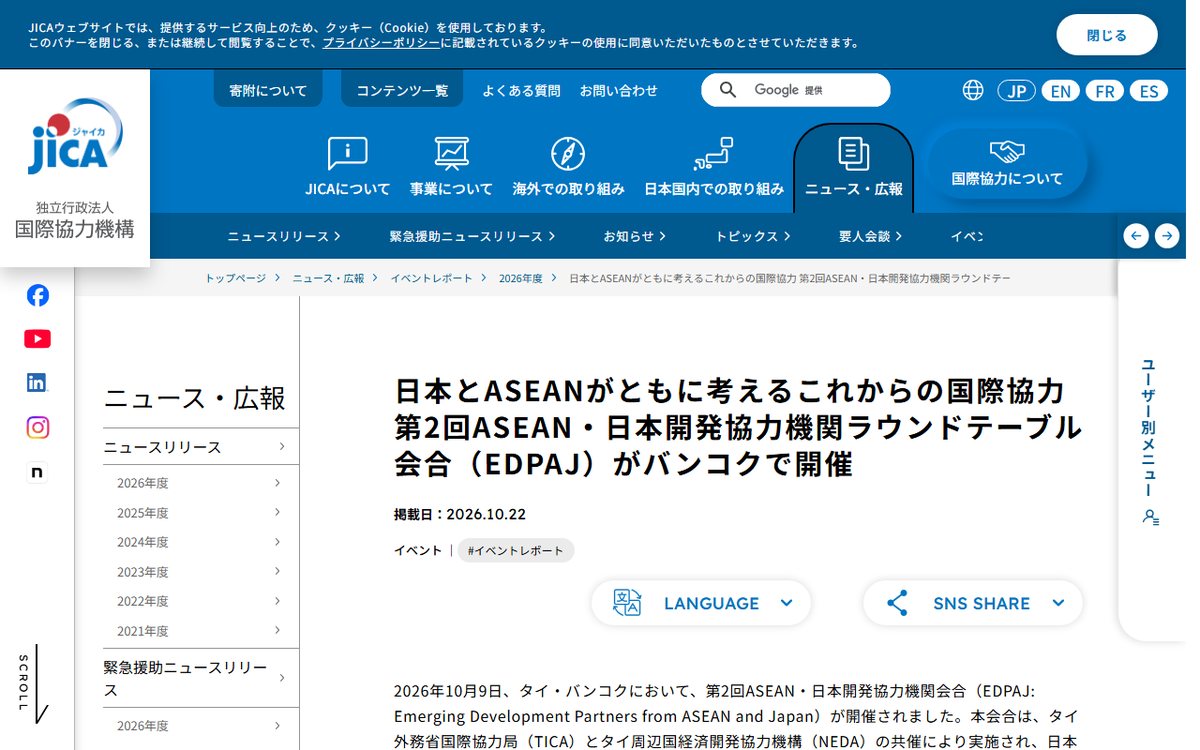
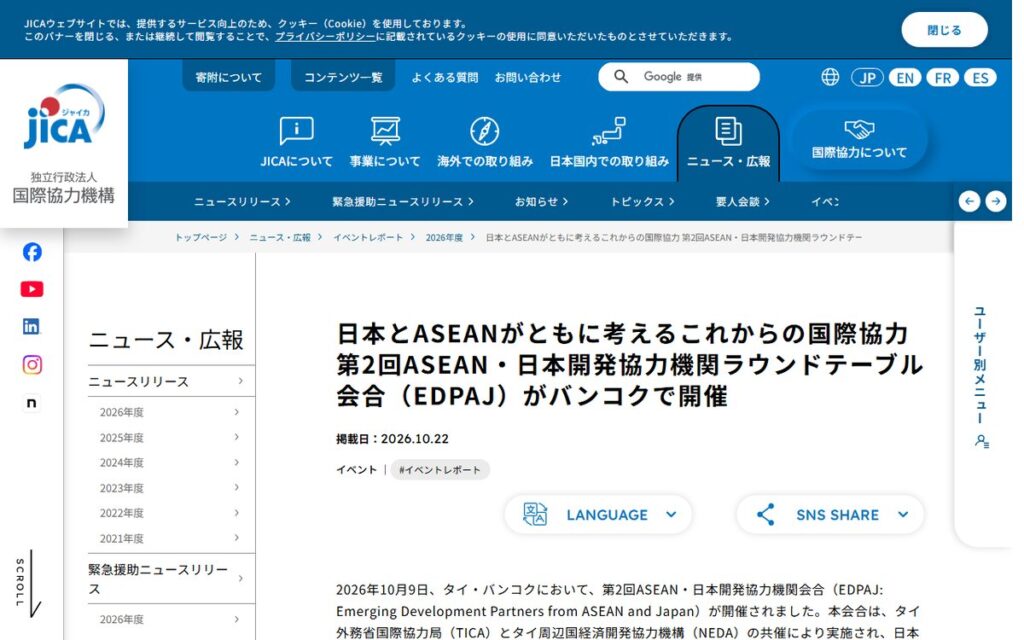
According to JICA's website, the second meeting of EDPAJ, a forum where development cooperation agencies from Japan and ASEAN countries share experience and knowledge, took place in Bangkok. The first was held in Tokyo in 2024.
Cross-border challenges such as climate change, natural disasters, food and energy security and public health are on the rise. The meeting proceeded on the understanding that tackling them requires many countries and organizations to pool their knowledge.
In its opening remarks, JICA expressed hope that EDPAJ would grow into a framework of "Circular Cooperation," in which participating agencies keep learning from one another and create new value. JICA also shared its experience with triangular cooperation in Latin America, and participants discussed how each country's strengths might be combined.
The outcomes were compiled into the "Bangkok Summary," and participants confirmed the aim of turning discussions into concrete cooperation through training, expert exchanges and joint projects.
Key points
- The second meeting bringing together Japan and ASEAN development agencies
- "Circular Cooperation": a concept of cooperation based on mutual learning
- Results compiled in the "Bangkok Summary"
Why This News Deserves Attention
Countries that once received aid now play active roles as development partners. The meeting reflects a growing move beyond the donor-recipient divide toward learning together as equals.
For NGOs and citizen groups, knowing the broader currents of international cooperation can help place their own work in context.
Staff comments

Minato AobaResearch
“What struck me about the second EDPAJ meeting in Bangkok is the call for circular cooperation, where participating agencies keep learning from each other and create new value. It feels like a move beyond the line between those who give and those who receive support.”

Sophie HiroseWriting and translation
“I agree with Aoba about moving beyond that line. The sharing of Latin American triangular cooperation experience, combining each country's strengths, could also be a hint for how civil society groups work together.”

Mako JozenjiProofreading and verification
“Listening to you both, I also think it matters that the outcomes were gathered in the Bangkok Summary, confirming a direction toward concrete cooperation such as training and expert exchanges. I would like to check the details on the official site.”
Editor-in-Chief’s comment
“The shape of international cooperation seems to be shifting, little by little, from "teaching and being taught" to "thinking together."
Following such public-sector developments may also reveal points of connection with citizen-led activities. For details of the meeting, please see JICA's official website.”