
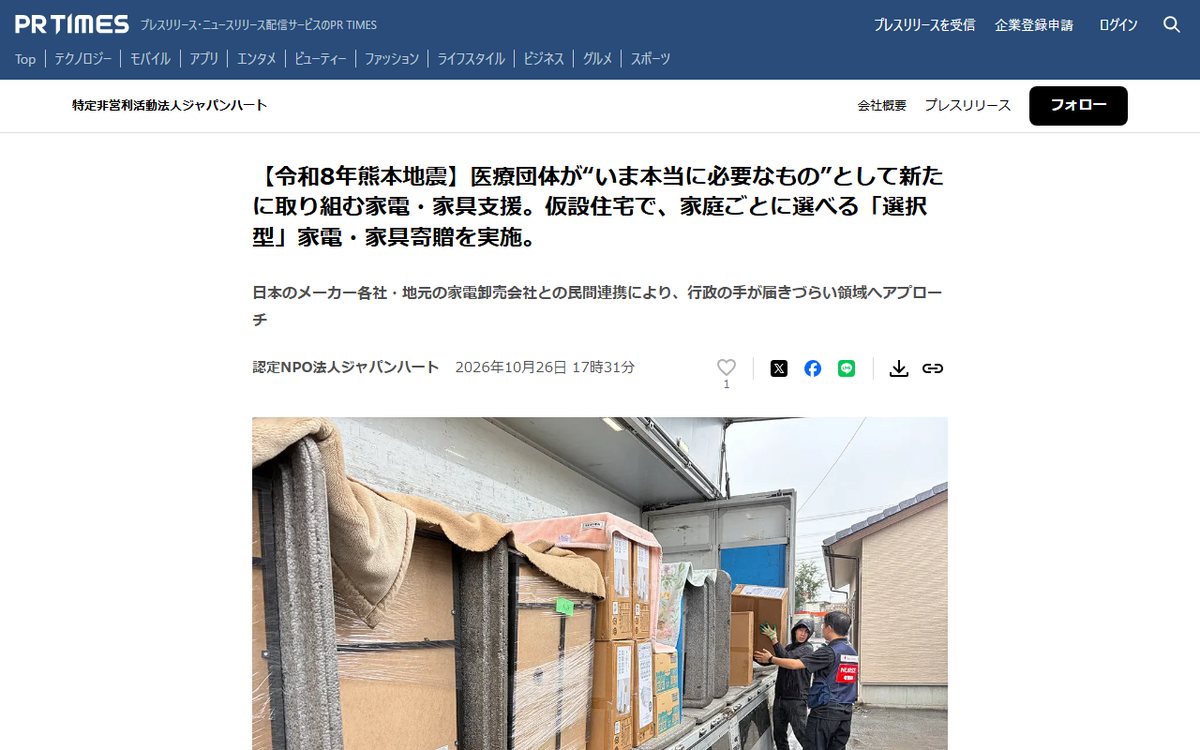
It will soon be three months since the earthquake. People affected by the disaster are moving from evacuation shelters to temporary housing. However, while temporary housing comes with some equipment such as air conditioners, not everything needed for daily life is provided. What each family truly needs, including items that became unusable because of the earthquake, differs from household to household.
Since the disaster, Japan Heart has been stationed at evacuation shelters in Yatsushiro City, providing ongoing support. This time, with the cooperation of Yatsushiro City, it conducted a survey in advance of households moving into temporary housing, asking them to choose what they need (multiple choices allowed) from a list of 11 items including televisions, freezers, microwave ovens, rice cookers, vacuum cleaners and bedding. The products are made by IRIS OHYAMA and Sharp and purchased by Japan Heart, with delivery and installation supported by the partner companies.
When items are delivered, medical staff accompany the team to check each household's physical and mental health and the daily movement paths of people who need special care. The aim is not just to deliver goods but to understand each person's concerns and help reduce the risk of disaster-related deaths. Japan Heart is also accepting donations in connection with this work.
Key points
- Rather than uniform support, a "choice-based" approach in which each household selects the appliances and furniture it needs through a survey
- With an NPO acting as a hub, manufacturers, a local appliance wholesaler and the city work together to provide individual support that is hard for the government to offer
- Medical staff visit households during delivery to understand their health conditions and help reduce the risk of disaster-related deaths
Why This News Deserves Attention
Moving into temporary housing is a big step toward rebuilding lives, but each household faces different challenges before regaining a life that feels like their own. This support, which listens to each person and delivers what they need, offers a useful model for standing alongside people after a disaster.
Another distinctive feature is how it combines material support with health monitoring, a perspective unique to a medical NGO. Building on the experience of visiting temporary housing on the Noto Peninsula, this effort can be called a meaningful step in preparing for future large-scale disasters.
Staff comments

Minato AobaResearch
“I was struck by the point that temporary housing lacks some essentials and that each household needs different things. Asking each home through a survey and letting them choose is a first for Japan Heart.”

Sophie HiroseWriting and translation
“Like Aoba, I strongly agree about the differences between households. Having medical staff come along on delivery to check people's physical and mental well-being is something only a medical NGO could do. It feels like peace of mind is being delivered with the goods.”

Mako JozenjiProofreading and verification
“As you both said, this is support that listens to each person's voice. Everyday items like a television or a rice cooker can become a strength for getting life back. I hope calm days return for the people of Yatsushiro.”
Editor-in-Chief’s comment
Ren DateEditor-in-Chief
“The words "what is truly needed differs for each household" really struck me. I hope the lives of those affected settle down as soon as possible.
Japan Heart is accepting donations in connection with this support. If you would like to support life in the affected area, please read the announcement and the organization's information.”