
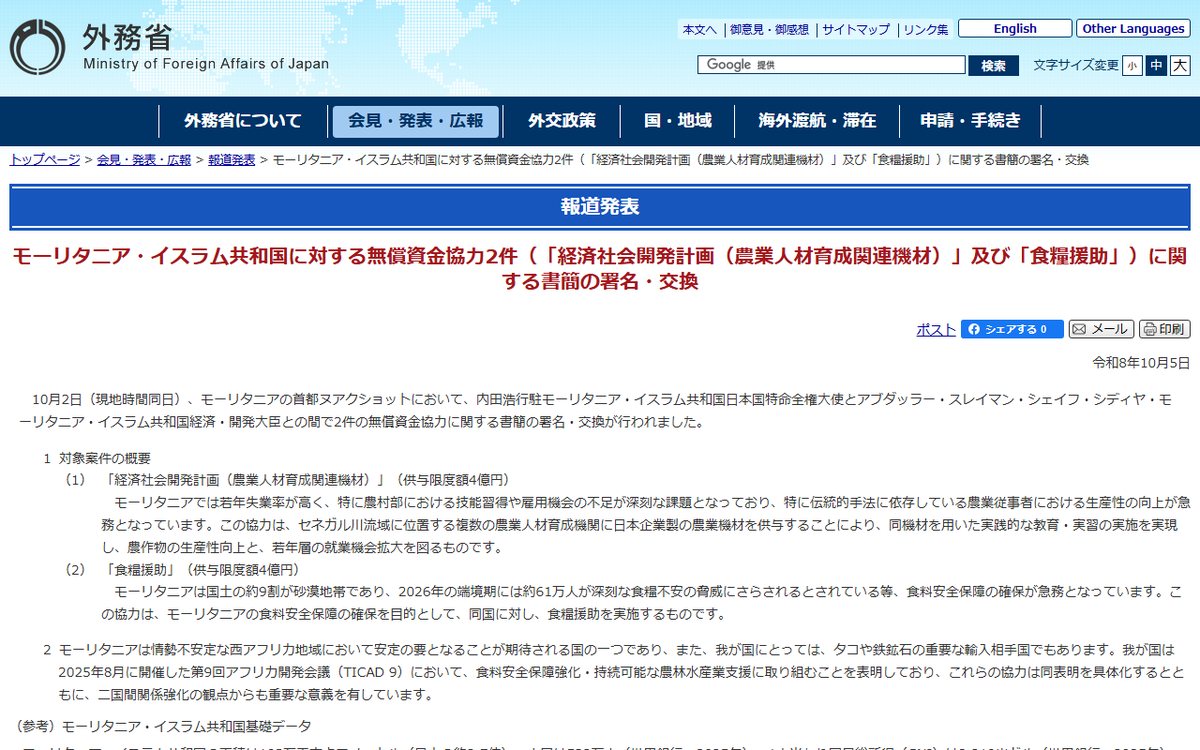
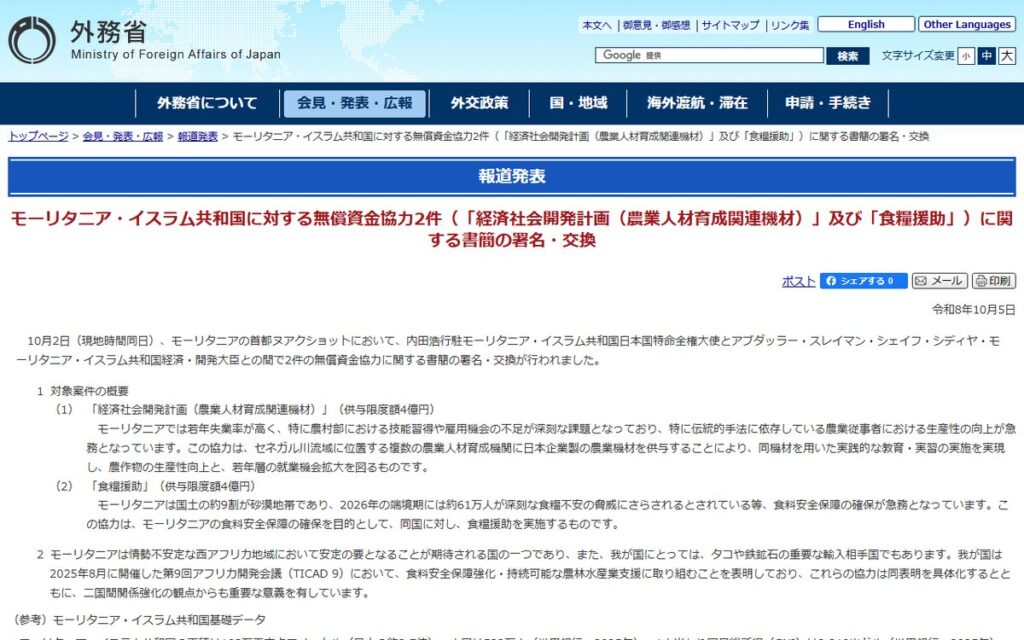
The Ministry of Foreign Affairs of Japan announced that notes were signed and exchanged in Mauritania for two grant aid projects for the Islamic Republic of Mauritania. The grant limit for each project is 400 million yen.
The first, the Economic and Social Development Programme (equipment for agricultural human resource development), will provide agricultural equipment made by Japanese companies to several agricultural training institutions in the Senegal River basin. With high youth unemployment and a shortage of skills training and job opportunities in rural areas, the project aims to improve productivity and expand employment for young people through practical education and training.
The second, food aid, supports food security in a country where about 90 percent of the land is desert and where about 610,000 people are expected to face serious food insecurity during the 2026 lean season. The announcement positions both projects as putting into practice the commitments on strengthening food security and supporting sustainable agriculture, forestry and fisheries made at TICAD 9 in 2025.
Key points
- Equipment supply enables practical education and training at agricultural institutions
- Food aid responds to an expected 610,000 people facing food insecurity
- Puts into practice the food security commitments made at TICAD 9
Why this news is worth noting
It combines urgent food aid with medium- to long-term support for training agricultural workers.
Addressing youth employment and food security, challenges shared by many African countries, it offers a window into how Japan's ODA is being used today.
Editor's comment
Reading the announcement makes it clear how ODA is put to concrete use.
If you are interested in international cooperation, please take a look at the original release from the Ministry of Foreign Affairs.