
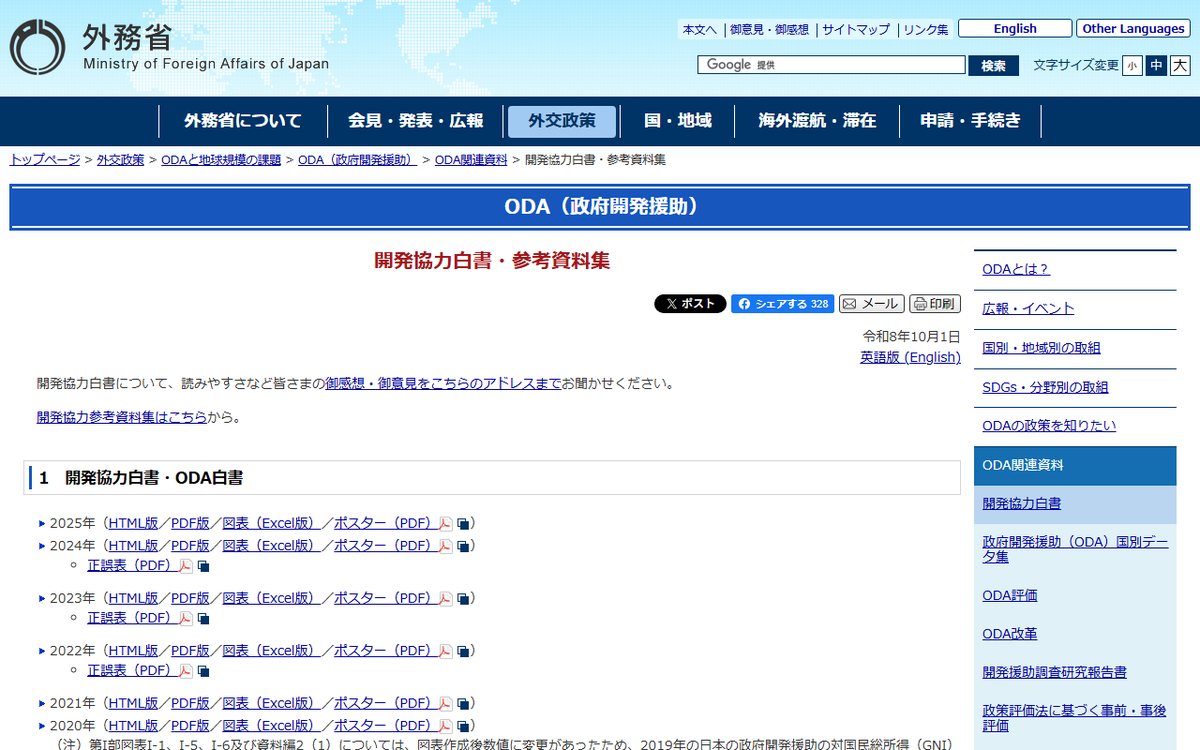
The Ministry of Foreign Affairs of Japan's "2025 White Paper on Development Cooperation: Japan's International Cooperation" includes a section on partnership with Japanese NGOs. The white paper explains that, drawing on long experience in the field and trust built with local people, Japanese NGOs provide carefully tailored support that responds to residents' needs, and can act quickly in times of disaster and other emergencies. The government regards these NGOs, which carry out "cooperation with a visible face," as strategic partners in development cooperation and works with them through three pillars: funding, capacity-building support and dialogue.
On funding, through Grant Assistance for Japanese NGO Projects, 53 NGOs carried out 102 projects in 36 countries and 1 region in fiscal 2024, totaling about 6.7 billion yen. The fields are wide-ranging, including health, medical care and sanitation, rural development, support for persons with disabilities, education, disaster risk reduction, and landmine and unexploded ordnance clearance. Japan Platform (JPF), through which NGOs, the business community and the government work together, had 47 member NGOs as of December 2025, and in fiscal 2024 carried out 106 projects in response to 16 disasters and conflicts as emergency humanitarian assistance. JICA's Partnership Program for grassroots technical cooperation also runs about 180 projects a year in roughly 80 countries.
To improve the environment in which NGOs work, the NGO Advisors system has NGOs across the country, commissioned by the Ministry of Foreign Affairs, answer questions from citizens and NGO personnel. In fiscal 2024, 10 organizations responded to more than 5,500 consultations and provided 69 on-site services. The white paper also introduces concrete examples, such as a project in northwestern Uganda in which Save the Children works with local authorities and communities to build a system that protects children from violence.
Key points
- NGOs are treated as "strategic partners" in development cooperation, with partnership built on three pillars: funding, capacity building and dialogue
- In fiscal 2024, 53 organizations carried out 102 projects under Grant Assistance for Japanese NGO Projects, totaling about 6.7 billion yen
- Under the NGO Advisors system, 10 organizations handled more than 5,500 consultations
Why this news is worth your attention
NGO activities are supported not only by donations and volunteers but also by a variety of mechanisms, including government funding and joint projects with JICA. This section of the white paper is a useful resource for seeing the overall picture of these systems and their results at a glance.
For people who want to start an NGO or are interested in working in international cooperation, it also shows where to find available support, such as the NGO Advisors system and internship programs. The descriptions of specific projects also give a sense of what results NGOs are achieving in the field.
Editor's comment
The phrase "cooperation with a visible face" reflects how much trust Japanese NGOs have built up on the ground. Behind figures like 53 organizations and 102 projects, I imagine, are countless individual encounters with the people living in each community.
If you are thinking about working with an NGO or starting one, please make good use of systems such as the NGO Advisors. The full text of the white paper can be read on the Ministry of Foreign Affairs website.