
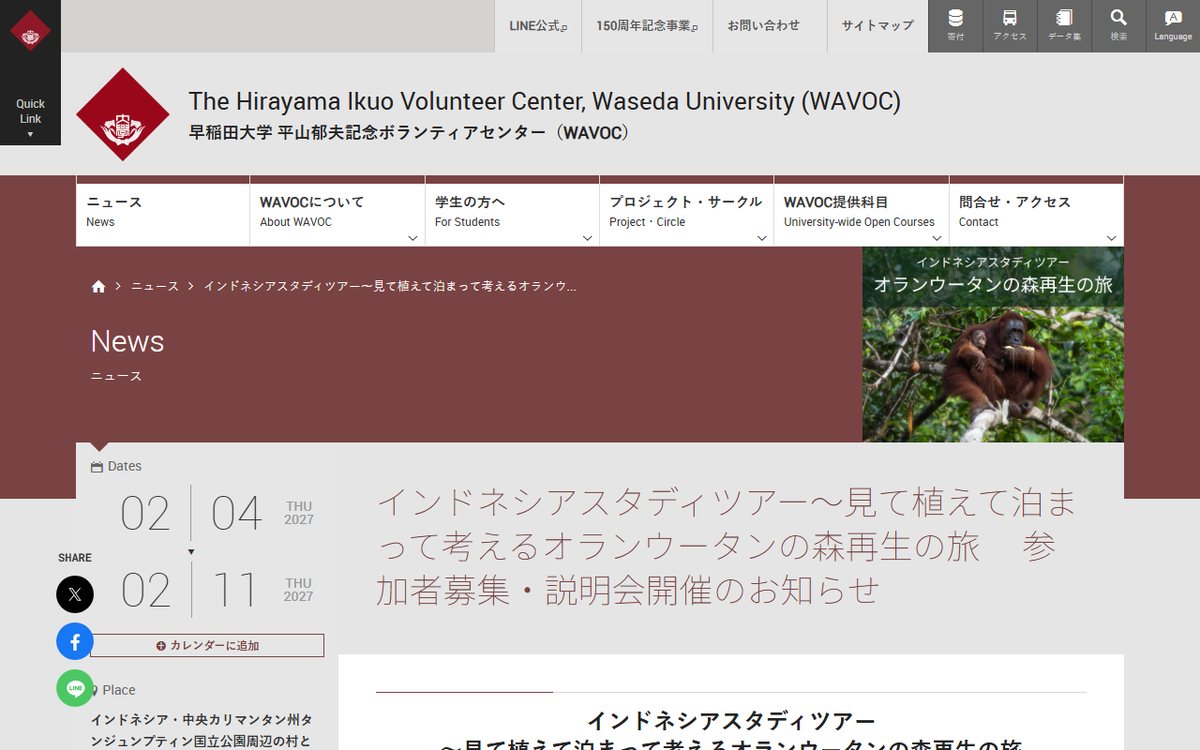
The Hirayama Ikuo Volunteer Center at Waseda University (WAVOC) is recruiting participants for its study tour "See, Plant, Stay and Think: A Journey to Restore the Orangutans' Forest" on the island of Borneo, Indonesia. The tour runs for seven nights and eight days from February 4 to 11, 2027, in the villages and forests around Tanjung Puting National Park in Central Kalimantan. It is open to Waseda University students.
According to WAVOC, the tropical forests in this region have been lost to large-scale plantation development by companies, as well as illegal logging and gold mining carried out by villagers for income. In years of severe drought, forest fires also spread; this year, an area equivalent to the whole of Japan's Shikoku region has burned across Indonesia. Alarmed by the ongoing loss of forest, local people are working with NGOs on tree planting and ecotourism, seeking ways to make a living while protecting the forest.
During the tour, participants will observe wildlife while traveling by boat and visit oil palm plantations and sites of forest fires and gold mining. They will experience village life and the natural environment through homestays and camping in the forest, raise seedlings and plant trees with young villagers, and discuss approaches to forest restoration in a workshop with local people. The local program is run by the Hutan Group (Utan Mori to Seikatsu o Kangaeru Kai), and there are two pre-departure sessions and one session after returning. To apply, students must attend one of the four information sessions in November; applications are accepted from November 12 to 30.
Key points
- Stay with families in a Borneo village and plant trees with young villagers on former gold-mining land
- Visit plantation and forest-fire sites and think with local people about balancing livelihoods and nature conservation
- The local program is run by an NGO working in the area, with thorough pre-departure and follow-up sessions
Why We Recommend This Study Tour
The loss of tropical forests is both an environmental problem in a faraway country and an issue deeply tied to the lives and economy of the people who live there. By staying in a village and planting trees alongside local youth, participants should be able to consider, as their own question, how to balance protecting nature with improving livelihoods.
An NGO working on the ground serves as guide, and both pre-departure study and post-tour reflection are built into the program. Even for students encountering a developing-country setting for the first time, the structure makes it easier to turn what they learn into their next step.
Staff comments

Minato AobaResearch
“I noticed that behind the loss of the forest lie not only plantation development but also illegal logging and gold mining done to make a living. It is a problem where livelihoods and nature are intertwined, one that cannot be solved simply by blaming someone.”

Sophie HiroseWriting and translation
“The intertwining of livelihoods and nature that Aoba describes is really the heart of this tour. By staying in a village and planting seedlings with young people, participants can touch the feelings of local residents that reading books or articles alone cannot reveal.”

Mako JozenjiProofreading and verification
“From what you both said, I could feel how hard it is to protect the forest while making a living. Planting trees on former gold-mining land may be a small step, but it should become time spent thinking about the future at eye level with the people who live there.”
Interested in this event?
Editor-in-Chief’s comment
Ren DateEditor-in-Chief
“Being on site as local people work to bring back the forest where orangutans live is a rare opportunity. The tour is limited to Waseda students, but we hope many readers will take a look at WAVOC's page as a way to learn what is happening in Borneo's forests.”