
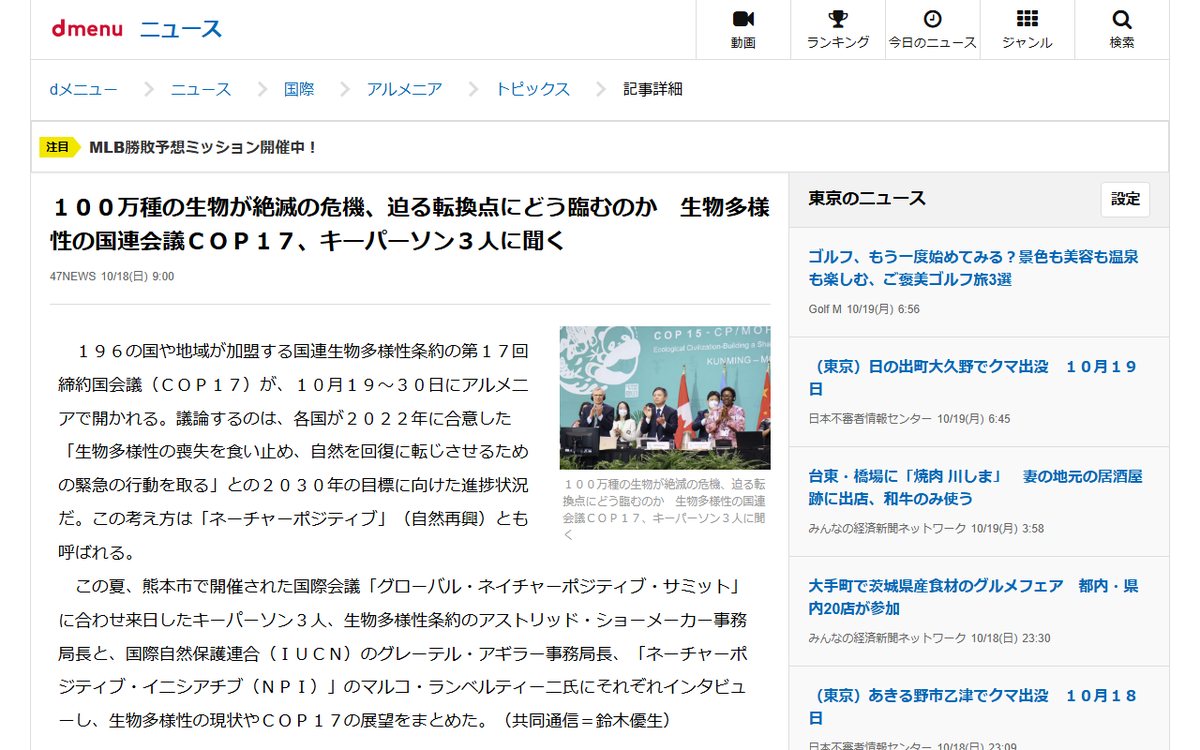
COP17 of the Convention on Biological Diversity will be held in Armenia from October 19 to 30. The main topic is progress toward the goal agreed by countries in 2022: to halt biodiversity loss and put nature on a path to recovery by 2030.
The article compiles interviews with the Executive Secretary of the Convention, the Director General of the International Union for Conservation of Nature (IUCN), and a representative of the Nature Positive Initiative, who visited Japan for an international conference this summer. They discuss how about one million species are said to be at risk of extinction and how the decline of pollinating insects affects food production.
As solutions, the interviewees point to a shift to a circular economy and regenerative agriculture, nature-conscious decisions by companies and financial institutions, and the importance of consumers choosing products with their environmental impact in mind.
Key points
- It is pointed out that spending on activities that harm nature far exceeds spending on activities that restore it
- Progress varies by target and region, and efforts need to be accelerated
- The article also touches on actions individuals can take, such as in shopping, eating and water use
Why this news deserves attention
Biodiversity is described not only as an environmental issue but as one tied to food, the economy and security. This is a good entry point for grasping the big picture before the conference opens.
The article also notes that a wide range of actors, including NGOs, research institutions and companies, are now involved, which is useful when thinking about the role of civil society.
Editor's comment
Coverage of COP17 is likely to increase over the next two weeks. Let's use it, together with the outcome, as a chance to rethink our everyday actions.
We will continue to introduce the work of related NGOs. Please read the article and look for what you can do yourself.