
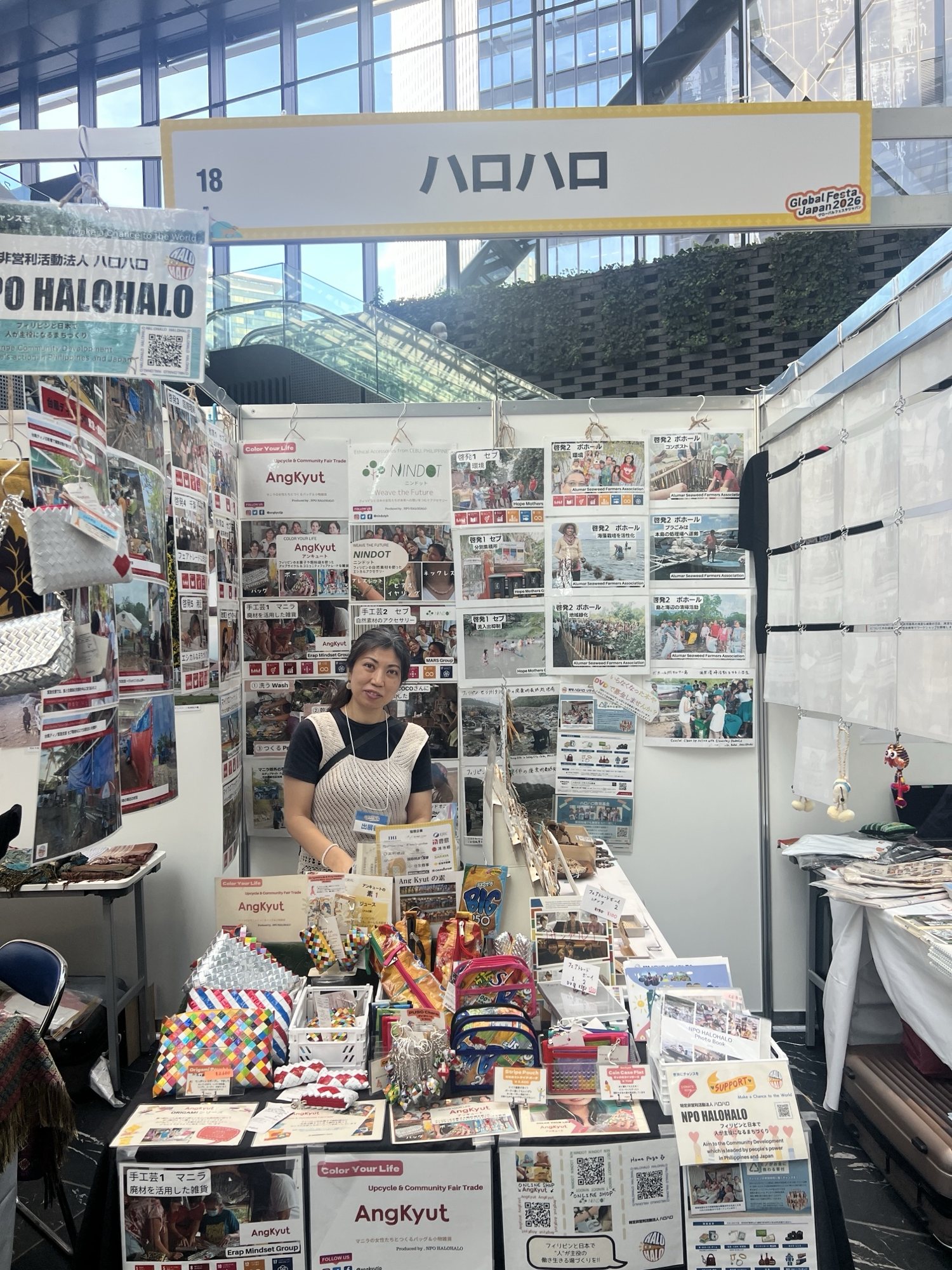
The Philippines, in Southeast Asia, is made up of more than 7,000 islands. Like Japan, it is hit often by typhoons and earthquakes. One organization there supports people’s steps toward self-reliance, staying close to what local residents say they want to do: NPO HALOHALO, a certified nonprofit.
As climate change makes natural disasters larger than ever, what challenges do local communities face, and how are they trying to overcome them? At Global Festa Japan 2026, held on October 17 and 18, we spoke with Ms. Haruka Naruse of the HALOHALO secretariat.
A companion that helps local people achieve what they want to do
HALOHALO works mainly in three areas of the Philippines: Cebu, Manila and Bohol. At the core of its work is not one-way aid but respect for local people’s own initiative.
“In the Philippines and Japan, we carry out activities that make real what local people have begun to say they want to do.”
So says Ms. Naruse. Residents notice local problems themselves and start moving toward solutions. HALOHALO plays the role of companion, supporting that first step and guiding it to reality.
The harsh reality brought by climate change
A serious problem on the ground now is the intensifying of natural disasters because of climate change. Typhoon damage in particular threatens people’s lives at their foundations. As a recent major challenge, Ms. Naruse named the typhoon of November 2025.
“In November 2025 an enormous typhoon, Typhoon Tino, hit, and 500 households were swept away, whole villages. That was a big thing.”
The scale of disasters has changed because of climate change, and villages are swept away entirely. In the recovery phase, rebuilding local communities is urgent.
The circle of “self-reliance” that widens beyond hardship
Japan, the Philippines, and the different regions within the Philippines: the distance between them brings its own difficulties.
“It’s daily coordination. Working with people across countries, not only within Japan, keeping in contact and getting accurate information, and not always being able to exchange information in a timely way, or misunderstandings with accurate information happening: those are things I worry about.”
Overcoming differences in language, culture and communications, and continuing to communicate accurately, is an everlasting challenge in international cooperation. Even so, there was a source of great joy in those difficult days: a citizens’ initiative started by local people took shape and bore fruit.
“Citizen groups started by local people have been registered as NGOs in the Philippines, both in Cebu and in Bohol, and the number of partner organizations is growing. I’m really happy about that.”
People who were once on the receiving end have set up their own organizations and been recognized by the state as formal NGOs. It is proof that they have begun to walk the road to real self-reliance, and a moment when HALOHALO’s accompanying support produced a major result.
What we can do: social media “likes” and recycle fundraising
What can we in Japan do about events in the faraway Philippines? Ms. Naruse told us about easy actions for everyday life.
“Just following us on social media and pressing ‘like’ makes us really happy. Seeing it first of all shows interest, and if people look at our posts and think, ‘Oh, that’s happening in the Philippines,’ or ‘there are efforts like this,’ that alone makes us very happy.”
HALOHALO also offers a way to take part easily from Japan: “Recycle Fundraising.”
“It helps us a lot. We run ‘Recycle Fundraising’ only within Japan, and with five items or more, a courier comes to your home free of shipping charges. We use the money from selling them for our activities, so we would be very happy if you could help.”
According to the flyer handed out at the booth, with Recycle Fundraising you offer books you have finished reading, DVDs, gift vouchers, precious metals, brand-name goods, hobby goods and the like, and the appraised value is donated to HALOHALO. Kishapon Recycle Fundraising (run by Sagano Co., Ltd.) handles everything from receiving the application to appraisal, reporting and remittance. There are three steps:
1. Pack and apply (free shipping from five items; a courier comes to pick them up with a slip)
2. Appraisal and conversion to cash
3. Donation (made to HALOHALO with your name attached)
For each participation, Kishapon also donates 100 yen. Donations go to efforts in which people in the Philippines improve their own livelihoods through handicrafts, microfinance, education and the environment.
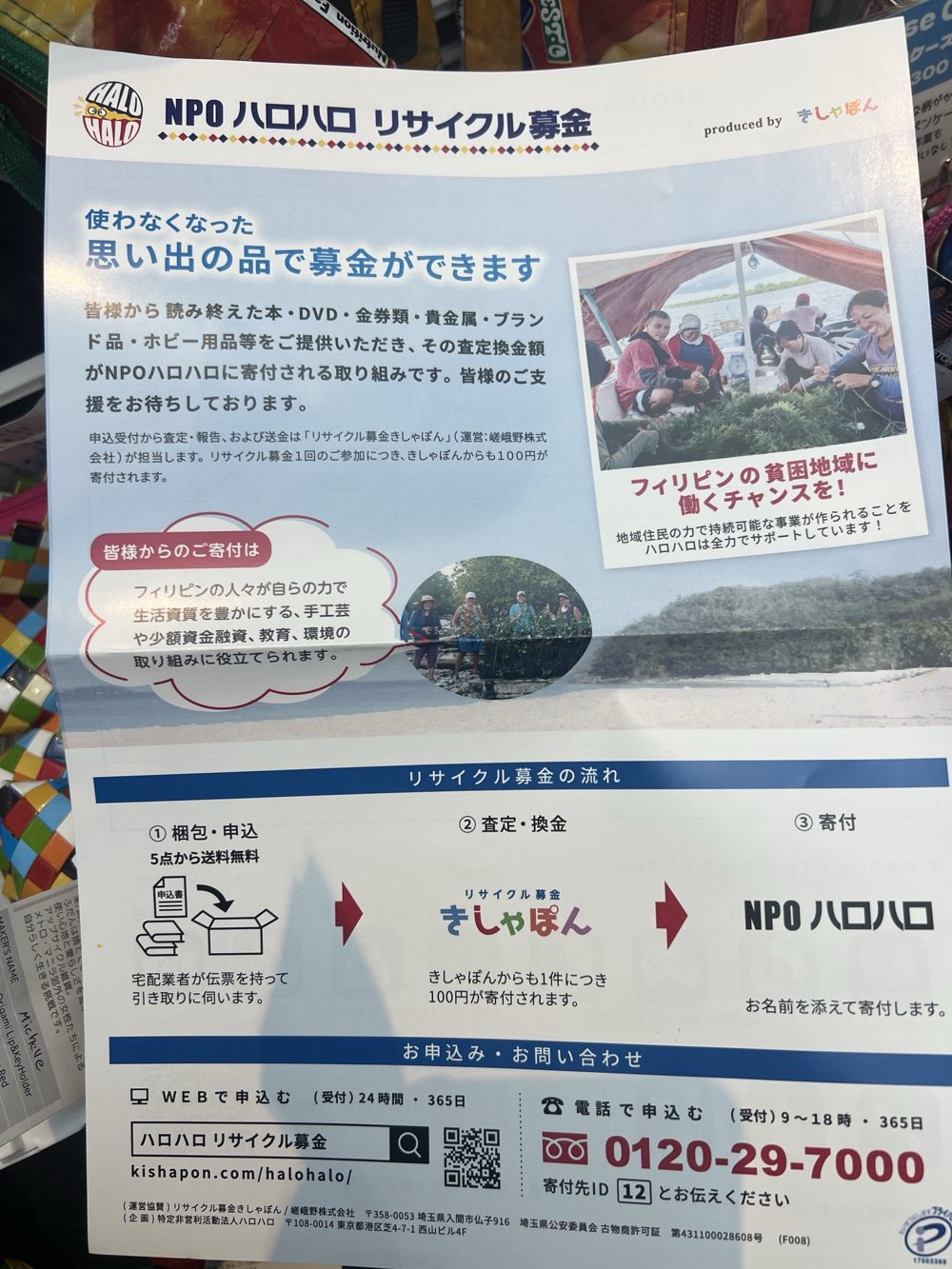
You can apply 24 hours a day on the web page. Search for “HALOHALO Recycle Fundraising,” or see the Kishapon Recycle Fundraising page for HALOHALO.
Facing the global challenge of climate change, people in the Philippines have begun to stand up on their own feet. Why not cheer on their strong progress from Japan, by sharing on social media and by recycling the books you have finished?
About the organization: NPO HALOHALO
You can read an overview of HALOHALO in our NGO profile.
Read the NGO profile of HALOHALO → / Official website: https://www.npohalohalo.org/
Interview information
Interview: NGO network Japan editorial team / Event: Global Festa Japan 2026 (booth no. 18) / Dates: October 17–18, 2026