
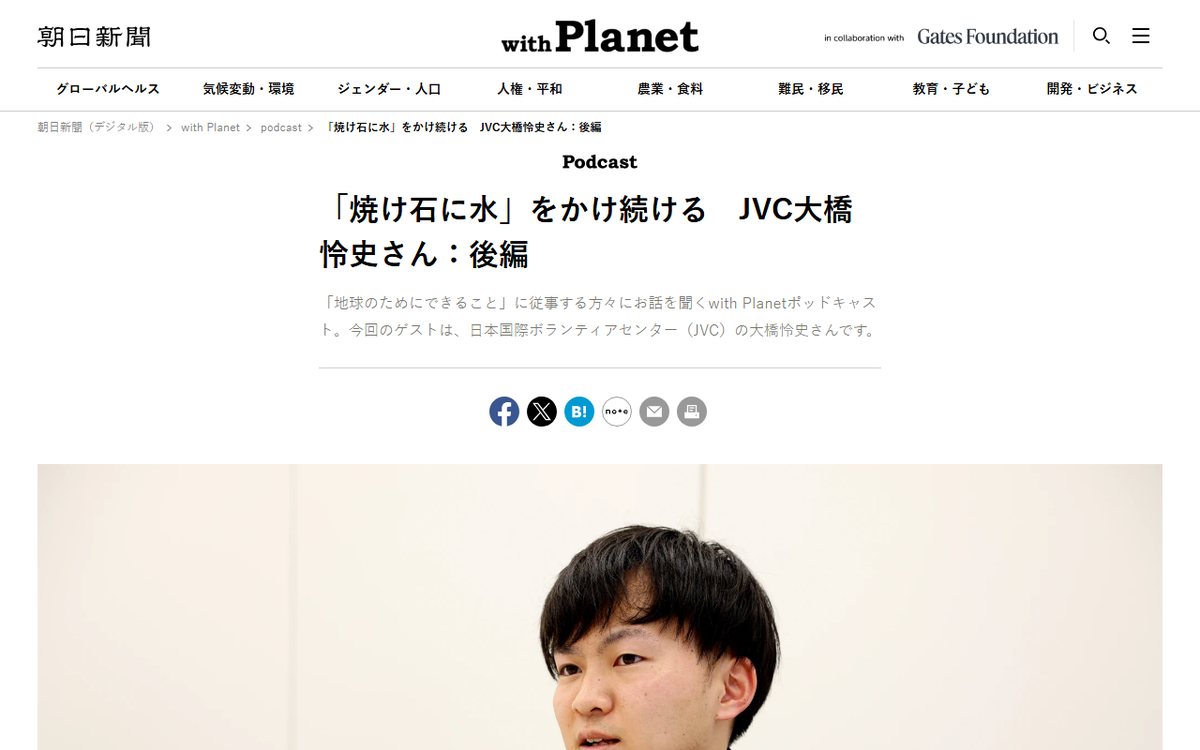
"Working on Earth!" is a podcast by The Asahi Shimbun's with Planet that invites people working in the field, including NGO staff, as guests. The second half of the episode featuring Mr. Ohashi of the Japan International Volunteer Center (JVC) has also been published as an article. While at university, Mr. Ohashi visited Paraguay in South America, and after graduating he worked as NGO staff on a women's empowerment project there. He joined JVC in March 2025 and is in charge of projects in Sudan, Yemen and other countries.
In Part 2, he shares how language skills helped him in the field. In Paraguay, local people asked him for help, so he held a workshop in Spanish on how to use a design tool, and one participant went on to take orders for making flyers. Because Arabic varies greatly by country and region, he uses it for greetings and for asking questions of people who speak only the local language.
In JVC's education support in Sudan and Yemen, new problems keep arising even as others are solved. In March this year, three staff members of a local partner organization that runs a "children's space" in a refugee camp in Yemen visited Japan for the first time, and about 70 people attended an event in Tokyo introducing Yemen's culture and current situation. At the same time, the Yemen project struggles to attract support, and JVC is calling for monthly donations.
Key points
- In Paraguay, a Spanish-language workshop led to new work for a local participant
- Three staff members of a local partner running a "children's space" in a Yemeni refugee camp visited Japan, and about 70 people attended the Tokyo event
- JVC is calling for monthly donations to sustain its Yemen project, which struggles to attract support
Why This News Deserves Attention
Sudan and Yemen are not regions that receive much media coverage in Japan. Here, a staff member in charge of projects there describes in his own words what the field is like and why he keeps working, offering a chance to feel closer to support for distant regions.
His view also stands out: even if efforts cannot keep up with the speed at which problems arise, it matters to keep doing what you can when you can and to share it with as many people as possible. The idea that international cooperation is not a one-way street and will eventually come back to us is a useful perspective for anyone hoping to get involved.
Staff comments

Minato AobaResearch
“The story that struck me most was the Spanish-language workshop in Paraguay that led one participant to start taking orders for flyers. It made me realize that language skills can become a force that changes someone's livelihood, even a little.”

Sophie HiroseWriting and translation
“The workshop story Aoba mentioned stayed with me too. Language is a tool for communicating, but it is also a doorway to standing in the same place as the other person. I sense the same spirit in his greeting people in Yemen in their own words.”

Mako JozenjiProofreading and verification
“I agree with you both about the power of words. The idea of continuing to do what you can when you can, even if you can't keep up with how fast problems arise, felt freeing to me. I'd like to start by bringing my own small bit of interest to the table.”
Editor-in-Chief’s comment
Ren DateEditor-in-Chief
“The scene of welcoming the Yemeni partner staff at Narita Airport with both countries' flags, after their journey of more than 30 hours, conveyed the warmth of the bond with people on the ground.
Support for regions where help is hard to gather is built from the small interest of each individual. Why not listen to the full podcast episode and start by learning about Yemen and Sudan?”