
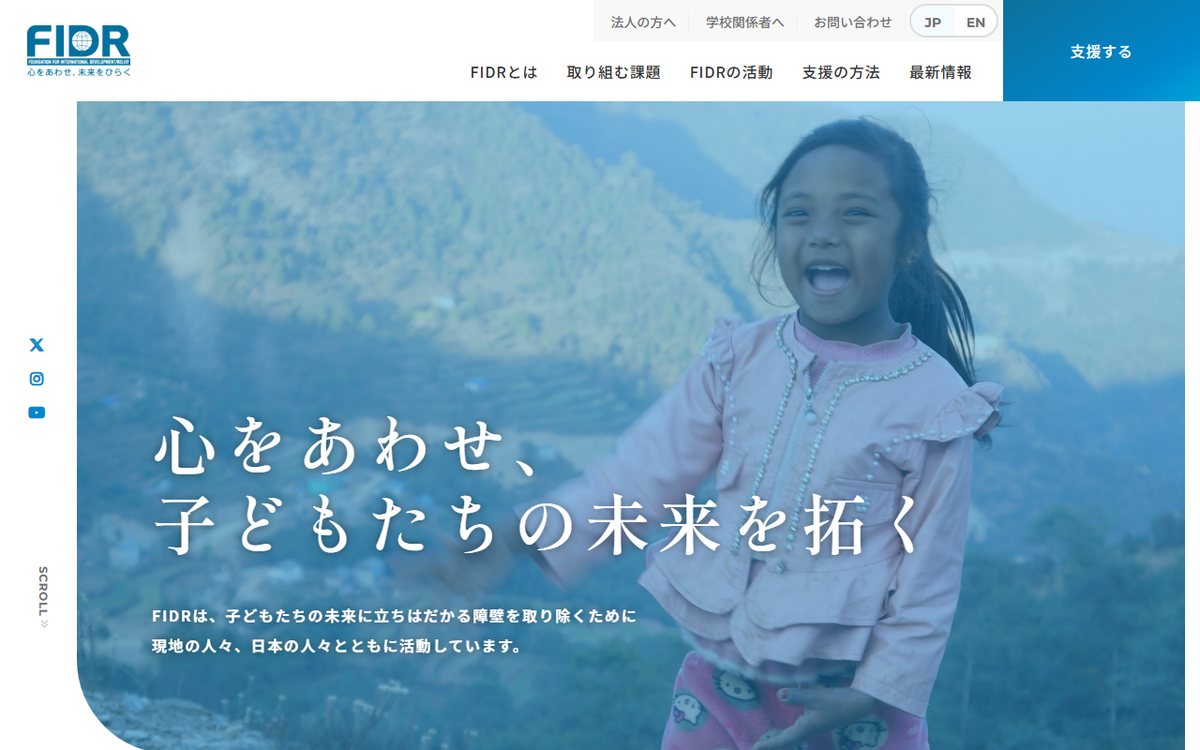
FIDR is an international cooperation NGO born in April 1990 with the aim of improving the lives and welfare of children in developing countries. Its official name is the Foundation for International Development/Relief, and it is known by the nickname formed from its initials. It started as a foundation under the jurisdiction of the Ministry of Foreign Affairs and later became a public interest incorporated foundation.
Its work is centered on Cambodia, Vietnam and Nepal. As economic development advances but gaps between regions widen, it supports children who struggle with access to safe drinking water, nearby medical care and schools from a broad range of angles: health and hygiene, medical care, nutrition, agriculture, education and industrial development. Its policy is to value local ownership and to make the most of local people, knowledge and experience.
It also provides emergency relief to victims of natural disasters overseas and in Japan, and in Japan it spreads understanding of its work through development education, events and report meetings, visiting seminars and video production. It is reported to have 2,421 individual supporting members and 312 corporate supporting members (as of February 2026).
Key points
- International cooperation that supports children's lives from several fields in Cambodia, Vietnam and Nepal
- An approach that respects the initiative of local people and makes use of local talent and knowledge
- Many ways to take part from Japan, including donations, supporting membership, volunteering and in-kind gifts
Why this organization deserves attention
It has worked in Asian countries for more than 30 years and is reported to have built up efforts tailored to local issues, such as creating a hospital meal system, producing a nutrition textbook and building disaster-resilient schools. Its distinguishing feature is that it faces overlapping issues on the ground from several fields at once.
Supporting local people to notice, decide and act for themselves lies at the core of its work. From Japan, people can choose how to be involved, through donations, supporting membership or volunteering, which makes it easy to take part.
Editor's comment
There are still children in the world to whom everyday things like water, medical care and the chance to learn do not reach. FIDR's work feels like a long-term effort to change that daily reality together with local people.
The official website also introduces its latest activities, events and report meetings. Why not take a look?