
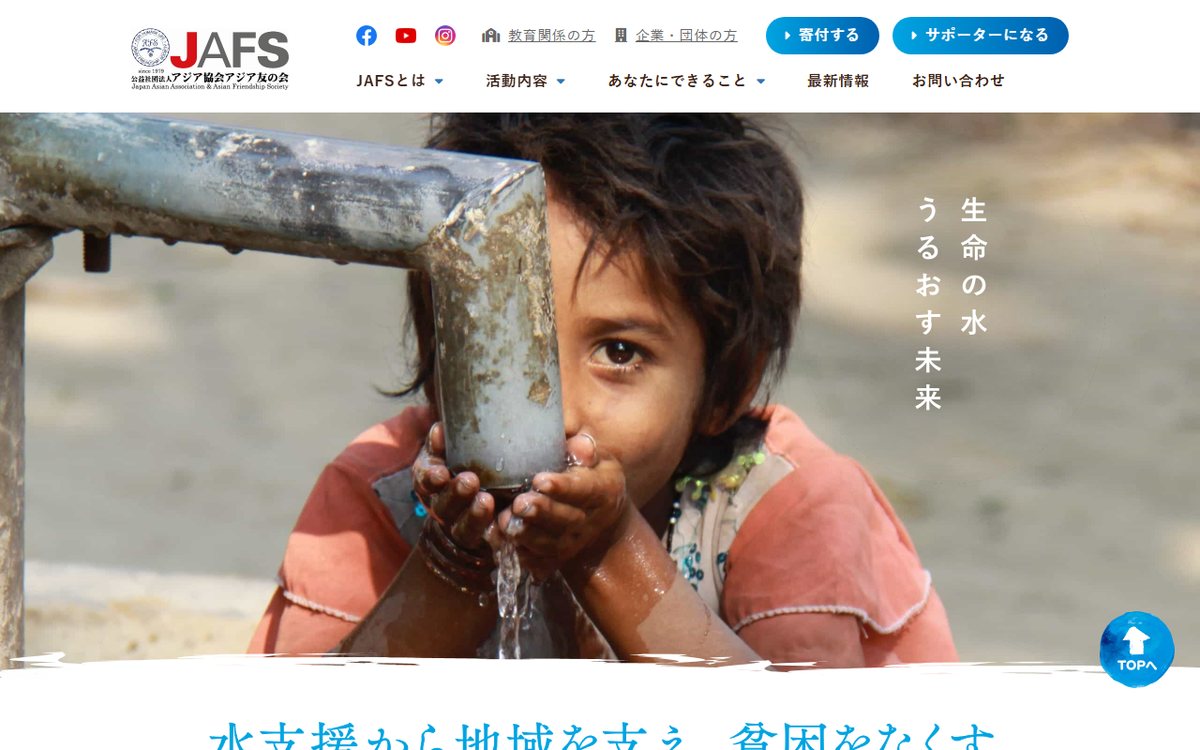
The Japan Asia Friendship Society (JAFS) is an international cooperation NGO founded in Osaka in 1979. Its predecessor was a group formed in 1972 by friends interested in volunteering in Asia, which began its work under the banner of the "campaign to give wells to India." In 1980, together with a local organization, it completed its first well in a village in Nagpur, Maharashtra, India.
It then expanded its work to Indonesia, Bangladesh, Thailand, Nepal and other countries, and now has local partner organizations in 70 areas across 18 countries. Rather than delivering aid one-sidedly from Japan, JAFS values an approach in which local organizations take on problems with residents at the center, and JAFS supports them.
Water is the pillar of its work. According to the organization's own tally, as of March 2026 it had built 2,429 wells and installed 2,595 toilets. It also works on education sponsorship (1,582 children supported), school construction, tree planting (about 2.62 million trees), livelihood improvement and emergency relief in disasters. In Japan, it creates opportunities for citizens to connect with Asia through study tours, work camps, guest lectures and the "Asia Citizens' University."
Key points
- An approach that starts from "safe water" and expands support into education, livelihoods and the environment
- A network of Asian citizens built with local partner organizations in 70 areas of 18 countries
- Many ways for citizens in Japan to take part, including study tours, local chapters and the Asia Citizens' University
Why this organization's work stands out
JAFS has set a goal for 2030 of supplying at least 15 liters of water per person per day in poor areas of Asia, promoting stable livelihoods and self-reliance. Its view of water as the starting point for improving life as a whole is easy to grasp, and makes the meaning of its support easy to feel.
Having built relationships with local organizations for more than 40 years, it has also held the "Asia International Network Seminar" since 1990, where partners from each country discuss common issues. Recently it has also worked on support for survivors of the Kumamoto earthquake and emergency fundraising for disasters in Nepal and Bangladesh, which shows well how the organization connects the power of citizens at home and abroad.
Editor's comment
The "campaign to give wells to India," begun by a 20-year-old, has grown over more than 40 years into a network of friends in 18 Asian countries, and that journey shows the strength of citizen action. Behind the figure of 2,429 wells are changes in daily life in each village, which warms the heart.
Another appeal is the many ways to get involved: as a supporter or sponsor, through local chapters, study tours and events. If you would like to build face-to-face relationships with people in Asia, please take a look at the official website.