
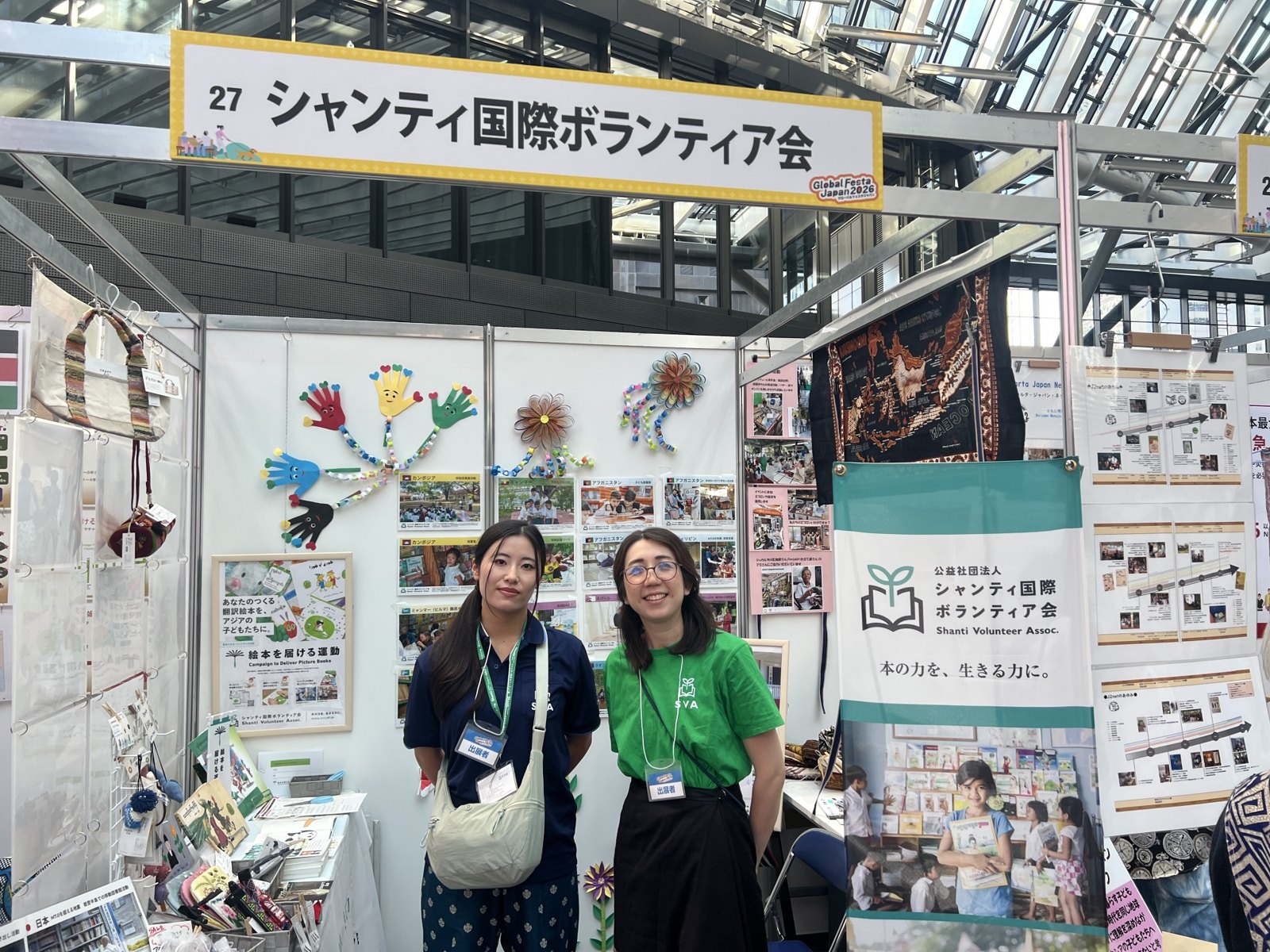
There are children whose schools come under attack and who are denied the chance to learn. At Global Festa Japan 2026, held on October 17 and 18, the NGO network Japan editorial team interviewed the Shanti Volunteer Association (SVA), a public interest incorporated association.
SVA carries out education support centered on library activities, along with emergency humanitarian aid, across Asia. We spoke with Ms. Marina Mizuki, who handles overseas emergency humanitarian aid in its Emergency Humanitarian Assistance Section, about how a single picture book becomes hope for children amid political upheaval and poverty.
Conflict and inequality: the crises facing children in Asia
SVA is an NGO that works mainly in Asia, providing education support centered on library activities and emergency humanitarian aid. In the regions where it works, serious situations threaten children’s lives and futures.
“We work in countries like Myanmar and Afghanistan, where political upheaval has caused food crises, children cannot get an education, schools become targets of bombing, and children’s lives are in disarray, and in countries like Cambodia, Laos and Nepal, where the gap between cities and rural areas is widening and children in the countryside cannot get enough education.”
Cycles of violence and poverty born of political instability continue to take learning opportunities away from children.
The difficulty of building trust and delivering aid
Working in a foreign land, especially one in turmoil, is never easy. Ms. Mizuki described the biggest hurdle to delivering aid:
“First we build trust with the community, follow administrative procedures and obtain permission for our activities from the authorities. That too can take time.”
Only through steady effort to respect local rules and build relationships with communities over time can aid take shape.
Tracing with a finger, reading aloud: the “hope for tomorrow” a picture book brings
Aid delivered through many hardships bears real fruit in the children themselves. Asked about a recent happy result, she shared an episode from around a camp for displaced people from Myanmar.
“When I see children reading picture books aloud, tracing the words with their fingers, or hear people say that it connects to hope for tomorrow, I feel it is very worthwhile. When parents and children come to the library together, that is very rewarding too.”
Even in the hardship of displacement, the moment a child opens a picture book brings back a child’s smile and lets their imagination grow toward the future. Libraries and picture books work as “support for the heart,” beyond simply learning to read.
What we can do in Japan: know, tell, take part
The situation in Myanmar remains severe, but it is rarely covered by Japanese media. What can we in Japan do for them?
“First, I would like people to learn about the countries where we work, and talk about them and tell as many people as possible. I think that is where to start.”
She also named a concrete action: the “Campaign to Deliver Picture Books,” a volunteer program in which translated stickers in the local language are attached to Japanese picture books before they are sent to children.
“So that people feel Myanmar is close to them, please tell others. And if you are interested, we run the Campaign to Deliver Picture Books for the picture books used in our library activities in Myanmar, and you can apply through our website. I hope you will take part.”
See events in distant countries as your own concern and tell those around you, then take part in making a picture book. That small step becomes a light that crosses borders and brightens children’s futures.
About the organization: Shanti Volunteer Association (SVA)
You can read an overview of SVA in our NGO profile.
Read the NGO profile of SVA → / Official website: https://sva.or.jp/
Interview information
Interview: NGO network Japan editorial team / Event: Global Festa Japan 2026 (booth no. 27) / Dates: October 17–18, 2026