
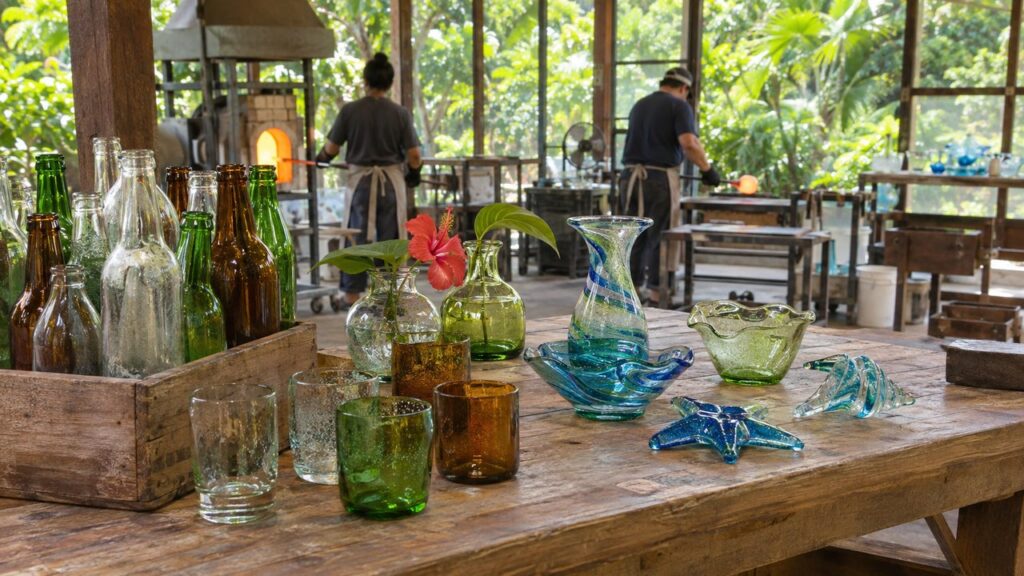

About 3,000 km south of Japan, a glass craft brand led by a Japanese man, "Belau Eco Glass," is popular in Palau. Using discarded glass bottles as raw material has struck a chord with tourists who care about environmental issues, and in just over a decade it became one of Palau's signature products.
It was started by Katsuo Fuji, who had worked in recycling in Japan. Dispatched in 2004 as a JICA senior volunteer, he stayed on as a consultant to the state government after his term ended. He recalls that Palau had no concept of recycling at the time. Around 2015 he launched the brand together with the government tourism bureau.
Artisans at the workshop make souvenirs with ocean motifs such as manta rays and coral, ranging from small items costing tens of dollars to pieces of over a thousand. JICA continues to support the project by sending instructors from Japan; glass artist Kyoko Hirako stayed there in August–September 2026.
Waste disposal is a shared concern for small island nations. The example drew attention, and many dignitaries visited the workshop in August–September, when the Pacific Islands Forum (PIF) leaders' meeting was held. Mr. Fuji says the quality has clearly improved.
Key points
- From waste bottles to a signature Palauan product in just over ten years
- A former JICA volunteer stayed on after his term to keep the effort going
- JICA sends artisans from Japan to support technical training
Why this news deserves attention
It is a notable example of tackling waste and building a local industry at the same time. Protecting the environment translates directly into tourism and jobs.
Mr. Fuji's long commitment to a place he first came to as a volunteer shows one form that international cooperation can take. Steady quality improvements, and recognition as true craftwork, are encouraging.
Staff comments
Minato AobaResearch
“I find it fascinating that in a place with no concept of recycling, discarded bottles became a signature product. Becoming one of the island's emblems in just over ten years shows the power of steady effort.”

Sophie HiroseWriting and translation
“I agree with Aoba-san about steady effort. Because Mr. Fuji stayed on after his term, trust with the artisans could grow, and his words about improved quality carry weight.”

Mako JozenjiProofreading and verification
“Hearing both of you, I love how protecting the environment links to industry and pride. Seeing waste reborn as works inspired by the sea must delight islanders and visitors alike.”
Editor-in-Chief’s comment
Ren DateEditor-in-Chief
“I am moved by Mr. Fuji's perseverance in staying on after his term and rooting the very idea of recycling there. It is lovely to see a small workshop's ingenuity become a source of pride for an island.
International cooperation does not always bring quick results. Please keep in mind that some efforts grow over time.”