
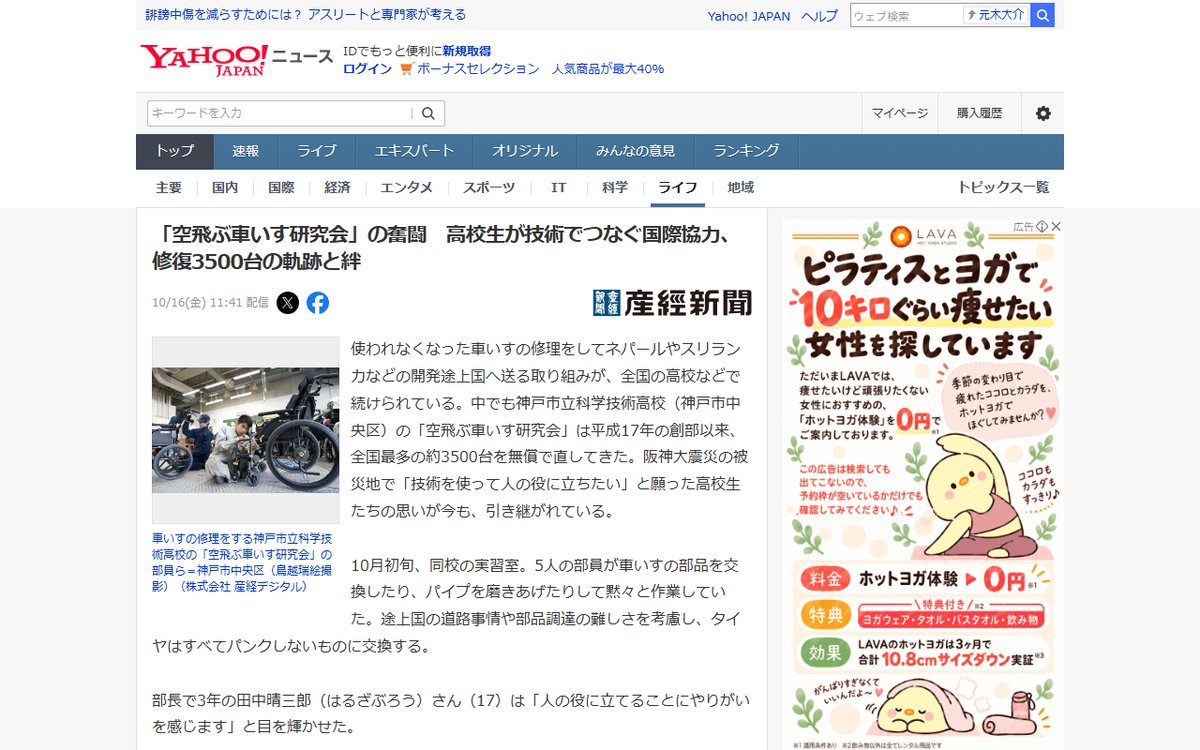
Across Japan, high schools and other groups are repairing unused wheelchairs and sending them to developing countries. Among them, the Flying Wheelchair club at Kobe City Science and Technology High School has repaired about 3,500 wheelchairs free of charge since it was founded, the most in the country.
In early October, five club members were quietly at work in the school's workshop, replacing parts and polishing pipes. With road conditions and the difficulty of obtaining parts in developing countries in mind, they replace every tire with a puncture-proof one. The club's third-year president said he finds it rewarding to be able to help others.
The activity has its roots in the Great Hanshin-Awaji Earthquake. While volunteering to sort relief supplies, students of the former Kobe Technical High School began to wonder whether they could also help using their technical skills. After learning of a newspaper article about high school students in Tochigi who repaired wheelchairs and sent them overseas, they found that parts could be taken from other wheelchairs and that sending them abroad would avoid friction with local businesses.
Repairing wheelchairs and delivering them overseas is a nationwide volunteer effort that began in 1999. Because the wheelchairs are flown, it is called "Flying Wheelchair." Led by the Japan Social Welfare Association (Nihon Shakai Fukushi Kojikai), high schools and social welfare councils across Japan do the repairs, and travelers heading to developing countries carry them as checked luggage. More than 12,000 wheelchairs have been delivered so far.
Key points
- High school students use their technical skills to repair wheelchairs
- A volunteer relay in which travelers carry the wheelchairs as luggage
- Experience from the Great Hanshin-Awaji Earthquake was the starting point
Why this news deserves attention
International cooperation often brings to mind large organizations, but here repairs made in a school workshop support someone's mobility in a distant country. Many hands are connected: those who repair, the travelers who carry, and those who receive.
It is a useful example of how people can take part in international cooperation with the skills they have, or simply while traveling.
Editor's comment
I was moved that feelings born from the earthquake have been passed down to younger students more than 20 years later.
There may be a way for you, too, to help someone by using what you do best. Why not look for it?