
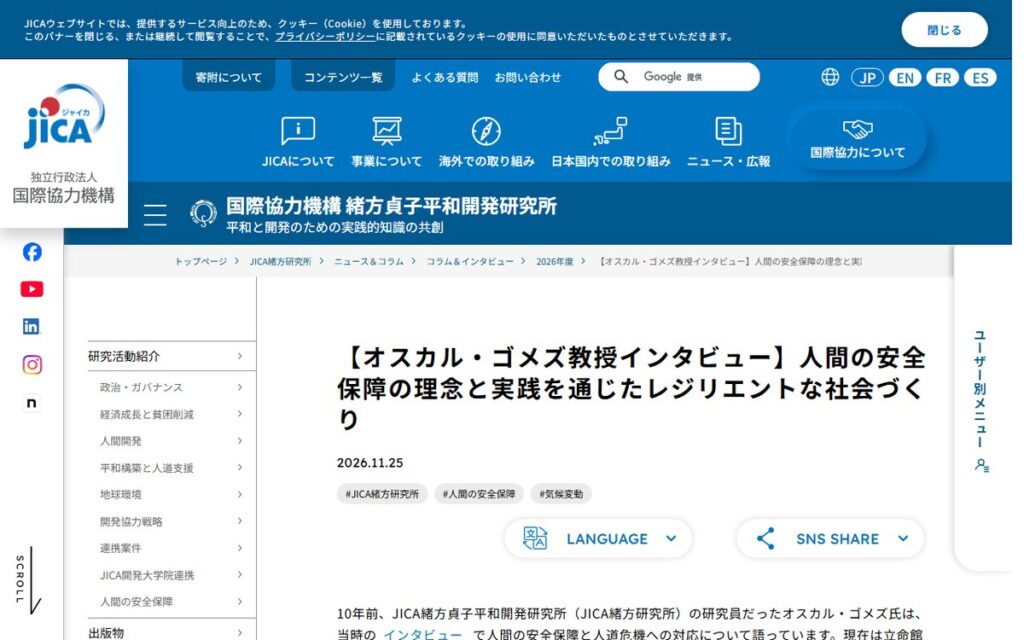
Professor Gomez once served as a researcher at the JICA Ogata Research Institute and now studies human security, international cooperation, and disaster and crisis management. In this interview, ten years on, he speaks about lessons drawn from disasters during that period.
He names the COVID-19 pandemic as the most significant disaster of the decade. He points out that migrants tend to be blamed in a crisis, that societies forget crises with surprising ease once they end, and that fair access to vaccines remains a challenge. He also says that responding effectively requires not wealth but knowledge, capable public institutions, effective communication and citizens willing to cooperate.
On climate change, he says efforts must continue, but we must also think about how to protect people living now. He stresses not overlooking the accumulation of small disasters as well as large ones, and notes that even when climate change is identified as a cause, communities cannot respond without the expertise to assess risks.
He says local actors are the most important in protecting people, and that individuals, families, communities and governments each have different roles. He also says that in human security, the idea that "humanity has no outside" is important.
Key points
- The importance of recording experiences after a crisis and sharing them across society
- Balancing climate action with protecting people from disasters happening now
- Societies become resilient only when local actors can fulfill their roles
Why this news deserves attention
International cooperation often brings to mind support for other countries, but this interview conveys the meaning of countries learning from each other how to build societies resilient to disasters. The perspective of local ownership is also useful when thinking about the work of NGOs and citizens.
The reflections on COVID-19 are close to our own lives. The point about not forgetting and keeping records may give many people involved in disaster preparedness something to think about.
Staff comments

Minato AobaResearch
“The remark that societies forget a crisis once it is over made me stop and think. Building ways to record and share experience seems needed not only for disaster response but also in NGO work.”

Sophie HiroseWriting and translation
“I agree with Aoba's point about recording and sharing. For me, the talk of looking at the accumulation of small disasters, not only climate change, offers a clue for thinking about everyday preparedness.”

Mako JozenjiProofreading and verification
“I nod along with both of your points. The phrase "humanity has no outside" is gentle yet strong, and I feel that never treating anyone as distant is where international cooperation begins.”
Editor-in-Chief’s comment
Ren DateEditor-in-Chief
“The phrase "humanity has no outside" stayed with me. A view that goes beyond countries and positions in asking how to support people in need also connects to the work of NGOs.
The full interview can be read on the JICA Ogata Research Institute page. Why not take some time to think carefully about preparing for disasters and crises?”