
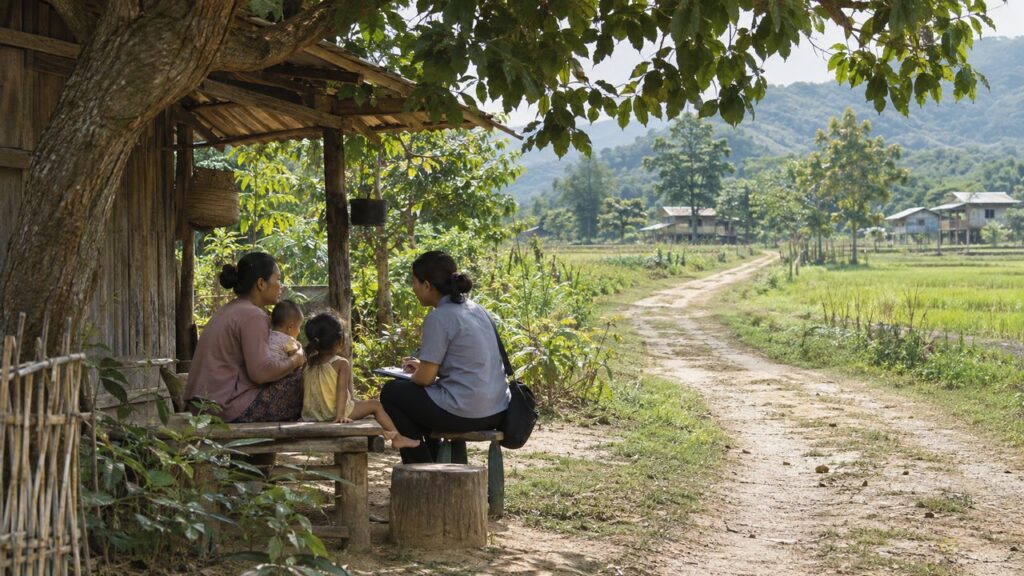
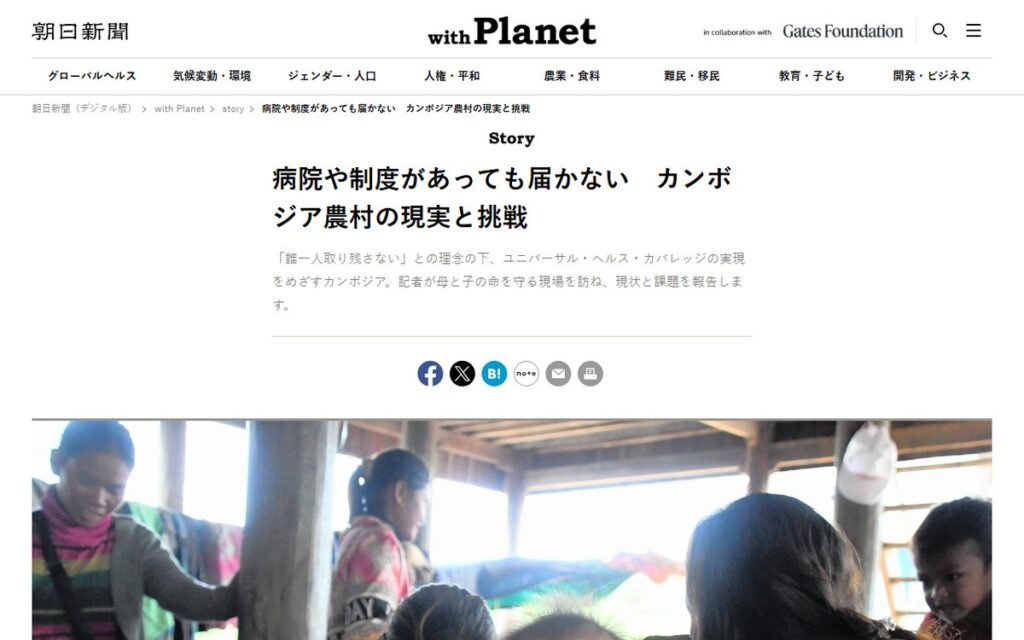
Under the pledge to leave no one behind, Cambodia is working toward Universal Health Coverage (UHC), so that everyone can get the care they need at an affordable cost. In August 2026, a reporter visited Preah Vihear Province in the north to see how mothers and children are being protected.
In the province, one in four children under five is said to be chronically malnourished. SHARE, a Japanese NGO that has worked on maternal and child health in Cambodia for nearly 40 years, has been active there since 2017. At infant health checkups it measures height, weight and arm circumference to check nutrition, and teaches how to prepare weaning foods and snacks suited to each stage of growth. At one village checkup, 50 of the 71 children under five took part, and children found to be malnourished were referred to the health center.
The maternal mortality ratio fell sharply from 476 per 100,000 births in 2000 to 137 in 2023, but it is still about 46 times Japan's. Poor roads in the rainy season, ambulance fees, out-of-pocket medical costs and the gap between urban and rural care all make services hard to reach even where facilities exist. About 41% of the population is covered by public health protection, and the government aims to raise that to 80% by 2035.
SHARE holds infant health checkups four times a year, two of them funded by the budget of the local commune. Health center staff, local officials and community health volunteers take part, with the aim that the community will eventually run the checkups on its own.
Key points
- On the ground, even where hospitals and systems are in place, lives are not protected unless people's behavior and daily lives change
- A careful approach of working alongside local people to share how to prepare food and why checkups matter
- Support that encourages local initiative, so checkups can continue with local government budgets
Why this news deserves attention
International cooperation is often pictured as building facilities and systems, but this report highlights the distance between having them and having them actually used in daily life. Sharing nutrition knowledge, encouraging families to attend checkups and sustaining them with local budgets: these steady efforts are what support the lives of mothers and children.
It is also a useful way to understand why NGOs put down long roots in the communities where they work, and a helpful read for anyone interested in global health.
Staff comments

Minato AobaResearch
“What struck me is the distance between having systems and facilities and actually reaching people's daily lives. I also noticed the effort to keep the checkups going with local budgets.”

Sophie HiroseWriting and translation
“I agree with Aoba's point about that distance. Sharing a weaning-food recipe over a bowl of porridge feels like support that walks beside people rather than pressing advice on them.”
Mako JozenjiProofreading and verification
“Both of your points matter to me, the distance to reach people and the support that stays close to them. Aiming for a form that communities can sustain themselves gives hope, even for a country far away.”
Editor-in-Chief’s comment
Ren DateEditor-in-Chief
“Rural Cambodia may feel far away, but the problem of systems that exist yet do not reach people may sound familiar closer to home.
We hope this introduces you to NGOs that work patiently in the field. Please read the original article as well.”