
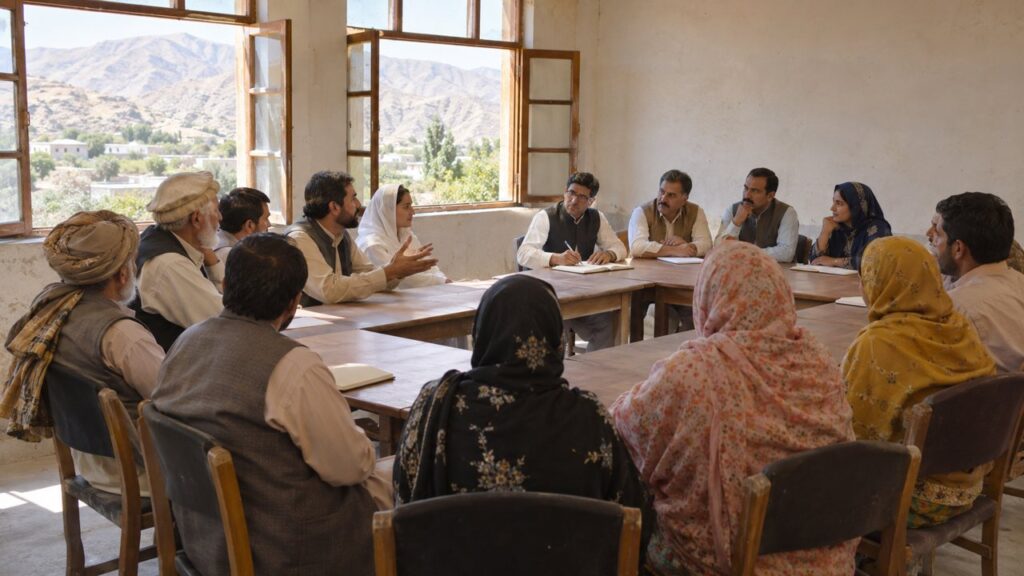
In the former Federally Administered Tribal Areas of northwest Pakistan, near the Afghan border, residents have long had limited opportunities to bring their views to the administration. Since the area was merged into the province in 2018, local government systems have been developed, and the first-ever local councils were established in 2022.
Since 2022, JICA has supported tehsil governments (local authorities comparable to Japanese municipalities) by strengthening the capacity of administrators and councillors so the new system takes root. About 800 local councillors were trained in the role of councils and the basics of local administration; around 20% of participants were women.
JICA also gave technical guidance on drafting medium-term development plans, drawing on Japan's experience, and carried out vocational training and awareness activities for women. Medium-term development plans reflecting residents' opinions were drawn up by each tehsil government for the first time, and resident-participatory administration is gradually taking hold. About 130 people, including provincial and tehsil government officials, attended the final seminar.
Key points
- About 800 local councillors trained, around 20% of them women
- Medium-term development plans reflecting residents' views drawn up for the first time in each tehsil
- Trust between residents and local government seen as a foundation for regional stability and peace
Why this news deserves attention
It shows a form of cooperation that goes beyond building roads and facilities to nurturing the very mechanisms through which residents' voices reach government.
At the seminar, a woman councillor said the methods learned benefit everyone in the community, including women and young people. It offers a hint for thinking about the link between participation and peacebuilding.
Staff comments

Minato AobaResearch
“I learned that in an area where residents long had few ways to voice their views to the government, the first-ever local councils were formed in 2022. It also struck me that about 20 percent of the roughly 800 trained members were women.”
Sophie HiroseWriting and translation
“I paid attention to the share of women that Aoba mentioned. A voice at the seminar said the methods learned benefit everyone, including women and young people, and I sense resident participation spreading.”
Mako JozenjiProofreading and verification
“Hearing your impressions, I felt that having a place where voices are heard is itself the foundation of peace. Imagining the joy of people who long struggled to speak up holding their own plan for the first time warms my heart.”
Editor-in-Chief’s comment
Ren DateEditor-in-Chief
“When we think of international cooperation, we tend to picture construction, but this news reminds us that supporting dialogue and planning matters too.
You can read the details on JICA's official page. Please take a look.”