
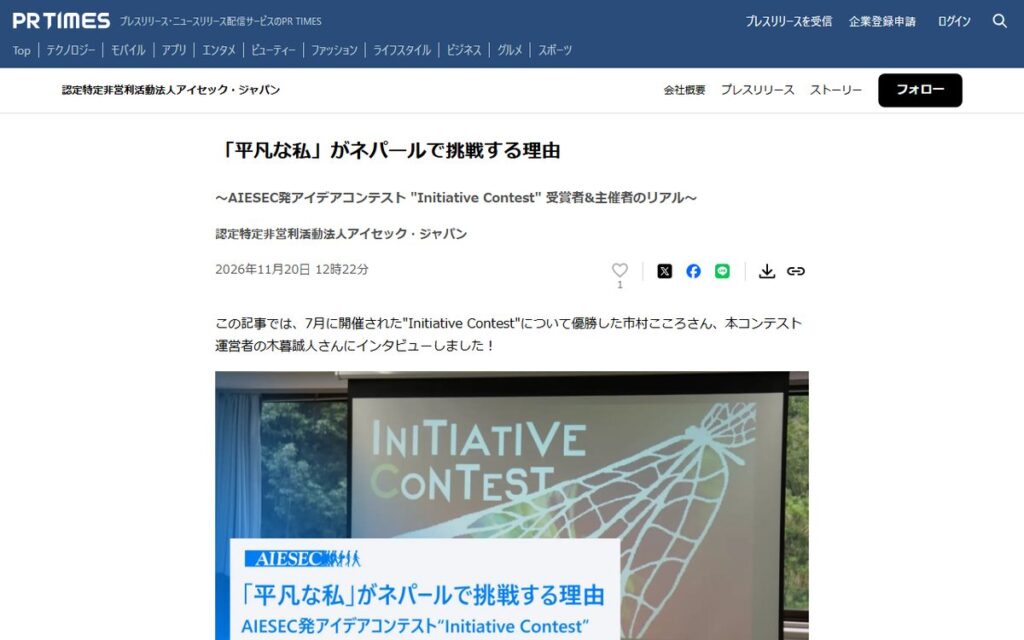
AIESEC Japan has published interviews with Kokoro Ichimura, the winner of the "Initiative Contest" held in July, and Makoto Kogure, who ran it. In the contest, members present ideas for solving problems they found overseas before a panel of judges.
Ichimura focused on the problem of corporal punishment and violence becoming habitual, and proposed using a card game as the solution. The winner receives a grant and will put the idea into practice in Nepal.
In the interview she recalls researching UNICEF in sixth grade and learning that some children cannot go to school, and says she keeps asking whether her ideas will be accepted by local people rather than serving her own ego. She also argues that student-led international cooperation need not bring returns to Japan, which leaves students more room to take on challenges.
Key points
- A contest where members take their own ideas to solve problems found overseas
- The winner gets a grant to try the idea on site
- A student's emphasis on whether local people will accept the idea
Why This News Deserves Attention
The contest does not end with a presentation; it connects to a chance to test the idea on site with a grant. It shows concretely how students can step into international cooperation.
It is also striking that the winner speaks of not working alone and of valuing local perspectives. The piece should be useful for students interested in international cooperation and for those who want to support them.
Staff comments

Minato AobaResearch
“I think the idea of changing corporal punishment and violence through a card game is gentle and lovely. A system where winning means a grant to go on site should encourage more people to try.”

Sophie HiroseWriting and translation
“I share Aoba's feeling about the card game. Even a heavy issue is easier to enter through play, and it could widen children's circles. Starting from whether local people will accept it is lovely too.”

Mako JozenjiProofreading and verification
“As you both say, it is appealing that a soft idea and respect for the local people go together. It is encouraging that students have a place to try without fearing failure, and I hope it brings smiles to children in Nepal.”
Editor-in-Chief’s comment
Ren DateEditor-in-Chief
“The phrase "ordinary me" may well nudge many readers to want to try something themselves. Taking a first step from a personal interest is a good model for entering international cooperation.
We will keep watching how the challenge in Nepal takes shape. Please read the original interview too.”