
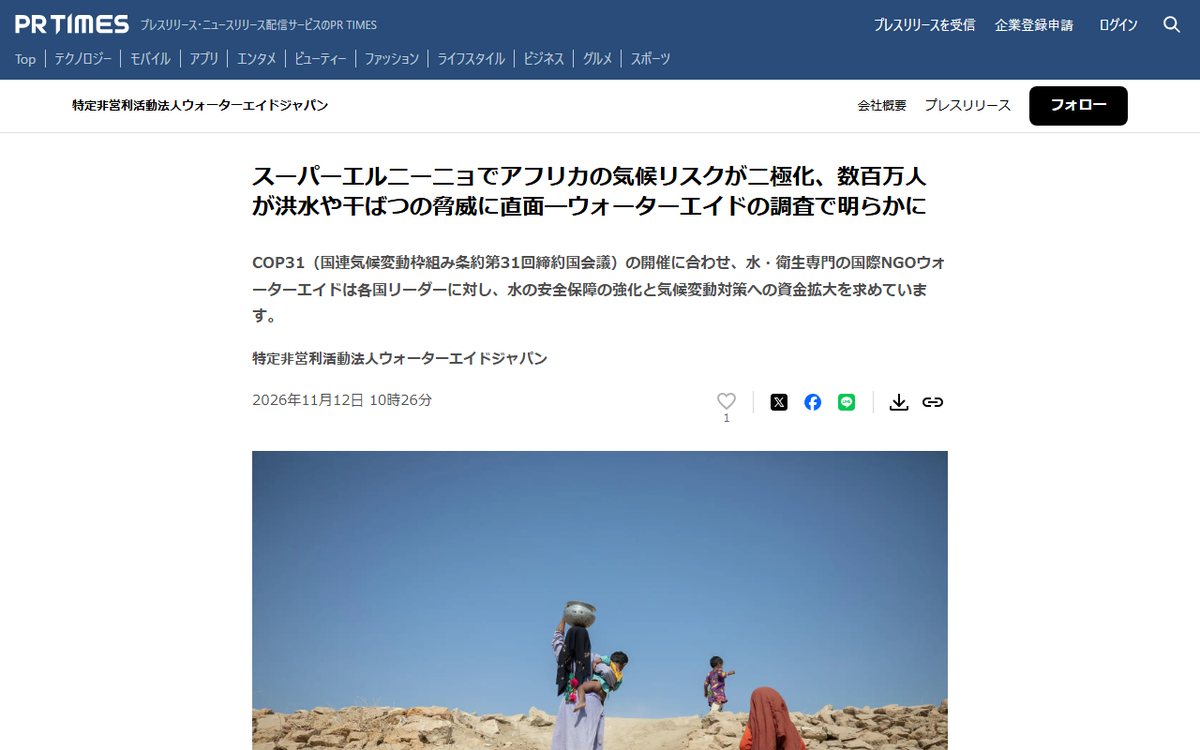
Timed with COP31, WaterAid has released an analysis of how a super El Niño could affect Africa's weather. It examined more than 40 years of rainfall data from 1982 to 2025, along with past El Niño events, for cities in East, West and Southern Africa.
The results show drying in many cities in Southern Africa, while East African cities such as Nairobi and Dar es Salaam showed sharply higher rainfall. In West Africa, unlike widely used forecast maps, drying stood out along the coast from Liberia to Nigeria, while parts of the Sahel are expected to see more rain.
Heavy rain raises the risk of flash floods, damage to water and sanitation facilities, contaminated drinking water and waterborne diseases such as cholera, while drought has long-lasting effects on water sources and agriculture. WaterAid is urging leaders to prioritize water security and funding for climate action, and is working with governments including Nigeria, Mozambique and Madagascar.
Key points
- More than 40 years of rainfall data used to analyze widening gaps between flood and drought regions
- In West Africa, drying stands out in areas different from those on widely used forecast maps
- Ahead of COP31, countries are urged to fund water security and climate action
Why This News Deserves Attention
The data show that climate change cannot be summed up as simply "less rain" or "more rain"; it appears differently in each region. Research by an NGO rooted in the field offers material for thinking concretely about what preparations are needed.
The report points out that those hit hardest are the most vulnerable people, who emit almost no greenhouse gases. It is a chance to connect a water and sanitation issue in distant regions with the discussions at COP31.
Staff comments

Minato AobaResearch
“What stayed with me was the analysis that even within Africa, drought regions and flood regions diverge. Decades of data quietly show that climate impacts cannot be lumped together.”

Sophie HiroseWriting and translation
“I agree with Aoba on the point that it differs by region. Because this is an NGO working on water and sanitation on the ground, it can read the climate through the lens of daily life.”

Mako JozenjiProofreading and verification
“Hearing both of you, I realized that the skies over distant Africa pose a question to the whole planet we share. When COP31 and the water story connect, the news feels a little closer to home.”
Editor-in-Chief’s comment
Ren DateEditor-in-Chief
“Water is the foundation of daily life, which is why preparing for both floods and droughts feels so important.
Along with news from COP31, please turn your attention to Africa's water and climate.”