
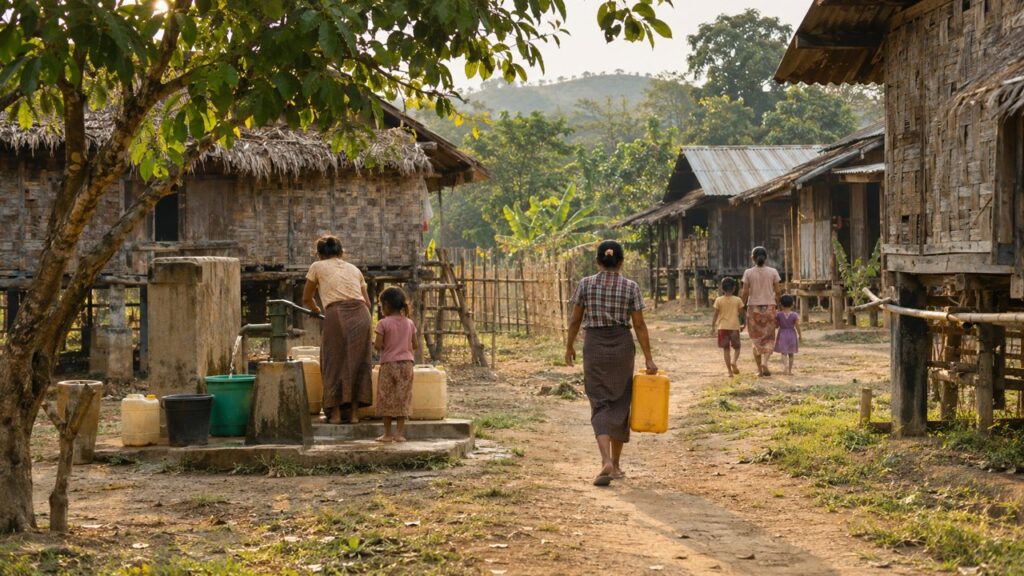
On October 8, the UN Development Programme (UNDP) released a report stating that 68% of Myanmar's population, more than 37 million people, are in multidimensional poverty or face the risk of falling into it. The prolonged civil conflict, economic turmoil and natural disasters are cited as compounding factors.
Multidimensional poverty goes beyond money, measuring health, education and living standards as a combined index. According to the report, about 17.9 million people (one third of the population) are in poverty, and about 19.5 million are at risk of falling into it.
Poverty is concentrated in the populous Ayeyarwady Region in the center, Sagaing Region in the north, and Mandalay, the second-largest city. Poverty indices were reported to be high in conflict-affected areas such as Rakhine State in the west, Kayah State in the center and Chin State in the northwest.
Key points
- 68% of the population (over 37 million) in multidimensional poverty or at risk
- Poverty measured not just by income but by health, education and living standards
- Civil conflict, economic turmoil and natural disasters are compounding
Why this news deserves attention
Looking at poverty through health, education and living conditions, not only income, is a perspective emphasized in international cooperation.
Knowing the numbers is a first step toward paying attention to the lives of people in Myanmar.
Staff comments

Minato AobaResearch
“I caught my breath at the figure that 68 percent of the population, over 37 million people, are in multidimensional poverty or at risk of it. The report points to the combination of civil conflict, economic turmoil and natural disasters.”

Sophie HiroseWriting and translation
“I feel the weight of the number Aoba raised, too. Because poverty is viewed through health, education and living standards, not income alone, we can get closer to how people actually live. It sheds light on hardship that is hard to see.”

Mako JozenjiProofreading and verification
“After hearing you both, I was reminded that every number is someone's daily life. Looking beyond income to health and learning seems to me a first step toward standing beside those in hardship.”
Editor-in-Chief’s comment
Ren DateEditor-in-Chief
“Behind the numbers are the lives of individual people.
Please read the original article for details, and consider looking into the work of organizations active in Myanmar as well.”