
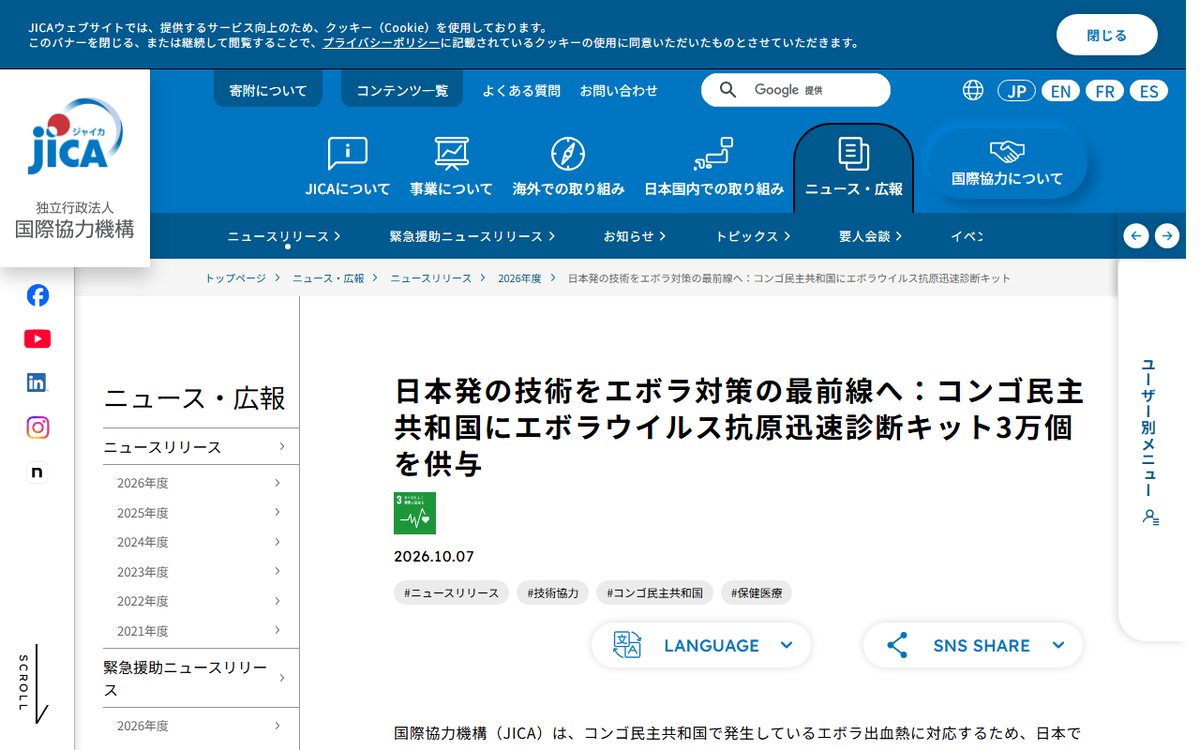
JICA announced that, in response to the Ebola outbreak in the Democratic Republic of the Congo, it has decided to provide 30,000 QuickNavi™-Ebola rapid test kits developed in Japan. On September 22, 2026, an initial 550 kits for emergency response were already delivered to the country's National Institute of Biomedical Research.
The kit was jointly developed by Hokkaido University and Denka Co., Ltd. In addition to the conventional Zaire ebolavirus, it can detect Bundibugyo ebolavirus, the strain behind the current outbreak. It needs no special analysis equipment and gives a result in about 10 minutes.
The provision is part of a JICA technical cooperation project in the DR Congo and Zambia that strengthens One Health surveillance for early detection of viral hemorrhagic fevers.
Key points
- Technology developed by a Japanese university and company is being used on the front line of an outbreak
- Results in about 10 minutes, usable in remote areas with limited power and lab facilities
- Also supports stronger testing systems and resilient health systems for future crises
Why this news deserves attention
Infectious diseases cross borders through the movement of people and goods. Even when an outbreak seems far away, stopping it early through international cooperation also protects our own safety.
Quickly identifying suspected patients helps prevent spread and protects local health workers. Combining the supply of technology with support for local testing systems is a useful approach.
Editor's comment
It is encouraging to see Japanese research put to work in health care settings overseas. International cooperation moves forward on two wheels: technology that supports diagnosis and treatment, and people-centered capacity building.
Details are available in JICA's announcement. If you are interested in infectious diseases and international cooperation, please take a look.