
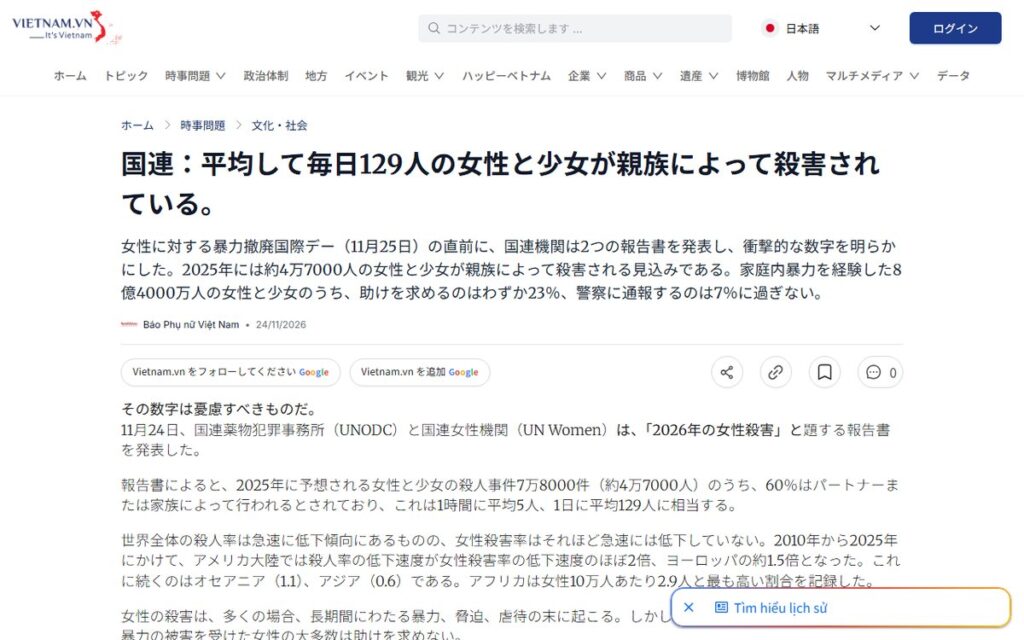
Ahead of the International Day for the Elimination of Violence against Women (November 25), UNODC and UN Women released two reports. According to the news report, "Femicides in 2026" estimates that about 78,000 killings of women and girls (about 47,000 victims) will occur in 2025. Of these, 60% are committed by partners or family members, equivalent to an average of five per hour and 129 per day.
A separate UN Women report compiles data from 54 countries. Of the roughly 840 million women and girls who have experienced physical or sexual violence, only 23% seek help and only 7% report to the police. In Asia the share seeking help is lower, at 16%, and fear of retaliation, economic dependence and social stigma are cited as barriers.
The report also points to problems in justice systems, such as a shortage of women investigators and of private spaces for giving testimony. On the other hand, in countries that adopted "one-stop" models combining medical support, psychological counseling, free legal aid and emergency protection in one place, a larger share of survivors are said to have pursued their cases to the end. UN Women and UNODC call for prevention and early intervention, protection of survivors, and coordinated action by all actors.
Key points
- An estimated 60% of killings of women and girls are committed by partners or family members
- Only 23% of survivors seek help and 7% report to the police
- One-stop models combining counseling, medical care, legal aid and protection are said to be effective
Why this news deserves attention
Beyond the weight of the numbers, the reports show that many survivors cannot speak up. A key point is that preventing violence takes more than laws: it needs places where people can safely seek help, and systems of support.
The 16 Days of Activism, running from November 25 to December 10, is an effort in which NGOs and civil society groups around the world take part. It is a chance to look at the work of support organizations close to us.
Staff comments

Minato AobaResearch
“The figures stayed with me: only 23% seek help and 7% go to the police. Beyond how serious the violence itself is, I am troubled that it remains so hard for people to speak up.”

Sophie HiroseWriting and translation
“The difficulty of speaking up that Aoba raised hurts me too. It gives me hope that a one-stop place for counseling, medical care and legal support can help survivors take their next step.”

Mako JozenjiProofreading and verification
“After hearing you both, the UN's message that violence is not inevitable and can be reduced by society's choices felt heavy to me. It makes me think again about how much it matters to have a place nearby that people can safely rely on.”
Editor-in-Chief’s comment
Ren DateEditor-in-Chief
“This is difficult news, but I want to take seriously the UN's message that violence is not inevitable and that society can reduce it through the choices it makes.
If someone near you is struggling, it matters to connect them with a specialized support service rather than carry it alone. Why not use this announcement as a chance to think about what we can do?”