
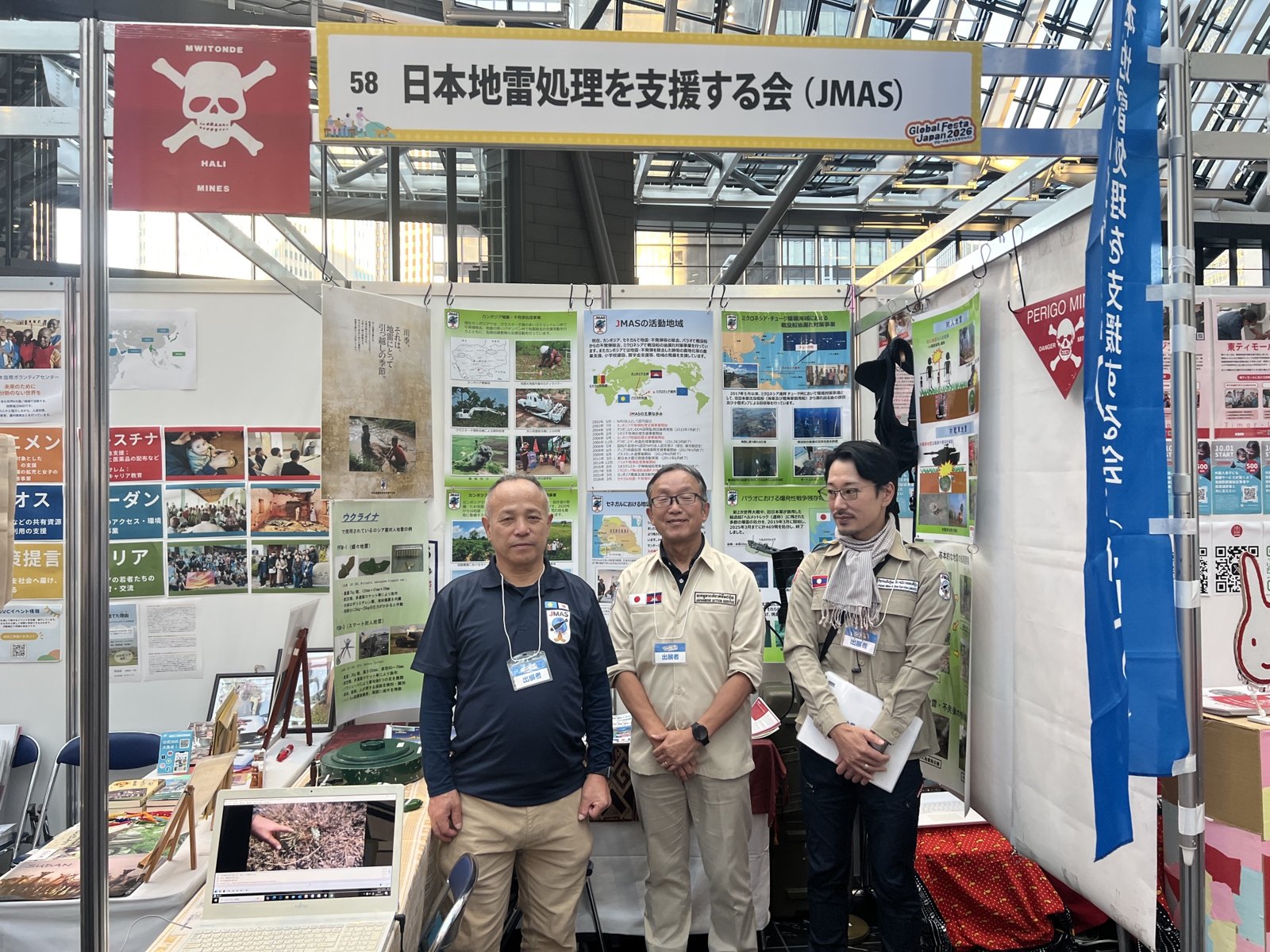
At Global Festa Japan 2026 we spoke with Dr. Yunosuke Kawazu, Director and Secretary General of the Japan Mine Action Service (JMAS), a certified nonprofit. JMAS supports the clearance of landmines and unexploded ordnance left in conflict areas and also recovers oil from ships sunk in the war, working on the front line against the “negative legacy” of past wars.
He told us about the satisfaction of work that sits next to danger, the wall of finding people willing to work overseas, and the “broad perspective” that those of us in Japan should hold.
Removing two threats left by past wars
Around the world, many landmines and unexploded bombs left by past conflicts still lie buried, continuing to threaten the lives of people trying to regain everyday life. JMAS is a Japanese NGO that supports clearing them. But its work does not stop at removing hazards on land.
When we asked Dr. Kawazu about its activities, he answered:
“We handle landmines and unexploded ordnance, and also recovering oil from ships sunk in the war, along with the bombs they were carrying, collecting and disposing of such things.”
Panels at the booth introduced landmine and ordnance clearance in Cambodia and Senegal, measures against oil leaks from sunken ships in Chuuk State, Micronesia, and the disposal of war remnants in Palau.
As hulls that have sat underwater for many years corrode, they can cause major oil spills that devastate beautiful coral reefs and local fisheries. JMAS confronts both the “direct threat to human life” and the “threat of environmental destruction” caused by remnants of war.
The biggest wall: finding people to send overseas
What is the biggest challenge in continuing work that demands advanced skills and involves danger? Dr. Kawazu pointed to a reality more serious than funding.
“(The hardest thing is) really gathering people. It is hard to find people willing to go overseas.”
In international cooperation, and especially in fields like landmine and ordnance clearance, people with specialized knowledge and experience are essential. They must also be prepared to stay away from Japan for long periods and keep working in harsh environments. Securing people who combine enthusiasm with practical ability and adaptability is a common challenge for many Japanese NGOs, and in a specialized field like JMAS’s the wall appears even higher.
The fulfillment of daily work beyond a difficult field
Despite the harsh reality of a shortage of people, he says the work on site brings a sure sense of accomplishment. Asked whether anything had made him happy recently, Dr. Kawazu looked a little shy and answered calmly:
“There are quite a lot of happy things. Overall, it’s fulfilling.”
Each time a piece of ordnance is cleared, local residents can farm their land safely. When oil is recovered from a sunken ship, a rich sea is protected for the future. Because each steady result connects directly to people’s lives and livelihoods, there is a real sense of purpose that lets him say, even in difficult conditions, that overall the work is fulfilling.
Seeing the world with a broad view, not a short-sighted one
Finally, we asked what those of us living in Japan can do about such international issues.
“What happens in the world affects us indirectly too. From that viewpoint, rather than responding to something in a short-sighted way, we should think about what to do with a long view, a broad view.”
When we encounter daily news, we tend to cut off conflicts and environmental problems in faraway countries as “unrelated to me.” Or we act on a momentary emotion, such as donating, and our interest does not last.
But as Dr. Kawazu points out, events in the world ripple back to our lives through the economy, the environment, security and more. Rather than hurrying to find a single answer (a short-sighted response), we should keep a broad view that “the world is connected” and keep thinking over the long term about what we can do from our own position. That is the first step of international cooperation and the driving force that moves society, little by little, in a better direction.
More about JMAS’s work is available on its official website. Please visit it and see the reality they face on site and the meaning of their work.
About the organization: JMAS
You can read an overview of JMAS in our NGO profile.
Read the NGO profile of JMAS → / Official website: https://www.jmas-ngo.jp/
Interview information
Interview: NGO network Japan editorial team / Event: Global Festa Japan 2026 (booth no. 58) / Dates: October 17–18, 2026