
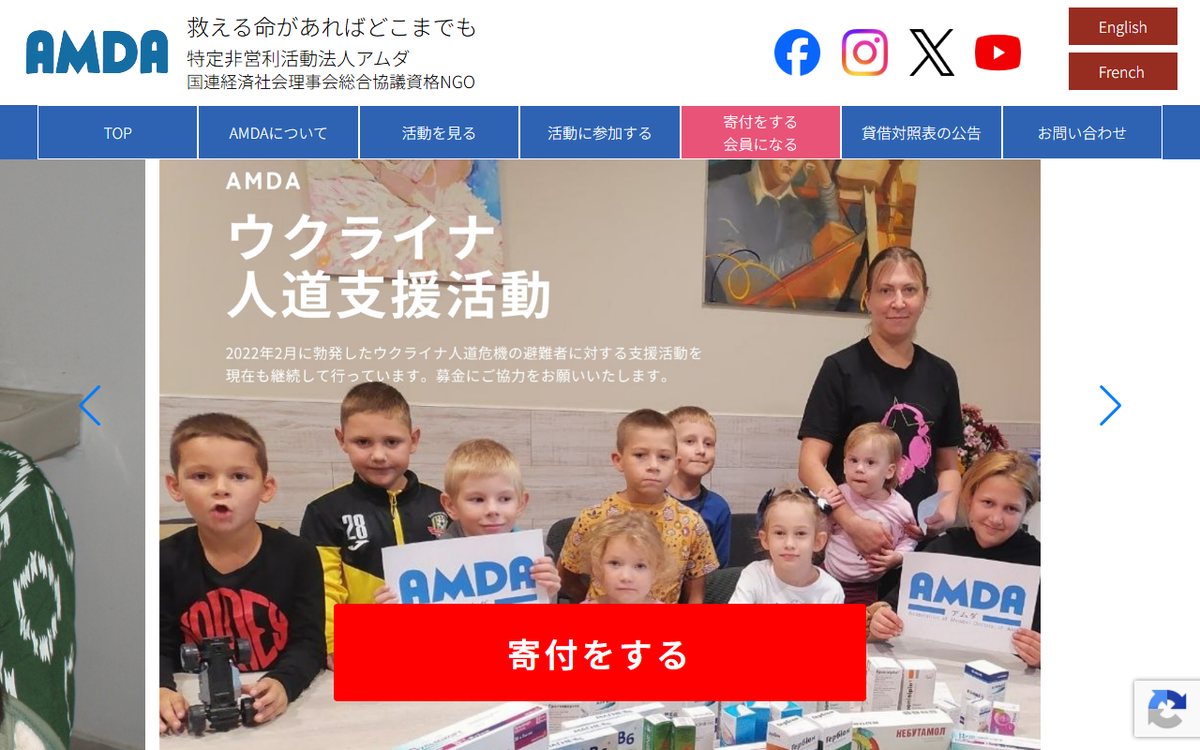
AMDA is an NGO that delivers humanitarian aid, centered on health and medicine, to people suffering from war, disaster and poverty around the world. Founded in Okayama City in 1984, it has branches in 32 countries and regions. When a disaster or conflict occurs, it uses this network to form multinational medical teams and works with UN agencies such as UNHCR and WHO, as well as local medical and educational institutions.
To date it has carried out 261 emergency relief operations in 62 countries and regions (as of June 2026). In 2006 it became the first Japanese NPO to receive general consultative status from the UN Economic and Social Council. It values three ideas: open mutual assistance, partnership, and local initiative, and it holds to a field-first approach based on the belief that local people know the best solutions.
Its Global Partnership for Sustainable Peace (GPSP) program is organized into four areas: peacebuilding, health promotion, educational support and livelihood support. The official website also posts many recent activity reports, including school health in Rwanda, humanitarian aid in Ukraine and emergency support for flood victims in Nepal.
Key points
- Emergency aid by multinational medical teams, drawing on a network of branches in 32 countries and regions
- 261 emergency operations in 62 countries and regions (as of June 2026), with a field-first approach that respects local leadership
- Rich information for learning about its work, including activity reports, journals and annual reports
Why this organization deserves attention
Over many years it has built a system in which health and medical professionals gather across borders at the sites of disasters and conflicts. The idea of helping one another in times of need, beyond differences of nationality, race, religion and culture, is the foundation of its work.
Its activity reports are updated frequently, and there are several ways to get involved, such as volunteering, membership, monthly support and donating unused postcards. It is a useful reference for anyone who wants to follow aid work as it happens.
Editor's comment
The phrase "wherever lives can be saved" seems to capture the attitude of an organization that has kept going to the field. For those of us living in disaster-prone Japan, medical aid and circles of mutual support are close to home.
Why not start by reading the activity reports on the official website to see what kind of support is happening, and where, right now?