

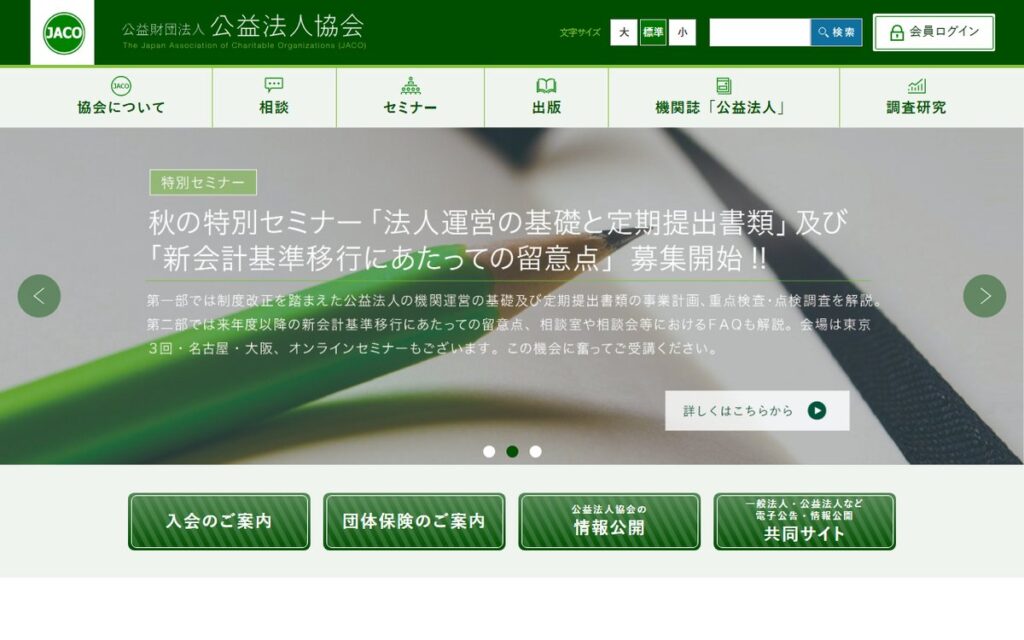
The Japan Association of Charitable Organizations (Koeki Hojin Kyokai, also known as JACO) was established in 1972 (Showa 47) with the permission of the Prime Minister's Office (now the Ministry of Internal Affairs and Communications). Its purpose is to contribute to the sound development of public-interest corporations and to the public welfare. With the enforcement of the three laws on public-interest corporation system reform, it obtained public interest certification and began anew in April 2009 as a public interest incorporated foundation, adopting the additional name "Center for Promoting Private Public-Interest Activities."
Its aim is to promote and support autonomous and creative activities by organizations engaged in public-interest work, and thereby to raise the role of the nonprofit sector in society and contribute to its development. Its work consists of consultation, seminars, publishing, its journal "Koeki Hojin" and research.
Its website announces free consultation sessions held as a project commissioned by the Cabinet Office, as well as seminars on taxation, accounting and asset management for public-interest and general corporations. It also offers explanations of the public-interest corporation system, public-interest trusts and the NPO corporation system, along with information on developments in the corporate system.
Key points
- Founded in 1972; a public interest incorporated foundation since April 2009
- A range of support for organizational management: consultation, seminars, publishing and research
- Free consultation sessions (Cabinet Office commissioned project) and on-demand seminars on taxation, accounting and more
Why this organization deserves attention
Nonprofit organizations such as public-interest corporations, general corporations and NPO corporations are key players in solving social issues. By delivering the knowledge of systems, accounting and taxation they need through consultation, seminars and publications, this association can be a reassuring presence for organizations on the ground.
It also provides information in step with changes to the system and carries out research, supporting the foundations of the nonprofit sector as a whole. It offers a way to understand how the system works not only to people involved in running organizations but also to anyone interested in public-interest activities.
Editor's comment
Many organizations working in local communities and around the world are in fact supported by steady, behind-the-scenes mechanisms such as legal systems and accounting. The work of this association feels like important work in maintaining that "hard-to-see foundation."
The official website also lists columns, books and seminar information. Why not take a look as a first step to understanding how public-interest activities work?