

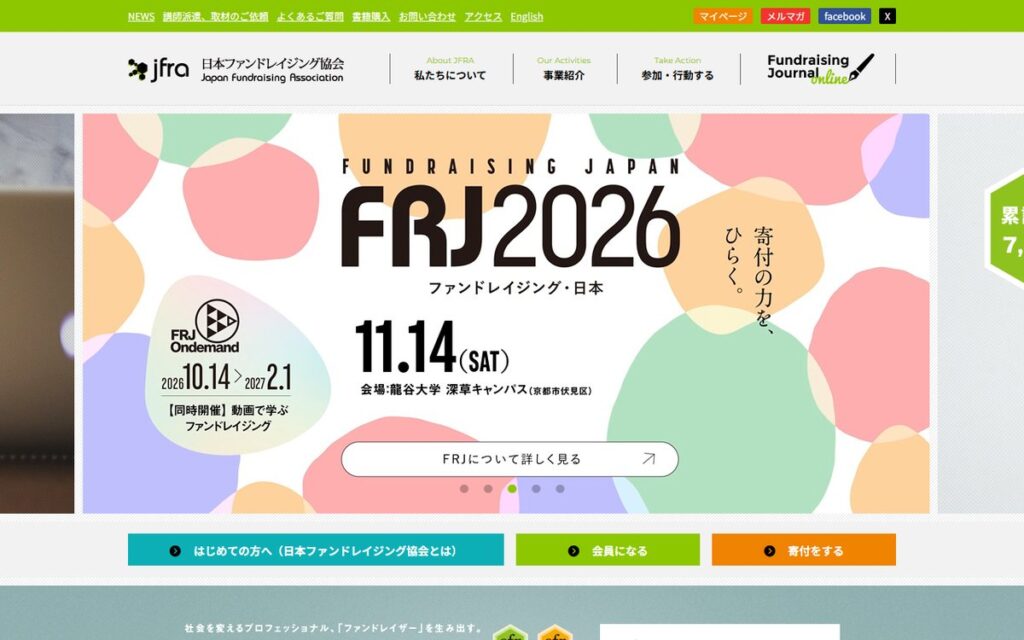
The Japan Fundraising Association is an NPO working toward "a society where giving and social investment advance." It was established in 2009 with the support of 580 founding members from all 47 prefectures in Japan, and supports people involved in the fundraising of private nonprofit organizations as well as people interested in giving and other forms of social contribution.
It obtained NPO corporation approval in February 2010 and was certified as a certified NPO corporation in December 2016. It also notes that it obtained Good Governance certification in 2019 and Good Giving Mark certification in 2025. Its work rests on three pillars: "training fundraisers," "changing policy," and "forming a market."
Specifically, it runs the Certified Fundraiser and Associate Certified Fundraiser qualification systems, which certify people with a sense of ethics (1,639 qualified people as of April 1, 2026); Fundraising Japan, one of the largest conferences in the country (17,366 participants in total); social contribution education for children (more than 17,441 students have taken the programs); promotion of legacy giving; and publication of the Giving Japan white paper.
Key points
- Three efforts: "training fundraisers," "changing policy," and "forming a market"
- 1,639 qualified Certified and Associate Certified Fundraisers (as of April 1, 2026)
- More than 17,441 students have received social contribution education for children
Why this organization deserves attention
Its strength is that it sees fundraising not as mere financing but as a process of nurturing empathy and inviting people to take part in solving social issues. It takes a broad view, from giving to social investment.
Qualifications, training, events, books and newsletters give people step-by-step ways to get involved. The doors are open not only to people who work at NPOs but also to citizens interested in giving and to school teachers.
Editor's comment
Talking about the money that supports NPO activities can feel a little awkward. The Japan Fundraising Association struck me as an organization that opens that conversation brightly, treating giving as a way of turning empathy into action.
If you would like to learn more about what giving means and how to choose, why not start reading from the "For first-time visitors" page on the official website?